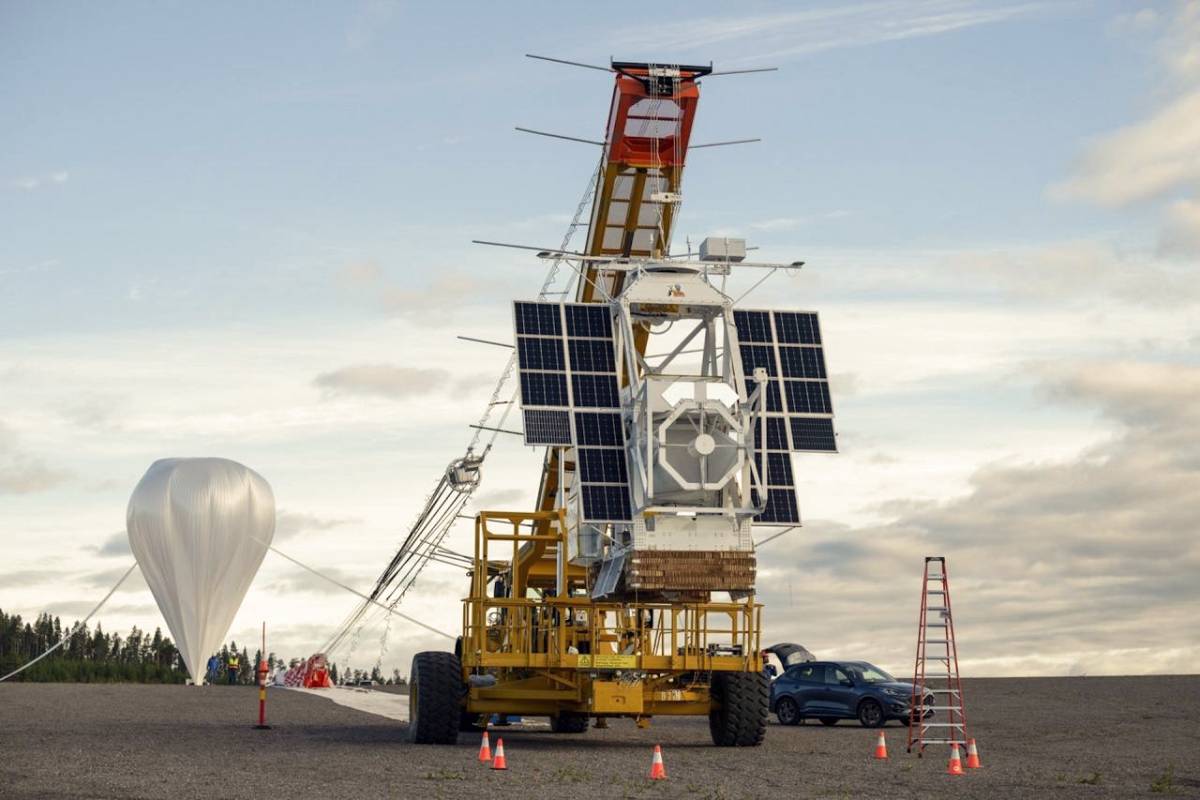
The Canary Islands Institute of Astrophysics (IAC) and the University of La Laguna are participating in the international Sunrise III mission, a balloon-borne stratospheric solar observatory that allows scientists to study the lower part of the solar atmosphere, from the Sun's surface to the middle chromosphere, with a spatial resolution of approximately 50 kilometers above the solar surface. In July 2024, Sunrise III successfully completed a nearly week-long flight, traveling the distance between northern Sweden and northwestern Canada, during which it collected around 200 terabytes of scientific data.
The main results obtained from this mission have been presented in a special issue from the scientific journal The Astrophysical Journal Letters, The study highlights the capabilities of the instrumentation used, the flight characteristics, and the quality of the data collected. The authors include researchers from the University of La Laguna and the IAC., Valentín Martínez Pillet, Christoph Kucken y Carlos Quintero Noda . Furthermore, several of the articles They are led by research staff from both institutions, including Sergio Javier González Manrique, Ramón y Cajal researcher from the ULL, Iñigo Juanikorena Berasategi, predoctoral researcher, and Juan Carlos Trelles Arjona, postdoctoral researcher from the IAC.
Sunrise III brings together scientific institutions from Europe, the United States, and Japan to study the lower layers of the solar atmosphere, where the interaction between magnetic fields and plasma plays a fundamental role in the Sun's activity. Operating at an altitude of 35 to 37 kilometers, above approximately 99 meters above Earth's atmosphere, the observatory drastically reduces the effects of atmospheric turbulence, allowing it to obtain images of a quality difficult to achieve from observatories located on Earth's surface.
Among the main objectives of this mission are investigating the structure, magnetism, dynamics, and energy processes of the photosphere and chromosphere with high spatial resolution. This includes studying the complex interaction between convection, magnetic fields, and oscillations in different magnetic environments, from regions with low magnetic activity to sunspots. The mission focuses particularly on small-scale phenomena. To this end, it takes advantage of observing from the stratosphere and near the Arctic Circle, where the Sun remains above the horizon during the summer. This allows for obtaining high spatial resolution observations, spectropolarimetric data, and long time series under very stable observing conditions. Furthermore, the absence of differential atmospheric refraction allows for simultaneous observations across a wide range of wavelengths, from the near ultraviolet to the near infrared, thus facilitating the analysis of different layers of the solar atmosphere simultaneously.
The observatory is equipped with a one-meter diameter telescope, three scientific instruments located behind the primary focus, and an image stabilization system designed to compensate for platform movements during flight, all integrated into a protective gondola. Following the Sunrise I (2009) and Sunrise II (2013) campaigns, which resulted in over one hundred scientific publications, virtually all components of the observatory have been renewed or upgraded. The new configuration incorporated three next-generation scientific instruments, a new light distribution unit, a redesigned gondola, and significantly more powerful control and data storage systems, which considerably expanded the mission's scientific capabilities.
The data obtained during the 2024 flyby constitute one of the most comprehensive observational datasets of the solar atmosphere to date. Among the recorded phenomena, a solar flare of M5.3 magnitude stands out, along with several hours of preceding activity, providing an exceptional dataset for investigating the physical mechanisms responsible for solar eruptions. This data will allow for a deeper understanding of the processes that trigger eruptive events and the transport of energy through the Sun's atmosphere.
The researchers emphasize that the quality of the observations and the breadth of the recorded phenomena have opened new avenues of research in observational solar physics. This is already resulting in numerous scientific papers, several of them led by researchers from the IAC and the ULL, while the large volume of data collected will continue to provide relevant results for the study of solar magnetism and the activity of our star in the coming years.

 Spanish
 English
 French