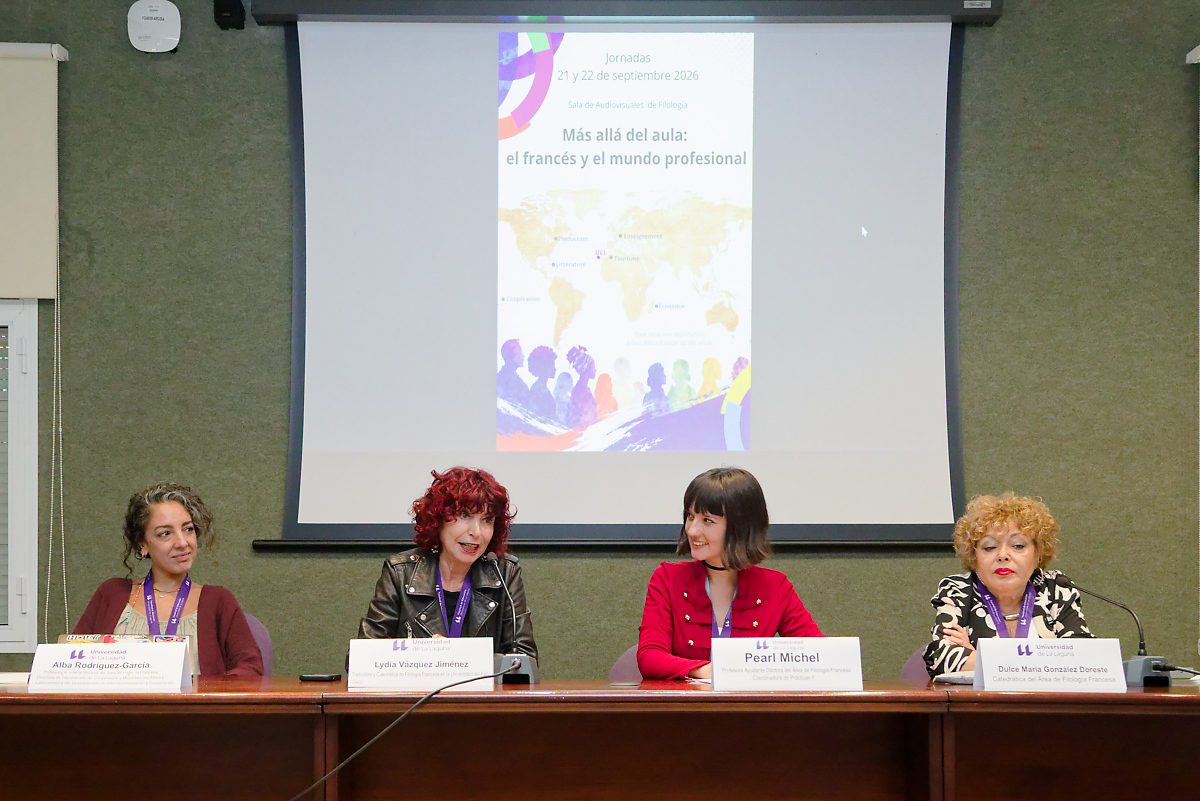
The Faculty of Humanities of the University of La Laguna inaugurated today, Monday, September 21, the conference «"Beyond the classroom: French and the professional world"», This event aims to broaden students' career aspirations and showcase the opportunities offered by fluency in this language in sectors such as translation, tourism, economics, and international cooperation. The initiative, which runs until tomorrow, Tuesday, September 22, features the participation of professionals from various fields, including Lydia Vázquez, translator of French writer Annie Ernaux, winner of the 2022 Nobel Prize in Literature.
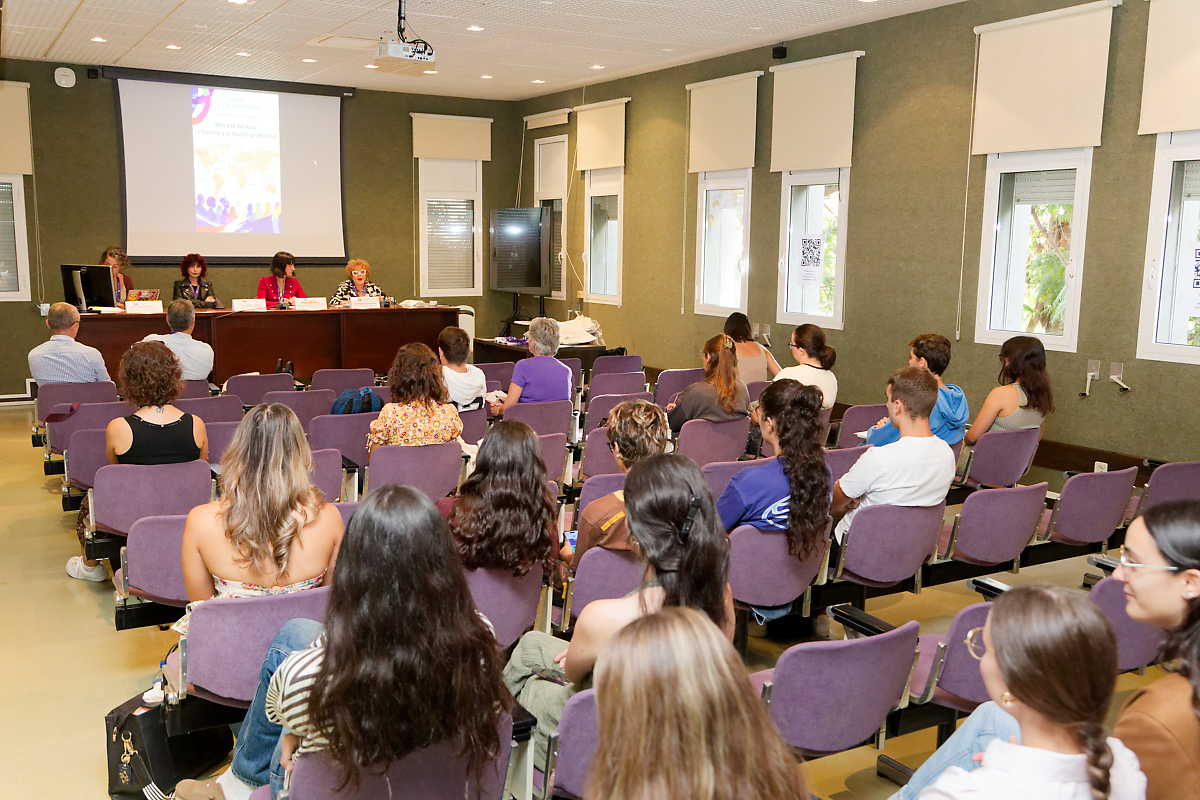 The event, held in the Audiovisual Room of the Department of Philology Building, is aimed at students from various degree programs related to French, including the Bachelor's Degree in Applied Francophone Studies, the Double Degree in English and French Studies, the Bachelor's Degree in Primary Education, and the Master's Degree in Teacher Training. Through a series of seminars, participants will learn about professional experiences, scholarship programs, and mobility opportunities, as well as ask questions directly to specialists from different sectors.
The inaugural session included the participation of Dulce María González, Professor Emerita of French Philology at the University of La Laguna. During her address, she emphasized the need to promote initiatives of this kind to raise awareness of the professional opportunities offered by the Bachelor's Degree in Applied Francophone Studies, a qualification with broad career prospects and a strong alignment with the demands of today's society. "French is a tool, not just a language," she noted, stressing that the training acquired allows graduates to work in fields such as international trade, cultural management, communication, research, and intercultural mediation. "Often, what an organization needs is not just someone who translates, but someone who understands what those words mean within another culture," she explained.
The professor also highlighted the opportunities offered by the geographical location of the Canary Islands, a territory situated opposite West Africa, connected with America and linked to economic, cultural and academic networks in which French plays an important role.
Alba Rodríguez, a teacher and researcher at the ULL, representing the Vice-Rector for Internationalization and Cooperation, Inmaculada González, He emphasized that job placement is one of the main concerns of the University of La Laguna and valued the celebration of these conferences as an opportunity for students to learn about different professional pathways and plan their future.
For their part, Lydia Vázquez, translator and professor of French Philology at the University of the Basque Country, focused her presentation on the professional possibilities of literary translation, a She considers philological training fundamental to this discipline. Annie Ernaux's translator argued that knowledge of literature, the history of language, and diverse cultural realities is an advantage for those wishing to specialize in this field, especially given the increasing integration of artificial intelligence into translation processes. In her view, literary translation requires a sensitivity and cultural background that cannot be replaced by machines.
In this context, he highlighted the unique nature of the Bachelor's Degree in Applied Francophone Studies at the University of La Laguna, which, he pointed out, is unique in Spain due to its characteristics. "We are not learning one language, but several languages, different cultures, and ways of life," he stated, noting that the French spoken in Senegal, Canada, and Morocco has unique features. He also encouraged students to take advantage of elective courses, international exchanges, and postgraduate training to develop a professional profile from their first years at university.
Finally, Pearl Michel, The assistant professor and academic director of the conference explained that one of the main strengths of these studies is precisely the breadth of their training, although this diversity also raises the need to specialize as one progresses through their academic career. During her presentation, she detailed that the initiative arose from the desire to highlight opportunities that can go unnoticed during university studies, as happened to her: from scholarship and mobility programs to the experiences of professionals who can inspire students when shaping their future.
French, beyond teaching
Through professional and academic experiences, the meeting seeks to show how linguistic knowledge and intercultural skills acquired during university training can be transferred to different work sectors.
The first day will focus on opportunities for international mobility and cooperation with Africa and Latin America, through the presentation of scholarship programs and projects that allow students to broaden their education and gain experience in other countries. Among the highlighted initiatives are the Africa-America Scholarships, presented by representatives of the Tenerife Island Council and the Codexca organization, as well as the Cooperation and Mobility programs with Africa and Latin America offered by the University of La Laguna.
Likewise, the participation of the Santa Cruz de Tenerife Chamber of Commerce will allow for the exploration of professional and business opportunities offered by the African continent, while a session dedicated to research in Senegal will introduce students to academic development opportunities in Francophone countries.
The second day will delve deeper into the opportunities offered by sectors such as translation and tourism, as well as the challenges posed by the integration of artificial intelligence into the professional practice of translation. The program also includes an overview of internships as a way to connect university education with the job market, along with experiences of working abroad and the opportunities that language proficiency offers in the Canary Islands' tourism sector.
Teaching, one of the traditional career paths for graduates of these studies, will also have its place within a program that aims to broaden students' job prospects and showcase the diverse career paths they can follow after completing their training.

 Spanish
 English
 French