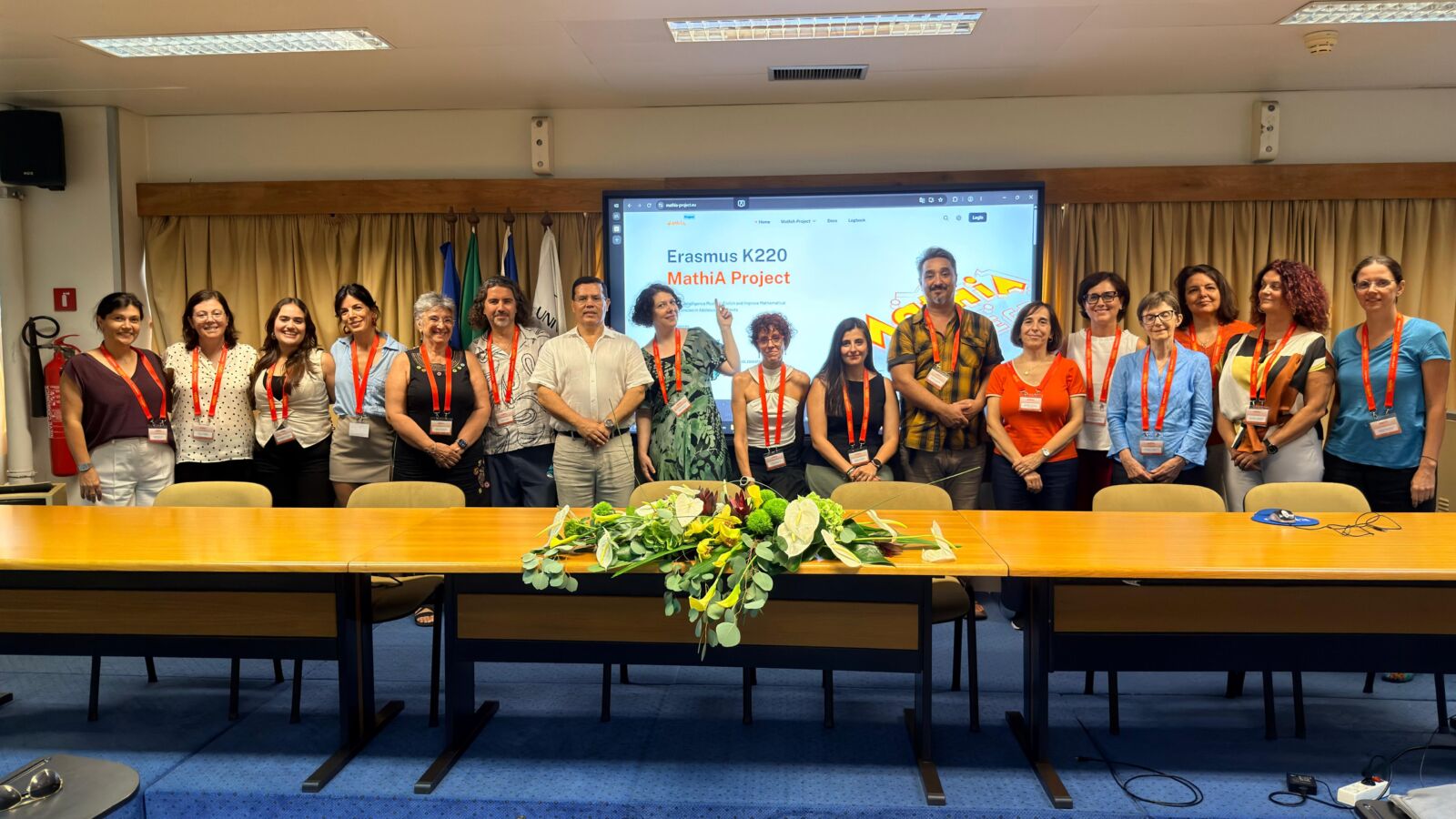
Researchers from the University of La Laguna participated last week in the final meeting of the European MathIA project, held at the University of Madeira, the institution that led the event. The meeting brought together 130 participants to share the progress and products developed during the three years of work and to discuss their application to mathematics education.
The project, coordinated by the University of Murcia, involves the universities of La Laguna, Madeira, and Pavia, along with other educational institutions, including the Mayco School in Tenerife. Its aim is to develop an Artificial Intelligence model to help teachers improve and enrich the mathematical skills of adolescent students, promoting equality, inclusion, and attention to diverse learning abilities and needs.
The delegation from the University of La Laguna included África Borges del Rosal, coordinator of the Canary Islands team and professor in the Department of Clinical Psychology, Psychobiology, and Methodology; Triana Aguirre Delgado; Alejandra Nazareth Rodríguez Suárez; and Atteneri Delgado Cruz. During the final seminar, the researchers presented the teacher training courses developed by the University of La Laguna, as well as their contribution to the educational resource bank and the dissemination of the project.
The proposed training program comprises two 15-hour courses designed to help teachers integrate AI into their educational practice using sound pedagogical principles and responsible practices. The first course, "Digitalization and Artificial Intelligence," offers an introduction to digital transformation and the fundamentals of this technology, explores its classroom applications, and addresses issues such as privacy, bias, and the ethical and legal implications of its use.
The second module, "Digitalization and Artificial Intelligence – Institutes," focuses on the teaching and learning of mathematics. Its content includes personalized learning, the creation of video tutorials and educational podcasts, and an introduction to the workings of neural networks through image classification activities. The goal is for teachers to be able to design interactive activities and mathematical projects supported by these tools, as well as to assess their contribution to the development of students' skills.
Both courses combine theoretical content, audiovisual materials, readings, and assessment activities. The training is presented as free, reusable, and transferable to different educational contexts, with the aim of maintaining its usefulness beyond the project's duration—an objective that will soon be supported by a platform. Open Ware Course (OCW).
The University of La Laguna's contribution stems from identifying the technological and training needs of the teaching staff and extends to course design, the creation of multimedia materials, and the development of teaching resources. This work has involved an interdisciplinary team of 14 members from fields such as mathematics, psychology, engineering and computer science, communication, and education.
The report presented in Madeira also included 61 resources distributed across five areas: technological training for mathematics, mathematical innovation, giftedness, equality, and attention to diversity. These materials aim to provide teachers with support to address different learning profiles and facilitate more inclusive teaching.
The meeting also provided an opportunity to share the development of the AI model, which is currently in the testing phase and has been developed in collaboration with universities, educational institutions, teachers, and students. Through exercises organized by skill level, this tool is designed to assess students' competencies and facilitate an educational response tailored to their needs.
With €400,000 in funding from the European Union through the Erasmus+ program, MathIA strengthens collaboration between European institutions to connect technological innovation with teaching practice. The ULL scientific team also includes researchers from diverse fields of knowledge, ensuring an interdisciplinary approach to the project's development. In the field of Mathematics, Israel García, Diana Sosa, and Rodrigo Trujillo are participating; in Science and Engineering, Belén Melián, Carlos Carbonell, and José Marcos Moreno. From the Behavioral Sciences area, Elena Rodríguez and Triana Aguirre Delgado are participating, and from the Social Sciences area, Patricia Delponti (Communication), along with Teresa González and Atteneri Delgado Cruz, are involved.

 Spanish
 English
 French