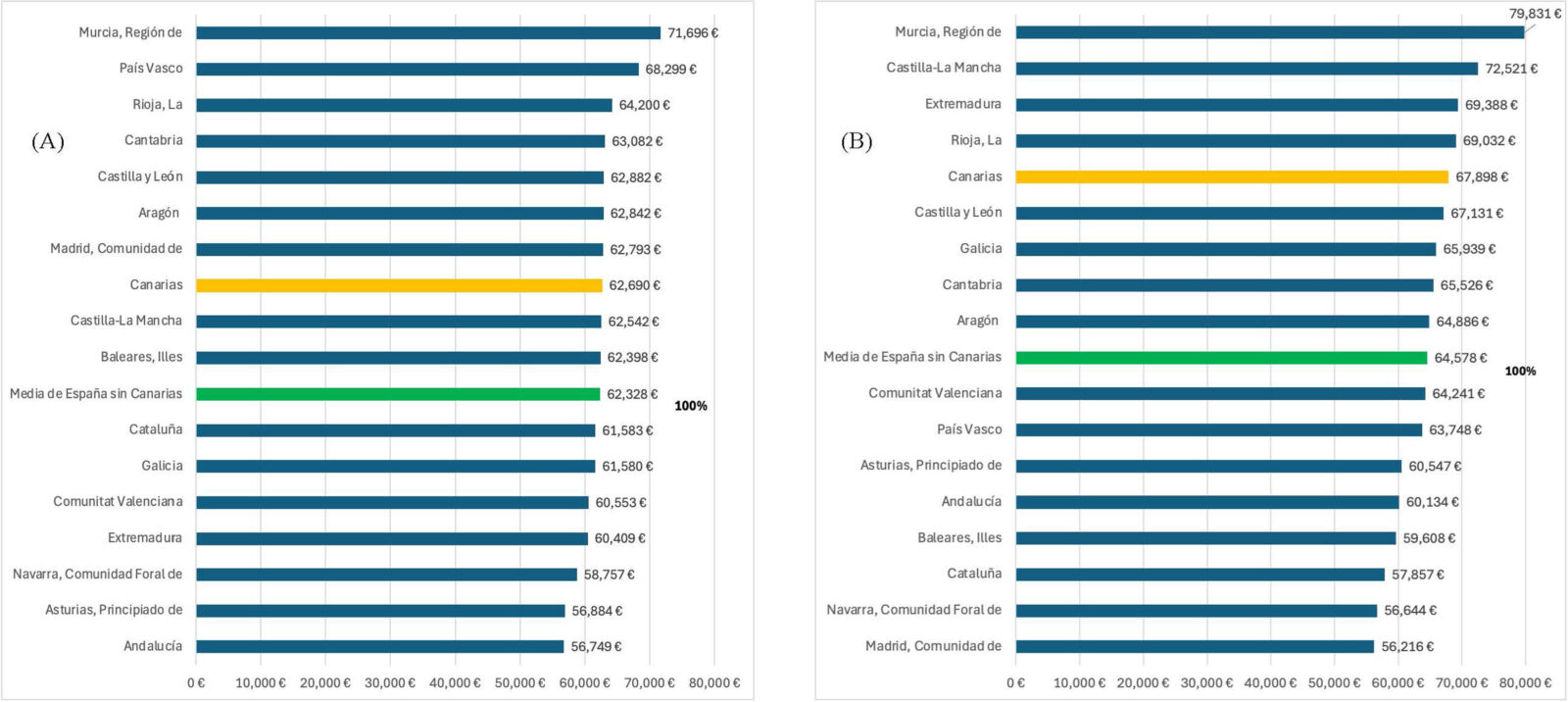
A study by the University of La Laguna, the University of Las Palmas de Gran Canaria (ULPGC), and Pompeu Fabra University (UPF) compares the salaries of healthcare personnel in the different Spanish autonomous communities and the autonomous cities of Ceuta and Melilla, and analyzes the relative position of the Canary Islands within the National Health System (SNS). job, published in Health Gazette, It indicates that the remuneration of medical staff in the Canary Islands is, in general, close to the state average, while in most of the other categories analyzed (such as hospital nursing staff, specialist technicians, nursing assistants, orderlies and administrative staff) it is above it.
The study, commissioned by the Canary Islands Health Service to the University of La Laguna through a service contract, has been carried out by Ignacio Abásolo Alessón, Professor in the Department of Applied Economics and Quantitative Methods at the University of La Laguna; Marina Elistratova, Patricia Barber, and Beatriz López-Valcárcel, from the University of Las Palmas de Gran Canaria (ULPGC); and Guillem López-Casasnovas, from Pompeu Fabra University (UPF). The research team maintained complete independence in the study design, data analysis, interpretation of results, and final drafting of the paper. The study examines gross annual salaries for 2024 in 10 healthcare and management professional categories, using the Canary Islands Health Service as a reference.
Given that the National Health System (NHS) is a decentralized system, pay differences can influence professional incentives and relative working conditions across different regions. When these differences are not due to variations in the cost of living or other justifying factors, they can generate labor inequalities and potentially distort the territorial distribution of human resources.
To carry out the analysis, the research group compiled official information on remuneration published by all the autonomous communities and built a database that allows for a homogeneous comparison of equivalent professional categories. In addition, they developed a specific simulation tool for medical personnel, capable of estimating the annual remuneration of comparable profiles, taking into account variables such as seniority, career advancement, exclusive dedication, and on-call shifts. The simulation tool used in this study is available at [link to tool]. Institutional repository of the University of La Laguna, where its terms of use are detailed.
The results show significant regional heterogeneity. In the case of physicians, salaries in the Canary Islands are generally close to the average for all regional health services, although there are significant differences depending on the professional profile analyzed. Young physicians without full-time dedication occupy relatively favorable positions in the regional comparison, while those with more seniority, advanced career levels, and full-time dedication occupy lower positions.
Furthermore, the study reveals a unique characteristic of the Canary Islands health system, since, for comparable profiles in terms of seniority, career path and dedication, primary care physicians receive higher salaries than hospital physicians, a situation that is uncommon in the rest of the autonomous communities.
Regarding other professional categories, the Canary Islands are above the national average in most of the cases analyzed, including hospital nursing staff, specialist technicians, nursing assistants, orderlies, and administrative personnel. The main exception is primary care nursing, whose salaries are close to the national average.
One of the most innovative aspects of the research is the incorporation of a purchasing power parity adjustment, which allows for the evaluation of salaries taking into account regional differences in the cost of living. The results indicate that the Canary Islands has a lower price level than the national average, which improves the relative position of salaries when their purchasing power is considered. In the case of physicians, the average salaries for the profiles analyzed move from being approximately at the average of all regional health services to occupying positions around fifth or sixth place after this adjustment.
Among the limitations of this work, the research staff highlights that the analysis is based on the official remuneration information available and does not analyze other factors that also influence the attraction and retention of healthcare professionals, such as working conditions or work-life balance.

 Spanish
 English
 French