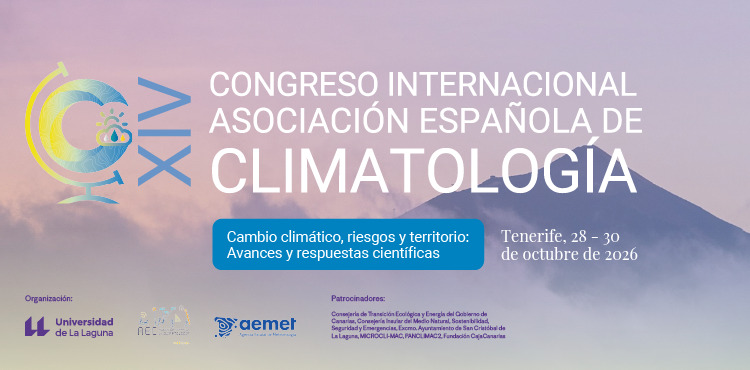
The University of La Laguna will be the venue for XIV International Congress of the Spanish Association of Climatology, one of the main scientific conferences on climate held in Spain. The meeting will take place from October 27 to 30 under the theme “Climate change, risks and territory: scientific advances and responses”. It has received around 300 submissions and will have participants from 12 countries, as well as representation from most Spanish universities.
This will be the first time this international scientific meeting has been held in Tenerife. The main sessions will take place from October 28 to 30 at the Faculty of Economics and Business, while a pre-congress day, aimed specifically at young researchers and doctoral students, will be held on the 27th.
Organized every two years by the Spanish Association of Climatology, the event has become a leading forum for the exchange of knowledge and proposals among climatology specialists and related disciplines. Its celebration on the island will place the Canary Islands at the heart of the scientific debate on the effects of climate change, its associated risks, and the responses stemming from research, public management, and land-use planning.
It is organized by Spanish Association of Climatology, the University of La Laguna, through the Chair of Disaster Risk Reduction and Resilient Cities and the GEORISGOS research group, and the State Meteorological Agency. It is sponsored by the Government of the Canary Islands, through the Ministry of Ecological Transition and Energy; the Island Council of Tenerife, through the Island Council for the Natural Environment, Sustainability, Safety and Emergencies; he San Cristóbal de La Laguna City Council; the CajaCanarias Foundation; Binter; PLANCLIMC2 and MICROCLI-MAC.
The president of the organizing committee, the professor from the Department of Geography and History Pedro Dorta, He emphasizes that the celebration of the congress constitutes "an important scientific milestone for the University of La Laguna and for climate research in the Canary Islands, by bringing together national and international reference specialists in Tenerife.".
The Island Councillor for Natural Environment, Sustainability, Safety, and Emergencies, Blanca Pérez, believes that the selection of Tenerife as the venue “recognizes the island’s role as a benchmark for studying the effects of climate change on island territories and as a space for collaboration between science and public administrations.” She also points out that, for the Tenerife Island Council, it is essential to support initiatives that allow for the translation of scientific knowledge into public management, since “adapting to climate change requires planning, anticipation, and cooperation.”.
Holding the event in the Canary Islands is particularly significant due to the exposure and high vulnerability of island and coastal territories to the effects of climate change. The program will analyze issues such as sea level rise, coastal erosion, extreme weather events, water security, and their impacts on activities like tourism and fishing.
Climate projections, disaster risk reduction, impacts on ecosystems, health and society, governance, climate communication, and changes affecting the oceans will also be addressed.
The day before, on October 27, will include a colloquium in which doctoral students can share the approaches and methodologies of their research, as well as the workshop “Visualizing the climate: fundamentals of visual communication”, taught by Dominic Royé, researcher at the Biological Mission of Galicia of the Spanish National Research Council.
The opening presentation will be given by Jane P. Messina, from the University of Oxford, who will analyze the relationship between climate change and the spread of mosquito-borne diseases in contexts of inequality.
The program will also feature specialists such as Omaira García Rodríguez, from the Izaña Atmospheric Research Center of AEMET; Marta Olazábal, from the Basque Centre for Climate Change; Sergio Rodríguez González, from the Institute of Natural Products and Agrobiology of the CSIC; and Jorge Olcina, head of the Climatology Laboratory of the University of Alicante.
The roundtables will address some of the main challenges associated with climate change. Among the planned topics are climate communication and the fight against misinformation, climate change adaptation in island and coastal areas, and the application of scientific knowledge to disaster risk reduction. In this way, the meeting will foster dialogue between the scientific community, public administrations, and social stakeholders, with the aim of bringing research findings closer to decision-making and moving towards more effective responses to the impacts of climate change.
The general term of registration It will remain open until October 1, 2026.

 Spanish
 English
 French