
The Faculty of Economics, Business and Tourism of the University of La Laguna hosted today the inauguration of the IV International Congress of Young People for Research, The event, which brings together more than two hundred scientists beginning their research careers, is being held this week. Organized jointly by the Tenerife Young Researchers Association (JINTE) and the Doctoral School and Postgraduate Studies of the University of La Laguna, the meeting features speakers from all areas of knowledge, from experimental and health sciences to the humanities, social and legal sciences, and engineering. The event is thus establishing itself as a cross-disciplinary forum and a meeting point to showcase the advances and contributions of young researchers in various fields of knowledge, as well as to share them with the national and international scientific community.
During the opening ceremony, Esteban Porrini, Director of the Scientific Strategy Secretariat of the Vice-Rectorate for Research and Transfer, emphasized the importance of this event for the institution as a platform to showcase the work of young people interested in research careers and to foster exchange among them. He also highlighted its proactive nature, both in disseminating their work and in conveying their needs and proposals for future research in the Canary Islands to government agencies, the university, the community, and businesses. Porrini also noted that these types of forums allow for an appreciation of the excellence that characterizes the work of early-career researchers, regardless of their field of study.
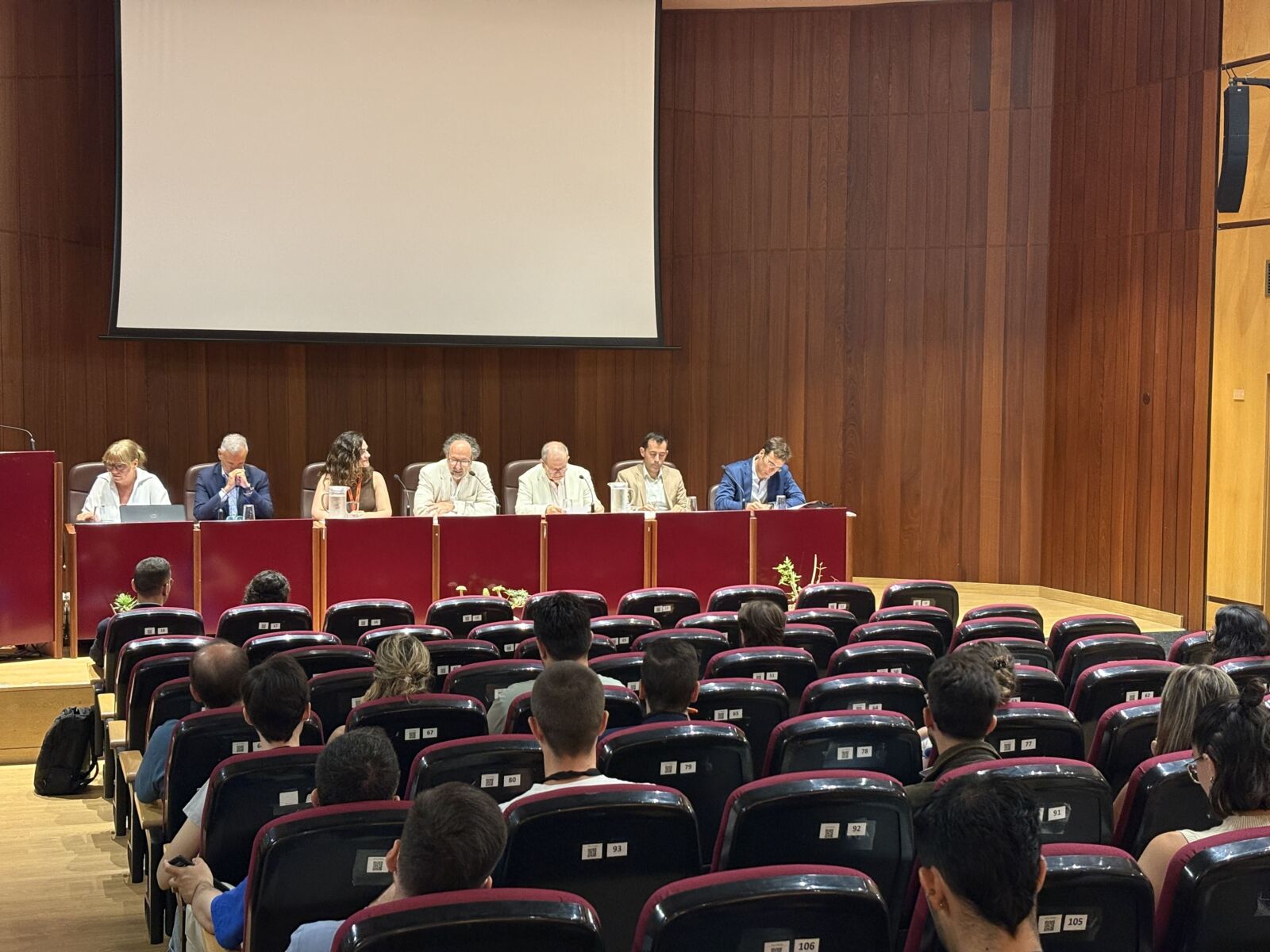
General view of the opening ceremony.
The director of the Canary Islands Agency for Research, Innovation and the Information Society, Javier Franco, emphasized the importance of promoting spaces like this one, where young researchers from different fields can share the knowledge they have generated and open new debates about the challenges facing the Canary Islands. He asserted that young people need “a public administration capable of supporting them, understanding their needs, and transforming public policies into useful tools” so that their work and innovative capacity can benefit Canary Island society.
For his part, Juan José Martínez, Councilor for Innovation, Research, and Development of the Tenerife Island Council, emphasized that these forums, driven by young people from the Canary Islands, are valuable spaces for generating synergies, advancing the frontiers of science, and contributing to the diversification of the islands' economic model. “They are the raw material needed to transform society,” he said, “reducing dependence on the tourism sector and achieving a qualitative leap in employment and industry.”.
Likewise, the president of the Social Council of the University of La Laguna, Francisco Vicente Almeida, particularly valued the opportunity the congress offers to meet, listen to, and learn from the diverse contributions of young researchers. The Councilor for Finance and Economic Services of the La Laguna City Council, Francisca Rivero, expressed the council's support for this initiative and emphasized the importance of society recognizing and valuing the work of researchers. Also, from the Canary Islands Startup Association EMERGE, Jorge Sánchez encouraged these young researchers to explore avenues that would allow them to create their own opportunities in innovation and entrepreneurship.
Interdisciplinarity
This event is presented as a unique, multidisciplinary gathering that serves as a platform for more than 140 posters and 130 oral presentations, distributed across fifteen thematic sessions and dedicated to areas as diverse as biodiversity, health, law, history, and tourism. As JINTE President Arianna Fanio pointed out, for many young researchers, the event represents their first opportunity to participate in a scientific conference and present their work to an international audience.
On its first day, the congress will host the presentation “Labor Rights and Activism in Research,” given by José Luis Moreno, a lawyer and PhD in Law from the University of Málaga. Also on the same day, the round table “Social and Political Neutrality in Today’s Academia” will take place, featuring Elena Lázaro, Director of the Scientific Culture and Innovation Unit at the University of Córdoba; Lucas Sebastián de Erice, Professor of Public International Law and International Relations at the University of La Laguna (ULL); and Sergio Urueña, Professor of Logic and Philosophy of Science at the ULL.
On Friday, October 2nd, Rocío Romero, Professor of Computer Science and Artificial Intelligence at the University of Granada, will discuss how artificial intelligence is changing the way research is conducted. The scientific day will conclude with the round table discussion “Breathing at Risk: Climate, Calima, and Volcanoes. Is the Canary Islands' Health System Prepared for the New Environmental Challenges?” featuring Jessica López Darias, Atmospheric Chemistry Researcher at IPNA-CSIC; Pablo J. González, Research Scientist with the Volcanology Group at IPNA-CSIC; Eleazar Padrón González, Researcher at the Institute of Technology and Renewable Energies (ITER); and Margarita Jambrina, Professor of Petrology and Geochemistry at the University of La Laguna (ULL). The congress will conclude on Saturday, October 3rd, with a program of sociocultural activities.

 Spanish
 English
 French