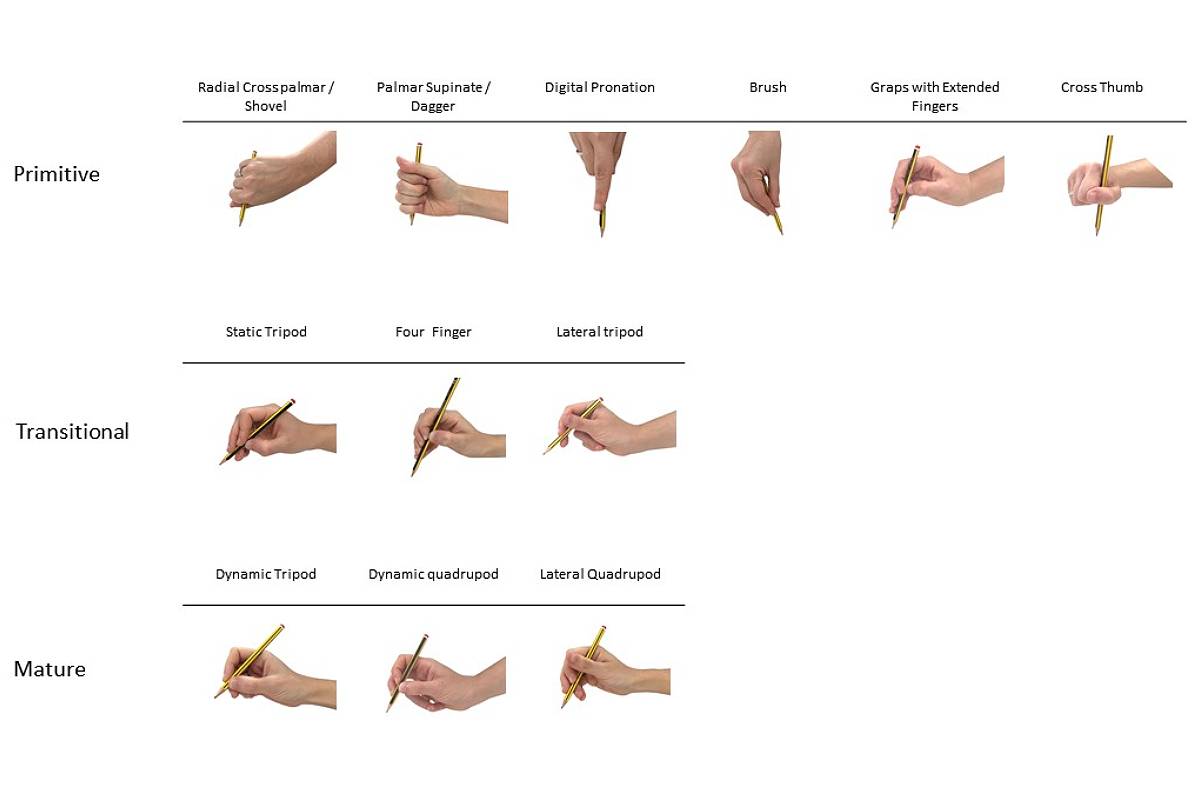
Researchers at the University of La Laguna have analyzed how pencil grip evolves during the early years of schooling and its relationship to the development of handwriting. study It followed 290 schoolchildren from Tenerife from Early Childhood Education to the end of the second year of Primary Education and took into account, in addition to the type of grip, the type of writing task and the possible presence of risk of learning difficulties.
The results, published in the scientific journal Reading and Writing, They point out that learning to write depends not only on linguistic and cognitive abilities. The capacity to control hand movements with increasing efficiency, until strokes are made with greater precision and automatism, also plays a role.
The research team, made up of Juan E. Jiménez, Jennifer Balade y Eduardo García, from the research group Learning difficulties, psycholinguistics and new technologies Researchers from the University of La Laguna assessed schoolchildren at five different points over 30 months. At each assessment point, the participating students performed two writing tasks: copying letters and writing classmates' names. The team also recorded twelve different pencil grips, which were grouped into three categories according to developmental level: primitive, transitional, and mature grips.
The data show that students using mature grips consistently achieved greater writing fluency and progressed at a faster rate than those using transitional or primitive grips. The difference was especially clear when the task involved writing names.
The study also indicates that the period from the end of preschool to the beginning of primary school is especially important. It is precisely during this stage that the greatest differences in the development of fluency among the different types of grip were observed.
Another aspect analyzed by the research team was the situation of schoolchildren at risk of developing writing-related learning difficulties. This group generally showed less fluency than their peers. However, those who used a mature grip and performed more meaningful tasks progressed at a faster pace. According to the authors, this result suggests that greater motor development could help compensate, at least in part, for some difficulties when task conditions are favorable.
The situation was different in the letter copying tasks. As these activities require greater perceptual and motor effort, the performance differences between the different grip types and risk groups were reduced.
The research team suggests that pencil grip may be more than just a visible aspect of child development. It could also serve as an early indicator of how writing is becoming automatic. These findings could be useful for improving the early detection of potential difficulties and for designing preventative interventions focused on motor development during early childhood education.
However, in their opinion, this line of research still needs to be expanded with future studies that should analyze not only fluency but also other dimensions of writing, such as its quality and syntactic complexity. It would also be necessary to replicate the results with larger and more linguistically diverse samples, as well as to conduct intervention studies to determine whether there is a causal relationship between the development of grip strength and the evolution of writing.

 Spanish
 English
 French