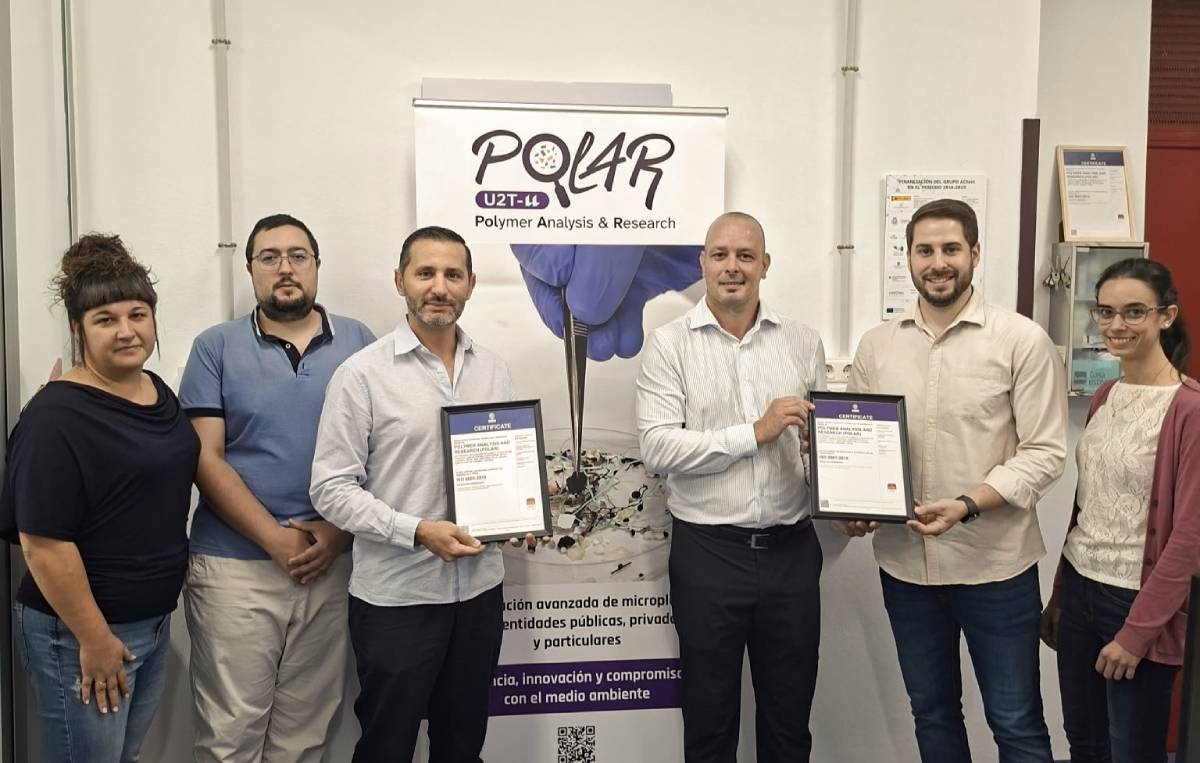
The laboratory Polymer Analysis and Research (POLAR) The Microplastics Identification, Characterization, and Quantification Laboratory of the University of La Laguna, located in the Chemistry Department of the Faculty of Sciences, has obtained certification of its quality management system in accordance with the international standard ISO 9001:2015, issued by the certifying body Bureau Veritas. The scope of the certification specifically covers the activity of the “Microplastics Identification, Characterization, and Quantification Laboratory,” which represents significant support for the management system and the procedures implemented by this unit.
The certification comes a year after The University of La Laguna will announce the launch of POLAR as a Transfer Unit (U2T), driven by the Research Group in Applied Analytical Chemistry and directed by the professor of Analytical Chemistry Javier Hernández Borges.
During this first year of operation, the POLAR team has worked on implementing procedures designed to ensure process and equipment control, staff training, traceability of analyses, customer service, and continuous improvement. The certification audit highlighted that, despite its recent implementation, the management system already demonstrates a high degree of maturity and comprehensive development.
The implementation of this quality management system and the improvement of the laboratory's analytical capabilities have been made possible thanks to funding from the Government of the Canary Islands, channeled through the Ministry of Ecological Transition and Energy. These funds have been used both for the acquisition of specialized equipment and for contracting technical assistance for the certification process.
POLAR is currently the only laboratory in the Canary Islands specializing in the identification, characterization and quantification of microplastics and is part of the small number of Spanish facilities with specific capacity to carry out these determinations.
Among its main features is an ISO 6 class cleanroom—installed in 2024 and financed by the Tenerife Island Council under the island's waste management contract executed by the Nivaria Joint Venture—as well as other spaces and procedures specifically designed to minimize contamination of samples, one of the main challenges in the determination of microplastics.
Relevance of the laboratory
Since its launch, POLAR has experienced steady growth and now serves numerous clients in both the public and private sectors. In less than a year, it has performed nearly one hundred analyses, a number that continues to rise. The company is also working to finalize several agreements with public institutions to develop various analytical programs and services related to microplastic detection.
The consolidation of POLAR is particularly relevant in a context where the European Union is progressively incorporating microplastics into its water monitoring programs. Thus, in the area of drinking water, Directive (EU) 2020/2184 included microplastics among emerging contaminants of special concern and provided for the development of a methodology to measure them with a view to their possible inclusion on a watch list. Subsequently, Delegated Decision (EU) 2024/1441 established a harmonized methodology for their measurement.
Directive (EU) 2024/3019 on urban wastewater treatment expressly introduces the monitoring of microplastics, including their tracking at the inlet and outlet of certain wastewater treatment plants and, where relevant, in their sludge. More recently, Directive (EU) 2026/805 strengthened this framework by stipulating that microplastics must be included in the watch lists for surface and groundwater.
This framework is further complemented by the recent Directive (EU) 2025/2360, on soil monitoring and resilience, which recognizes that microplastics and nanoplastics can pose a risk to soil health and fertility and establishes the framework for advancing their inclusion in soil contaminant monitoring.
Taken together, these new European provisions are progressively extending the monitoring of microplastics, increasing the need for specialized laboratories capable of reliably identifying, characterizing and quantifying them with quality assurance systems.
Although much of POLAR's activity focuses on the determination of microplastics in drinking water, wastewater and other aqueous matrices, its capabilities also allow it to address matrices of different nature, such as soils, sediments, table salts and beverages, among others.
This ISO 9001 certification represents a further step in consolidating the laboratory as a leading scientific and technology transfer facility in the Canary Islands. It also contributes to strengthening the University of La Laguna's capacity to address this significant environmental problem and the analytical needs that are expected to grow in the coming years.

 Spanish
 English
 French