The Canary Islands Chair of Agritourism and Wine Tourism of the Canary Islands Institute of Agri-Food Quality (ICCA) and the University of La Laguna, in coordination with the Department of Agricultural and Rural Engineering of the academic institution, has organized a Conference for the International Day of Rural Women of the Canary Islands which, under the motto "Sowing the Future: Women, Science and Territory", will be held on October 15 in the Aula Magna of the Sections of Physics and Mathematics of the University of La Laguna, with the aim of making visible and valuing the role of rural women in the Canary Islands as key agents in areas such as science, agri-food innovation, food sovereignty and the sustainable management of the territory.
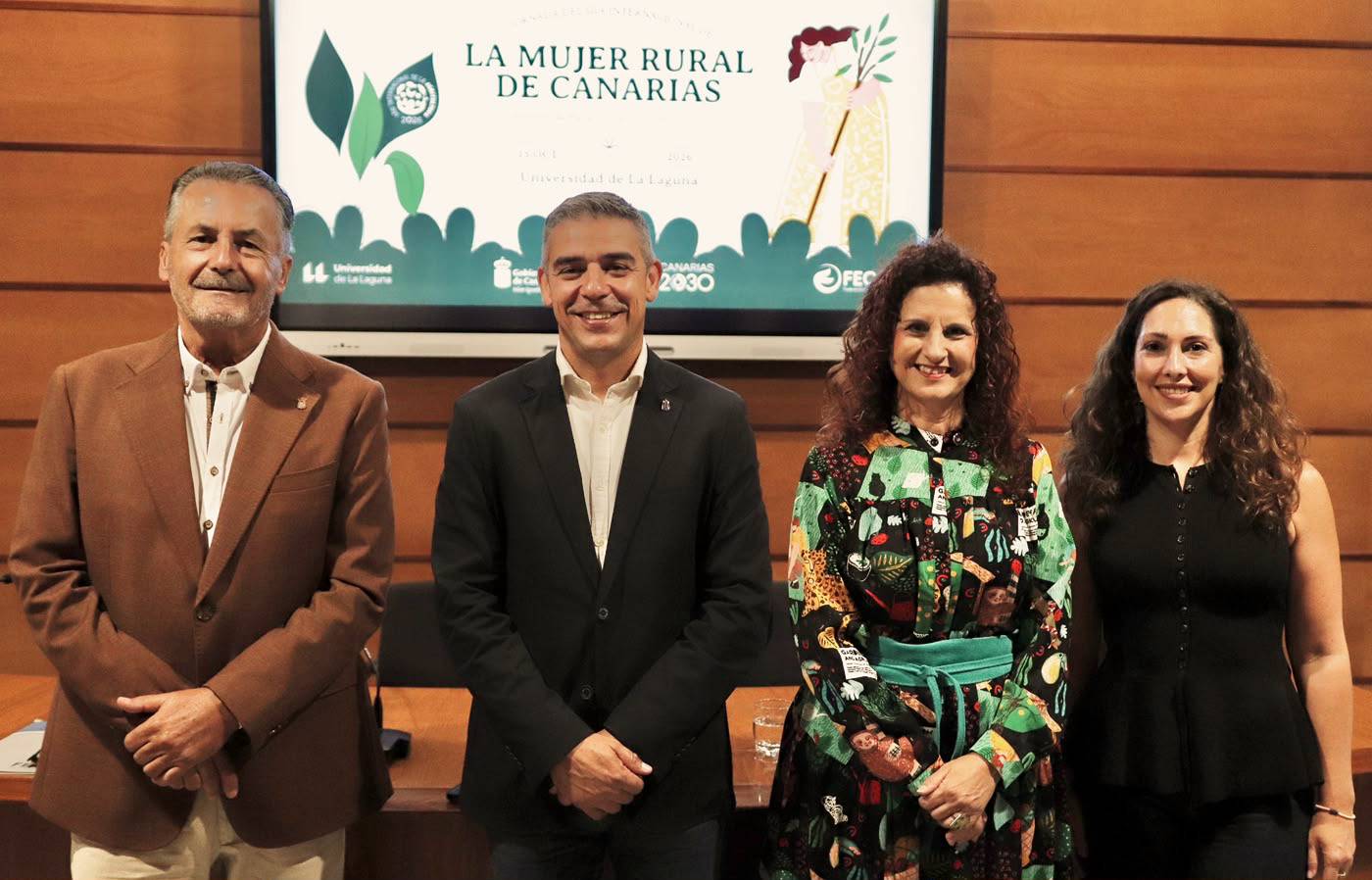
The event was presented today, Thursday, October 8, at the headquarters of the Ministry of Agriculture, Livestock, Fisheries, and Food Sovereignty in Santa Cruz de Tenerife. Participants included the Vice-Rector for Culture and University Extension at the University of La Laguna, Isabel Karely León Pérez; the Minister, Narvay Quintero; the President of the Rural Development and Fisheries Commission of the Canary Islands Federation of Municipalities (FECAM), Vicente Rodríguez Lorenzo; and the coordinator of the International Day of Rural Women and member of the Advisory Council of the Canary Islands Chair of Agritourism and Wine Tourism, Noelia Cruz Pérez.
During her speech, Quintero pointed out that “continuing to advocate for and highlight the role of women in rural areas is a matter of justice, but also a necessity to guarantee the future” of the islands. Women have historically played a decisive role in agricultural and fishing activities, in the conservation of the land, and in the social cohesion of our communities, and today they continue to be key players in many of the innovation, entrepreneurship, and transformation processes taking place in the sector.”.
The councilor also emphasized the need to move towards greater female representation in positions of responsibility and decision-making related to the primary sector and rural development. “We must continue to create opportunities for more women to own farms, businesses, and cooperatives, and to lead research projects or innovation initiatives in the agricultural sector. Their participation in governing bodies and in the areas where policies are developed, investments are decided, and the future of the agricultural and fisheries sector is defined is essential to building a more equitable rural environment with more opportunities, generational renewal, and greater capacity for development,” he stated.
Noelia Cruz, for her part, highlighted the evolution of this initiative, which this year expands its scope with the incorporation of experiences from the local, national, and international spheres, as well as a specific space dedicated to scientific communications. “We want to continue growing these conferences and broaden their perspective each year, incorporating new experiences and knowledge to address the reality of rural women from different angles,” she added.
On the other hand, Vicente Rodríguez emphasized the importance of addressing the reality of rural women from the perspective of the demographic challenge and through the close relationship of local governments. In this regard, he praised the collaborative work being carried out to translate priorities related to rural areas into “concrete mechanisms and initiatives” that will improve living conditions and opportunities in these communities. “The 88 municipalities of the Canary Islands have a rural reality that we must address, and it is essential that the proximity of local government helps to identify needs and find viable solutions,” he stated.
Finally, Isabel Karely León highlighted the role of the academic institution as a meeting point between scientific knowledge and the experiences of women working in rural areas. “It’s not just about transferring the knowledge generated at the University to society, but also about incorporating the experiential and specialized knowledge of women who work and live in rural areas into research and decision-making,” she explained. In this regard, she particularly valued the hybrid format of the event, which will allow for broader participation, as well as collaboration between institutions to promote transformations more closely aligned with the real needs of the region.
A space for meeting and promoting public policies
The International Day of Rural Women in the Canary Islands is conceived as an institutional, academic, and territorial forum designed to promote reflection and the exchange of knowledge regarding the role of women in rural areas and their contribution to the islands' sustainable development. Through various presentations and discussions, the initiative will address issues related to women's participation in agri-food science and innovation, their contribution to food sovereignty, and their role in the conservation and sustainable management of the land.
The event also aims to raise awareness among Canary Island society about the importance of moving towards a more inclusive rural environment and to promote the development of cross-cutting public policies that permanently integrate the gender perspective into land management and strategies linked to the agri-food development of the Canary Islands.
The celebration of the meeting is also framed within the lines of work of the Canary Islands Agenda 2030 and has the institutional support of the Canary Islands Federation of Municipalities (FECAM), thus reinforcing the transversal nature of a proposal that seeks to connect the academic field, public administrations and the reality of the rural territories of the Canary Islands.
Full program
The event will begin with an opening presentation by the president of the Canary Islands Institute of Agricultural Research (ICIA), Janira Gutiérrez Peraza, and a dialogue with the professor from the University of Las Palmas de Gran Canaria and member of the Advisory Council of the Chair of Agritourism and Wine Tourism of the Canary Islands, Anabel Calderín Castro.
Later, the round table “Governance, Science and Territory: Institutional and Social Alliances for the Development of Rural Women in the Canary Islands” will be held, moderated by Professor Noelia Cruz Pérez of the University of La Laguna and member of the Advisory Council of the Chair of Agritourism and Wine Tourism of the Canary Islands. Participants will include Angélica Belén Padilla Herrera, Mayor of San Sebastián de La Gomera and member of the FECAM Rural Development and Fisheries Commission; María Gloria Lobo Rodrigo, Coordinator of Programs of the Department of Plant Production in Tropical and Subtropical Zones of the ICIA; Estefanía Daswani Borges, Senior Technician in Economics, Employment and Local Development of the Tenerife Island Council; and Ventura del Carmen Rodríguez Herrera, President of the Association Mujeres 7 Fademur Canarias.
This will be followed by a series of scientific presentations and defenses by doctoral students covering different topics related to the role of women, the rural world and the agri-food industry.
Specifically, the presentations are “Women and the rural world in the Canarian oral tradition: the figure of the witch”, by Daniel Hernández Rodríguez; “Re-inhabiting the land: A lesbian-feminist reading of the body and rural territory in the Canary Islands”, by Alba Rico Martínez; “Masculinity and the Rural Environment”, by Ico Escatllar Louart; “From Creativity to Territory: A methodological proposal to strengthen rural identity through art and the living heritage of the Canary Islands”, by Ira Loewe; “From the museum to Instagram: representation and self-representation of rural Canarian women between heritage and digital narratives”, by Andrea Jiménez Cejas and Carlos Manuel Rivas Pérez; “Prunas La Palma: For the Urgent Reactivation of New Sustainable Agroeconomies in La Palma”, by María Gómez Melini, Elena Castro Pérez, Paula Barreto Rodríguez and Numa Bellisario; and “Now we can talk: women in politics and the development of the Muriaé microregion”, by Naiara Raimundo Morais.
In the afternoon, the invited experiences block will take place, where the creator of Floresiendom, Natalia Molina Concepción, from Tegueste; the co-leader of the Val de Conso Goat Farm, Paula Jarque Azañedo, from Ourense; and the founder and director of Catilífero SAS, Laura Yulissa Buitrago Gómez, from Boyacá, will present the development of their business initiatives at the local, national and international level prior to a shared dialogue moderated by Noelia Cruz and Anabel Calderín.
Finally, the closing ceremony will take place with the reading of the manifesto “Canary Islands Charter for Rural Women” and the presentation of the ULL Canary Islands Farmer Awards, the recognitions for Rural Women's Day in the Canary Islands and the award for Best Scientific Communication of the Day.
The event can be followed both in person and online, after registering through this link.

 Spanish
 English
 French