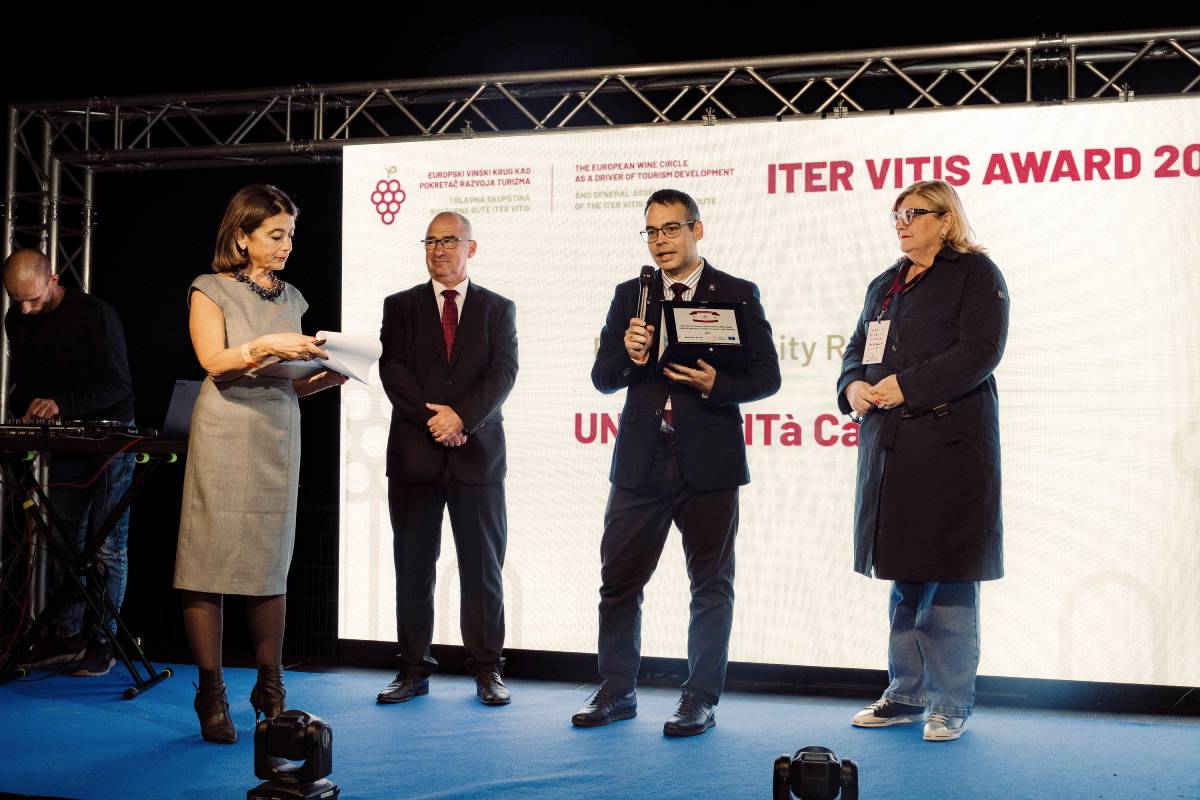
The Chair of Agritourism and Wine Tourism of the Canary Islands, linked to the Canary Islands Institute of Agri-Food Quality and the University of La Laguna, has been awarded the Best University Research prize in the Iter Vitis Awards 2026, an international distinction awarded by Iter Vitis, a cultural route of the Council of Europe dedicated to European wine heritage.
The official award ceremony took place on October 8th in the Croatian city of Ilok, during the general assembly and international conference of the Iter Vitis network. The chair was represented by its director, Jesús Enrique de las Heras Roger, and its general coordinator, Gabriel Santos García, who participated in a meeting with representatives from different territories and international entities linked to wine heritage, research and cultural tourism.
The award recognizes the Canary Islands institution's contribution to research, conservation, and promotion of wine heritage, cultural tourism, and sustainable territorial development. The distinction strengthens the Canary Islands' international profile and highlights the work carried out in the archipelago to connect university knowledge with the needs of rural communities.
De las Heras Roger emphasized that the award represents much more than an institutional prize, as it recognizes a particular approach to research, cooperation, and commitment to the regions. He highlighted the collaboration between the University of La Laguna and the Canary Islands Institute of Agri-Food Quality, which fosters training, research, and knowledge transfer, bringing the chair's activities closer to all the islands, especially rural areas and those who live and work there.
The director also highlighted the institution's growing international reach, with cooperative initiatives in Europe and Latin America, and especially with the Macaronesian archipelagos of Madeira, the Azores, and Cape Verde. He also expressed his gratitude for the commitment of the teaching and research teams, the professionals, the collaborating institutions, and those who have previously held positions of responsibility within the organization.
Regarding the future of the sector, he advocated a vision of wine tourism that goes beyond simply attracting visitors. In this respect, he emphasized the importance of protecting wine-growing heritage, strengthening rural communities, and generating real opportunities through sustainable territorial development based on knowledge and international cooperation.
International Meeting and Cooperation
Participation in the Iter Vitis general assembly and international conference allowed the chair's representatives to connect with more than fifteen international territories, fostering the exchange of experiences and dialogue with institutions and agents linked to wine culture and sustainable tourism development.
This international context offers opportunities to share initiatives, identify areas of common interest, and explore potential avenues for academic and institutional collaboration. For the Canary Islands, its presence in these spaces helps to showcase its wine heritage and its expertise in rural and cultural tourism within an international network of territories working towards shared objectives.
The participation of Jesús Enrique de las Heras Roger and Gabriel Santos García is part of the desire to strengthen the chair's cooperation with universities, administrations and international organizations, especially in those areas where research and knowledge transfer can contribute to generating new opportunities for island territories.
Boosting cooperation
During the meeting held in Ilok, the first steps of the Iter Vitis academic and research project were also outlined. This project, promoted by the University of La Laguna through its chair, in conjunction with the universities of Madeira, the Azores, Las Palmas de Gran Canaria, and Cape Verde, aims to consolidate a strategic alliance in Macaronesia and the Atlantic region to enhance the shared winemaking identity, promote sustainable tourism, and foster technical and scientific cooperation.
This collaboration establishes a framework for sharing knowledge and experiences among island territories facing challenges related to heritage conservation, economic diversification, and strengthening local communities. University research and knowledge transfer are fundamental tools for developing tourism models adapted to the social, cultural, and environmental characteristics of each territory.

 Spanish
 English
 French