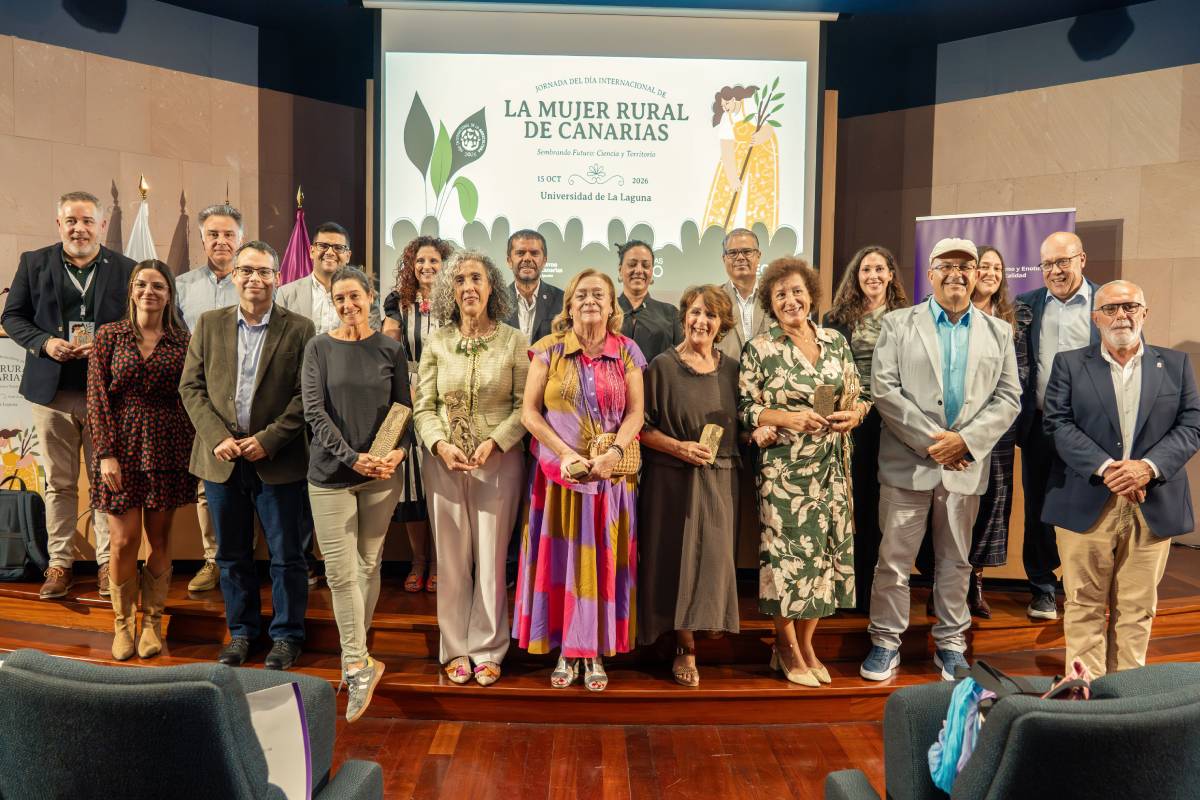
The Chair of Agritourism and Wine Tourism of the Canary Islands The Canary Islands Institute of Agri-Food Quality and the University of La Laguna, together with the Department of Agricultural Engineering and Rural Environment, held the event "Sowing the Future: Science and Territory in the Canary Islands" on October 15th, to mark International Day of Rural Women. The event provided an opportunity to present awards to women who have contributed to the development of the sector: María Zebina Hernández Hernández and Elisa Blanco Gestal, for their agricultural work; and researchers María de los Ángeles Camacho Pérez, María Candelaria Vera Batista, Ana María Josefina de León Hernández, and María Rosa Medina González.
The meeting, held in the Aula Magna of the Physics and Mathematics departments at the University of La Laguna, was supported and involved by the Government of the Canary Islands, through the Canary Islands Agenda 2030, and the Canary Islands Federation of Municipalities. The event connected university research with the realities of the archipelago's rural municipalities and highlighted the role of women in agriculture, agri-food innovation, and territorial development.
The celebration is part of the International Year of the Woman Farmer 2026, promoted by the United Nations and the Food and Agriculture Organization of the United Nations (FAO), and highlighted the contribution of rural women to food production, landscape conservation, sustainability, and the continuity of traditional activities.
Research, public policies and rural experiences
The program began with an opening presentation by Janira Gutiérrez Peraza, president of the Canary Islands Institute of Agricultural Research (ICIA), focused on the role of science and research in the development of the agricultural sector.
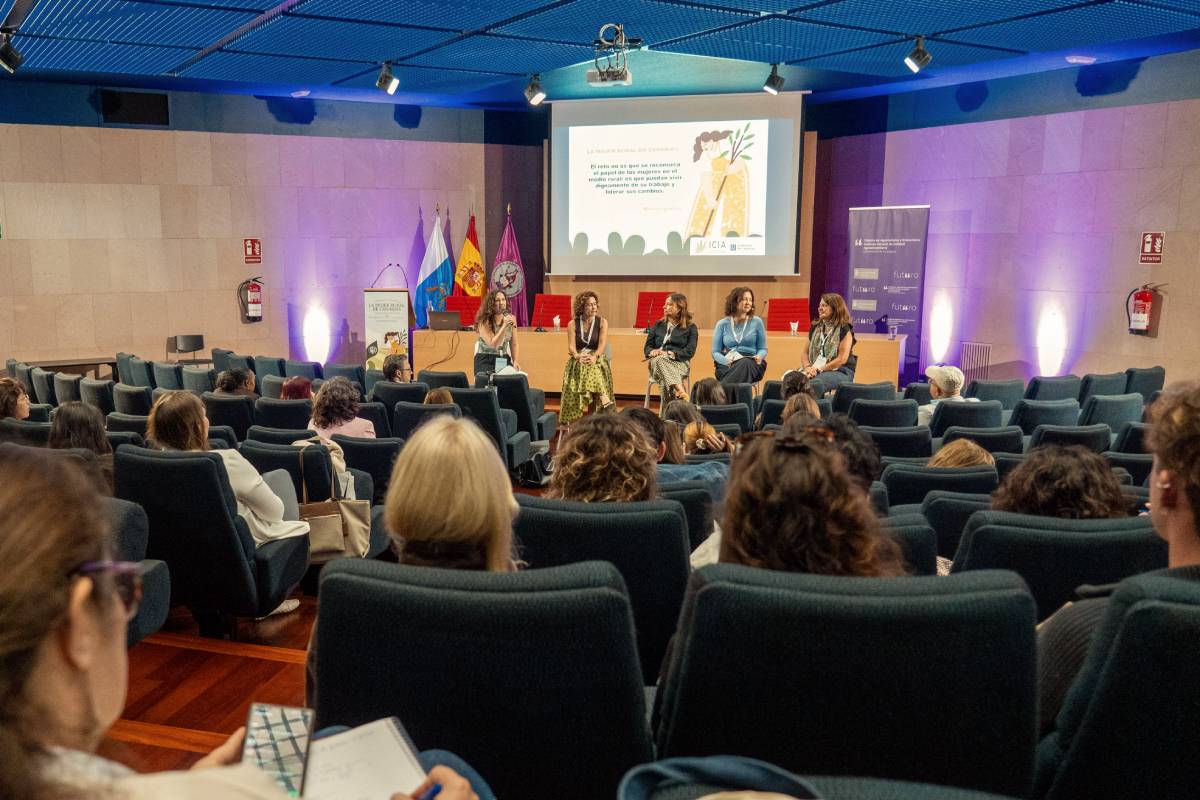
Later, a round table discussion brought together María Gloria Lobo Rodrigo, a researcher at ICIA; Angélica Belén Padilla Herrera, representative of the Rural Development and Fisheries Commission of FECAM; Estefanía Daswani Borges, a technician from the Tenerife Island Council; and Ventura Rodríguez Herrera, president of the Mujeres 7 Fademur Canarias Association. The debate addressed rural governance, public policies, and community organizing.
The day also included scientific presentations on digitalization, innovation, ecological transition, environmental sustainability, and generational renewal in agricultural holdings. In the area of entrepreneurship, initiatives such as Floresiendom, by Natalia Molina Concepción, in Tegueste, were presented, along with experiences from other regions, including the Val de Conso Goat Farm, represented by Paula Jarque Azañedo, in Galicia, and the Dactilífero SAS project, led by Laura Yulissa Buitrago Gómez, in Colombia.
 Rural women's leadership
The closing ceremony was presided over by Francisco J. García Rodríguez, Rector of the University of La Laguna, along with Abel López Díez, President of the Committee of Experts of the Canary Islands Agenda 2030; Janira Gutiérrez Peraza, President of the ICIA; Lot García Delgado, member of the Rural Development and Fisheries Commission of FECAM; Luís Alberto Bermejo Asensio, Director of the Department of Agricultural and Natural Environment Engineering of the University of La Laguna, and Noelia Cruz Pérez, member of the Advisory Council of the Chair and coordinator of the day.
Rector Francisco García, drawing on his personal experience as the son of a rural woman, emphasized the importance of women's daily work in caring for people and the land: "The connection between women and rural life can be summed up in a single word: life." Similarly, Noelia Cruz Pérez highlighted "the need to maintain a university connected to the realities of the region, capable of listening to those who work in rural areas and contributing, through education, innovation, and knowledge transfer, to meeting their needs.".
Luís Alberto Bermejo Asensio emphasized the value of the day as a space to give visibility to women who work in the agricultural sector, while Lot García Delgado recalled the historical contribution of several generations of women to the care of the Canary Islands' agricultural landscapes and the preservation of traditions.
For his part, Abel López Díez stressed that sustainability and territorial development require recognizing the essential role of rural women, and Janira Gutiérrez Peraza defended the need to move towards a rural Canary Islands in which women have the same opportunities to develop projects, lead farms and participate in decisions that affect the future of the Canary Islands territory.
Recognition of career achievements and university research
One of the central moments of the day was the presentation of awards to women whose career has contributed to the development of the primary and agri-food sector of the Canary Islands.
The Special Award for Lifetime Achievement in Supporting Women Farmers was given to María Zebina Hernández Hernández, in recognition of more than three decades of collaborative work and promotion of local products. Her career has been closely linked to women farmers, livestock breeders, cheesemakers, and women in the fishing sector, helping to raise awareness of their work and their contribution to the archipelago's agri-food production.
The Canary Islands Farmer Award, proposed by the Buenavista del Norte City Council, was awarded to Elisa Blanco Gestal for her organic production model at the La Econtenta farm and her role in promoting the Isla Baja Farmers Network. This initiative promotes short supply chains and the consumption of locally sourced food, linking agricultural activity with environmental sustainability and local development.
The University of La Laguna recognized four professors for their scientific and technical contributions to the Canary Islands agri-food sector: María de los Ángeles Camacho Pérez, for her career in animal production and academic management, her studies on local sheep breeds and her contribution to traditional livestock farming and the valorization of waste; María Candelaria Vera Batista, for her research on the propagation of proteas by cuttings, her participation in the Plant Architecture group and her applied innovation projects in the water sector, including IDIWATER.
Ana María Josefina de León Hernández, for her studies on the growth, nutrition and fertilization of Leucospermum cultivars in clay soils and her scientific contributions in international publications; and María Rosa Medina González, for her teaching and research work in food technology and her studies on Canary Island viticulture, including international publications on white grape varieties of the archipelago.

 Spanish
 English
 French