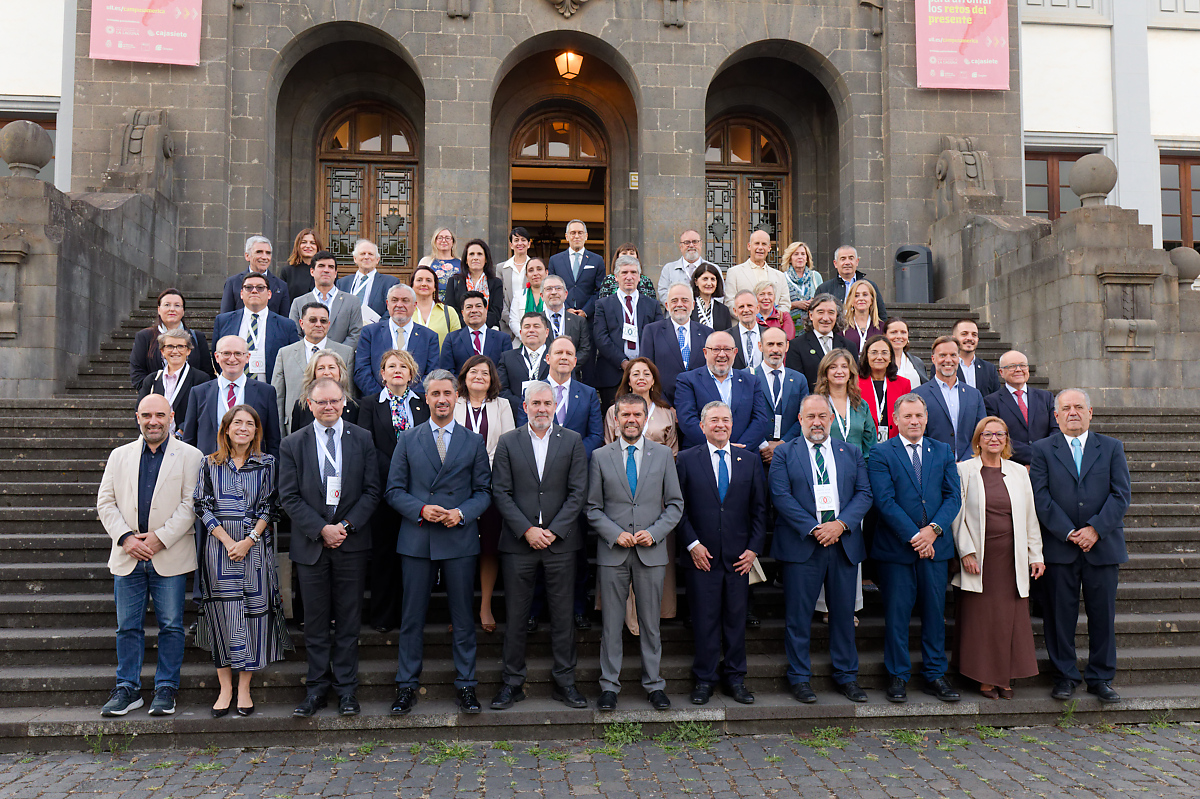
The Paraninfo of the University of La Laguna was the venue chosen today, Monday, October 19, to celebrate the opening session of the 2026 edition of Campus America, the international event that this institution carries out biennially to strengthen academic, scientific and cultural relations with the Latin American sphere, and which this year has Chile as the guest country.
The ceremony was presided over by the Rector of the University of La Laguna, accompanied by the President of the Canary Islands, and other authorities such as the Chilean Ambassador to Spain, the Mayor of La Laguna, and the Deputy Government Delegate, as well as the President of the Conference of Rectors of Spanish Universities (CRUE) and the Vice President of its Chilean counterpart. Forty Spanish and Chilean university rectors also attended the event.
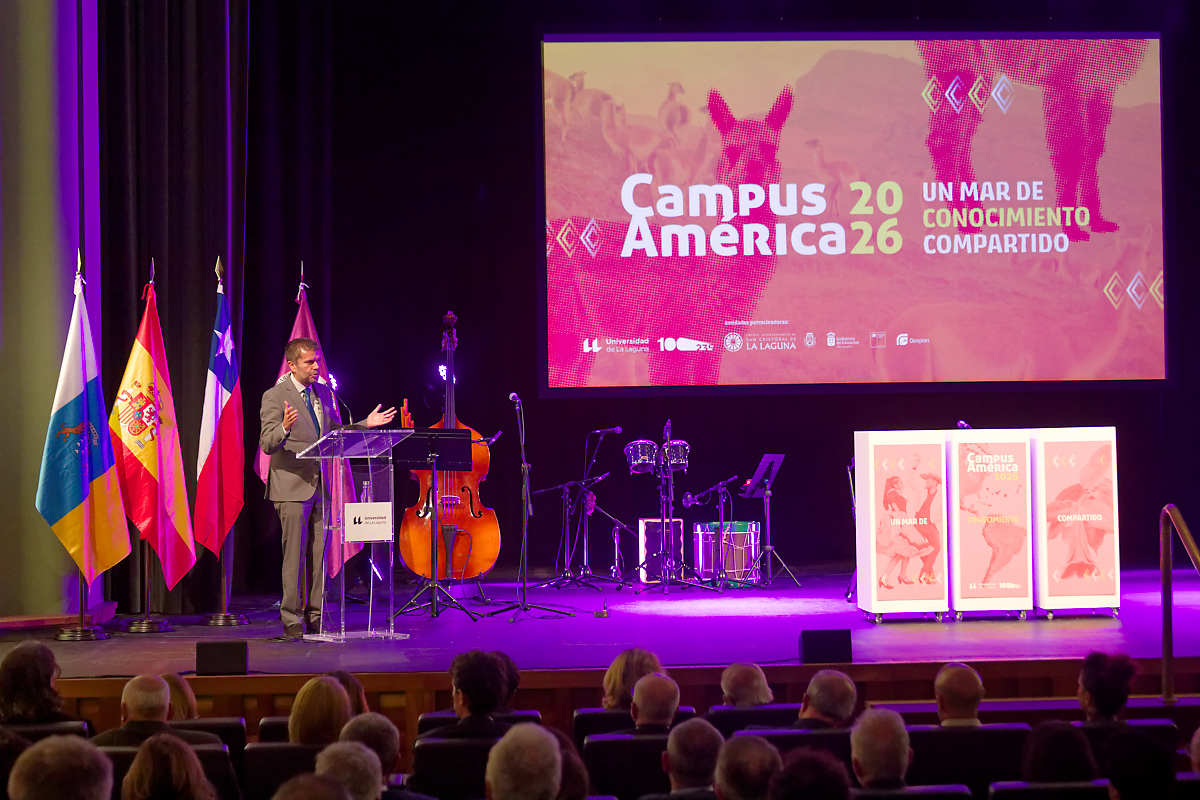
Francisco García, rector of the ULL.
Campus América is thus consolidating itself as an institutional initiative that, since 2017, has been established as a space for academic, scientific, cultural, and socioeconomic exchange between the Canary Islands, and by extension Spain and Europe, with the American continent. “This is not a new role for our archipelago,” stated the Rector of the University of La Laguna (ULL), Francisco García. “Our position in the Atlantic has made us a tricontinental hub that goes far beyond geography, as it has decisively shaped our history, our culture, and our way of seeing and relating to the world.”.
The consequences of all this will be explored over two weeks at Campus América, the rector continued, with the participation of 300 speakers and 56 universities from 14 countries on both sides of the Atlantic. Some thirty research seminars and academic workshops, in addition to twenty cultural events, are part of this forum, which includes institutional roundtables to continue working on building an Ibero-American Higher Education Area, with an emphasis on international mobility, joint degrees, and academic internships.
“Today, universities play a decisive role in what is known as academic diplomacy—that is, in the strategic use of knowledge, research networks, higher education alliances, and academic mobility to build geopolitical bridges, foster intercultural dialogue, and address complex global problems. And Campus America is, above all, a powerful tool of academic diplomacy,” the rector added.
Pedro Afonso, director of Foreign Action for the Tenerife Island Council, praised the launch of
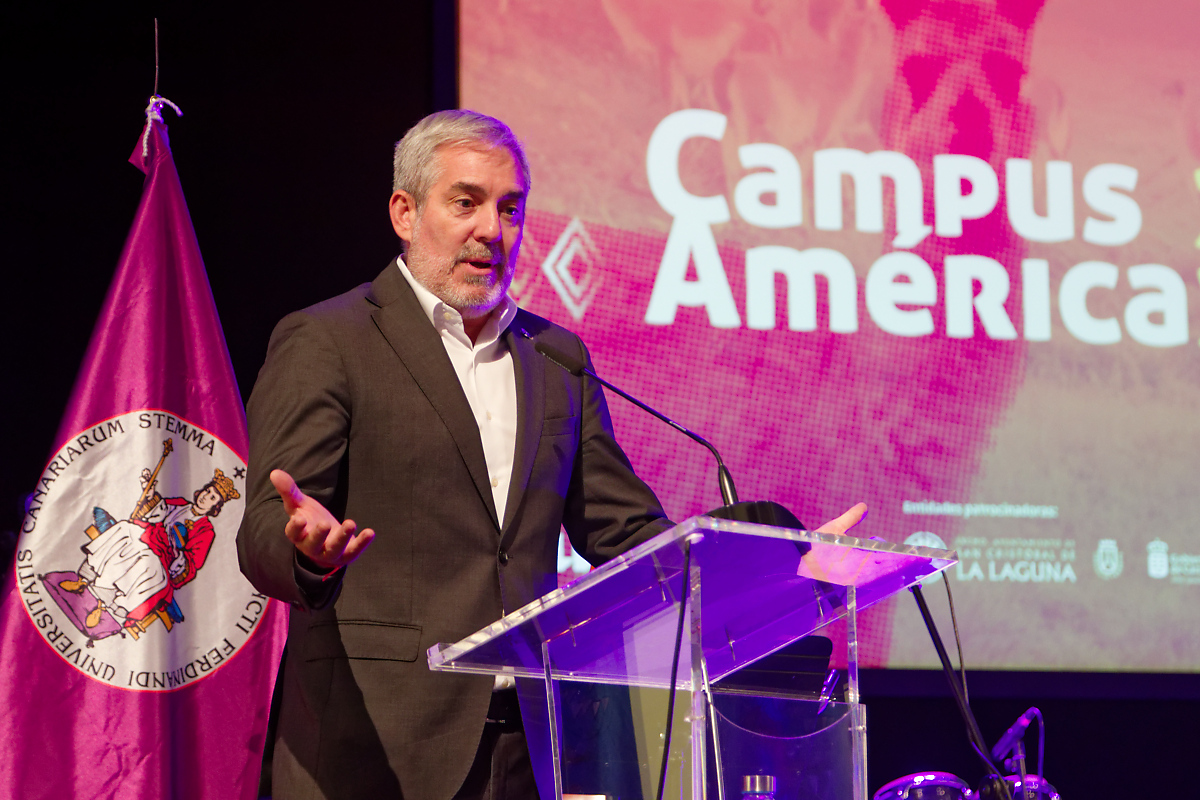
Fernando Clavijo, President of the Canary Islands, during the opening ceremony.
This initiative, designed to share knowledge with the American continent, with which the Canary Islands maintains so many ties, was highlighted by Osvaldo Corrales, Vice President of the Conference of Rectors of Chile and Rector of the University of Valparaíso. He emphasized the pursuit of truth, the defense of pluralism, and social values as pillars of university operations, while also thanking the University of La Laguna for the trust placed in them by choosing Chile as the thematic focus of Campus America.
For his part, Julián Garde, president of the Conference of Rectors of Spanish Universities (CRUE) and rector of the University of Castilla-La Mancha, focused on the enormous shift in the international order, without this diminishing the universities' commitment to defending knowledge and learning in general. The cooperation, dialogue, and international work of higher education institutions were also highlighted by the CRUE president. The mayor of La Laguna, Luis Yeray Gutiérrez, praised the city's more than 500 years of history, its enduring strength, and its role as a melting pot of cultures.
Also participating was the Spanish Ambassador to Chile, Juan Antonio Coloma, who highlighted some similarities between his country and the Canary Islands, such as their winemaking traditions, their fascination with the skies, and their coastal territories. He emphasized the importance of academic cooperation in creating new opportunities and knowledge. The event concluded with remarks from the President of the Canary Islands, Fernando Clavijo, who thanked the University of La Laguna for its support of the regional government in all its institutional endeavors, while also praising the nearly ten years of Campus América.
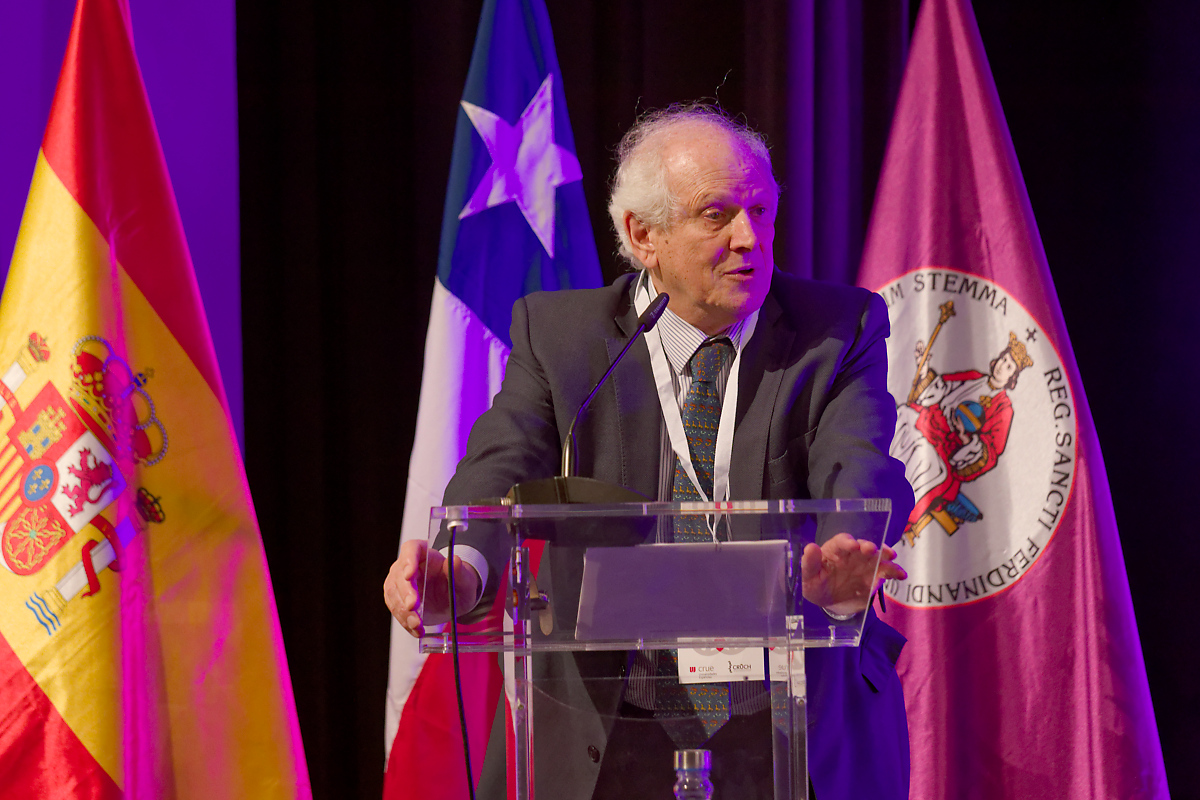
The historian Carlos Malamud.
America, a fragmented continent
The historian, Americanist, and senior researcher at the Elcano Royal Institute, Carlos Malamud, delivered the opening address. The expert spoke of a continent fragmented into multiple parts, making it impossible to find a common pattern for the internationalization of Latin America.
Previously, economics ruled the world; today, geopolitics does, the historian stated. He also maintained that the interest in Latin America is by no means altruistic; it holds approximately 601,000 pounds of the world's lithium reserves, 381,000 pounds of copper, and 201,000 pounds of rare earth elements, in addition to 451,000 pounds of renewable freshwater reserves, for example. Furthermore, it boasts excellent human capital and, above all, an almost nonexistent absence of bilateral conflicts compared to other regions of the world.
“Anyone who thinks that cozying up to the United States or China can solve all their problems is sorely mistaken,” Malamud pointed out, noting that the former is very short-sighted and the latter more strategic, with a long-term perspective. The historian maintained that the United States, despite everything, remains the region's leading economic partner, and in fact, it is the largest investor, both in terms of volume and consistency.
The United States' national security strategy, after decades of neglect following the 11M attacks, is once again focusing on Latin America, the speaker explained. However, the hegemonic deployment of the United States faces some obstacles, such as the upcoming US midterm elections, which are expected to result in a protest vote against US hegemony, as well as the
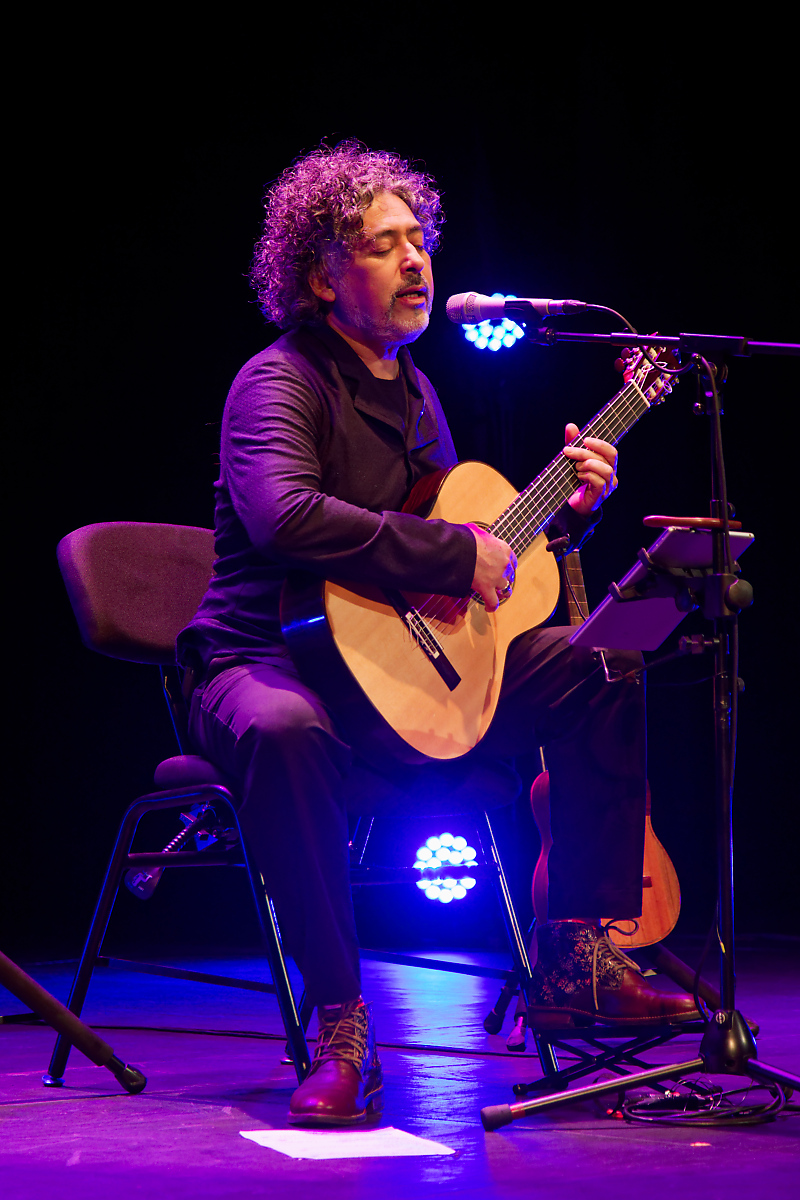
Chilean singer-songwriter Manuel García gave a concert at the end of the session.
Malamud pointed out that this anti-imperialist attitude is fueled by Donald Trump himself. To avoid being caught in the crossfire between the two powers, Latin America should diversify its economy with other partners, Malamud argued.
The historian also addressed the challenge posed by artificial intelligence to the common language, Spanish, and advocated for a greater number of Jean Monnet chairs in South America. “Europe must look more deeply at Latin America, and Latin America must look more deeply at Europe,” he concluded.

 Spanish
 English
 French