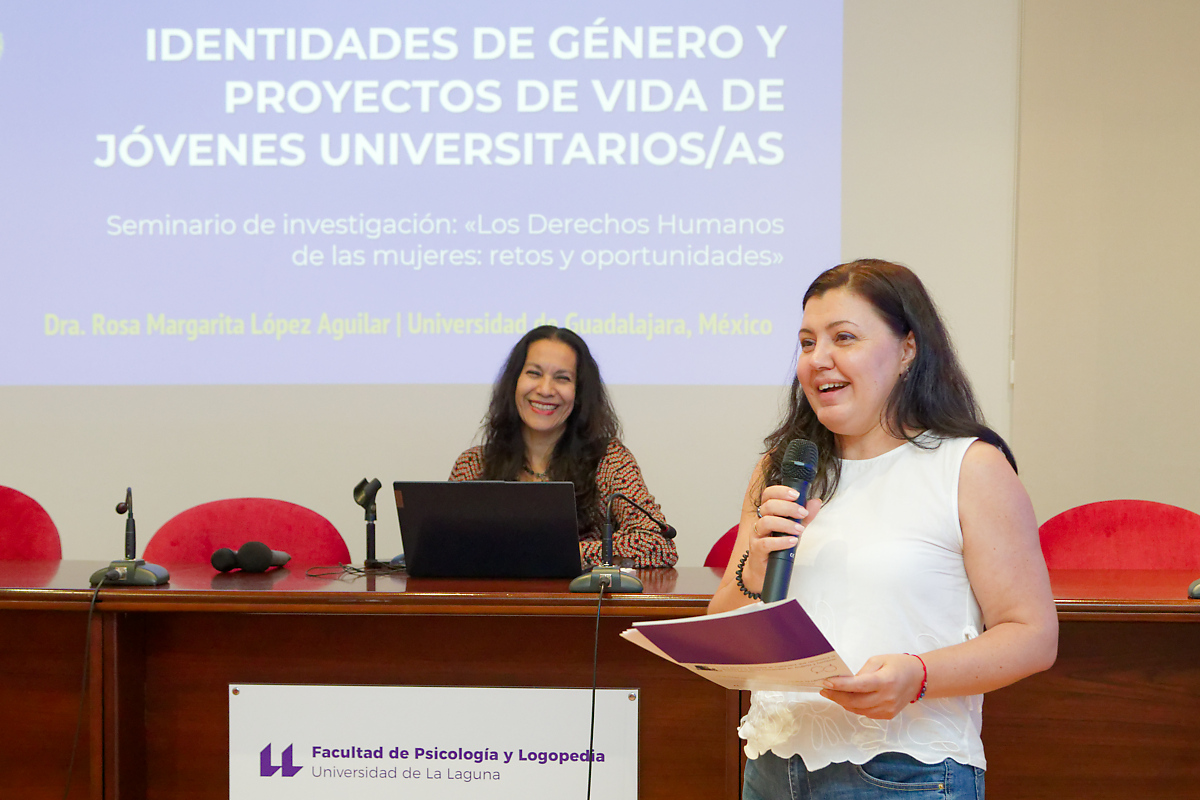
The 5th edition of Campus America It continues its extensive scientific program on the afternoon of its second day with the research seminar entitled “Women’s Human Rights: Challenges and Opportunities”, The event, held at the Faculty of Psychology and Speech Therapy, was coordinated by Professor Matilde C. Díaz Hernández, who teaches Cognitive, Social, and Organizational Psychology. Its aim was to explore the relationships between the University of Guadalajara-Jalisco (UDG), the University of Madeira (UMA), and the University of La Laguna, and to learn about the research and academic activities carried out by a group of female professors.
Human Rights, Inclusion, and Gender are the main themes of this seminar, approached from legal, psychosocial, and socioeconomic perspectives and within diverse social contexts. The primary objective is to share the results of research conducted in these areas and to collaborate on future lines of work and research. This collaboration will establish a network among the three universities, defining the lines of work to be developed from this forum.
The hybrid seminar began with a lecture by the keynote speaker, Rosa Margarita López Aguilar, a tenured professor of Social Psychology at the University of Guadalajara (Jalisco, Mexico). Titled “Gender Identities and Life Projects of University Students,” López Aguilar discussed the projects she has developed within her university, based on fieldwork conducted between 2016 and 2017 in the field of Health Sciences. This research has been enriched over the past ten years since an initial diagnostic assessment.
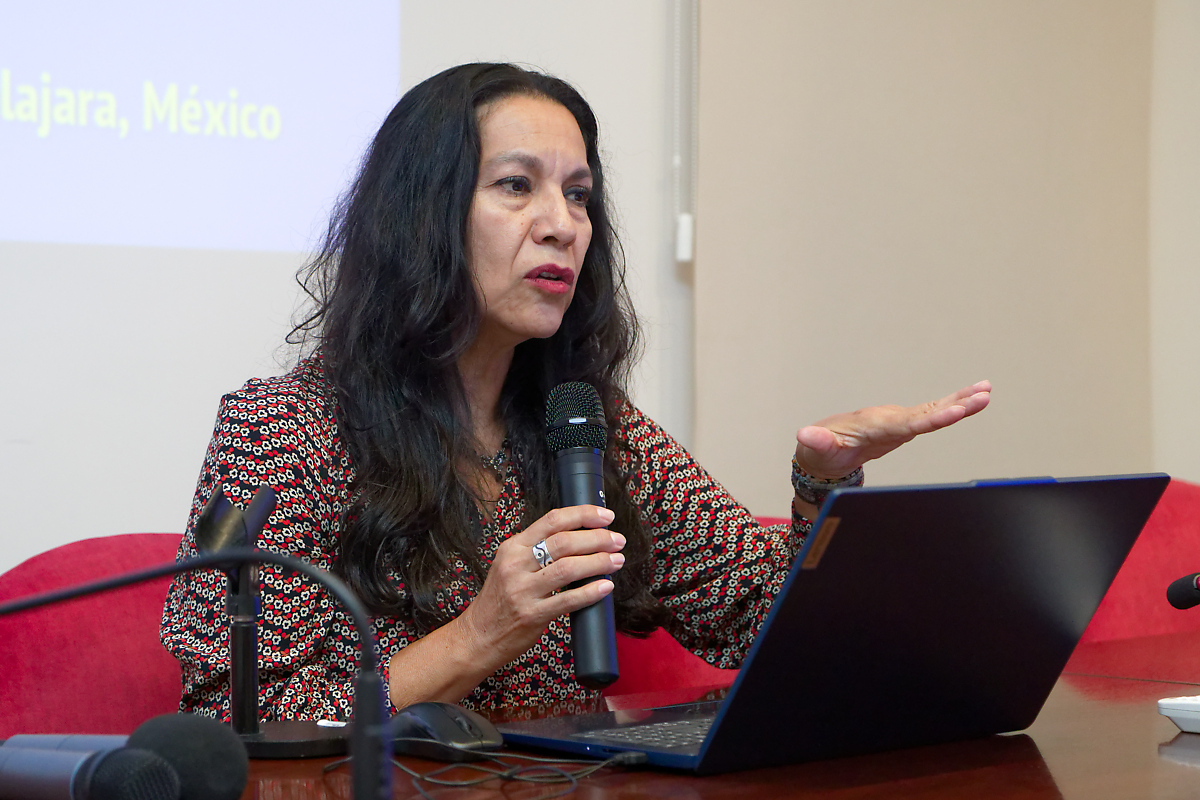 Her presentation begins with the question of why it is important to link human rights within the university and youth context. From there, she establishes five key concepts for analysis: gender as a lived experience in specific contexts, giving rise to a plurality of femininities and masculinities; identity as constructed from everyday relationships; social expressions through symbols and the perception of concepts as natural when they are social constructs; gender identity as linked to constant negotiation and the capacity to actively decide, redefining and transforming it; and the plurality of youth, implying that being young and being a university student cannot be separated, as both conditions intersect with gender.
Regarding the study and methodology, it was developed in the context of the University Center of Health Sciences of the University of Guadalajara-Jalisco, at the time when the transformation towards the model of excellence was carried out, which was extended throughout the world, which the speaker defines as a business logic model, focused on productivity, quality and competitiveness.
Fifty young people (22 men and 28 women), with an average age of 22, from six different degree programs were interviewed on a campus with a higher proportion of women, but encompassing three of the largest programs in terms of student enrollment: Medicine, Psychology, and Nursing. Three dimensions were measured through an in-depth qualitative study: biography and references to gender identity, experiences as university students, and future plans and life projects. Given that the study was conducted at a single academic center using an ethnographic methodology, it does not serve as a definitive reference point, but rather provides a comprehensive understanding of the process, which can be compared with other studies and authors.
López Aguilar outlined the main findings, which she summarized in the conclusions of her presentation, establishing that the university space is perceived as equitable but is permeated by inequalities. She emphasized that the family and the relationship with parents are the most important axis of interaction from which young people's lives and their understanding of gender are projected. She also explained how situations of discrimination and violence, as well as the reproduction of stereotypes, are perpetuated, with an asymmetrical evolution of the concepts of femininity and masculinity.
The Mexican expert reinforced the idea of the need for gender construction to be based on everyday practices: “We are facing a cultural change in process, not linear or homogeneous but significant, where a real change beyond the university is relevant, and as active subjects, creating a space for social transformations.”.
Finally, she described the current situation at the University of Guadalajara-Jalisco and the opportunities this seminar offers for analyzing this issue in the future. The researcher summarized the most important achievements in the effective defense of human rights, such as the creation of an equality unit in 2021 and the development of a code of conduct, regulations, and protocol for the prevention, attention, sanction, and eradication of gender-based violence between that same year and the following one. However, she concluded that, despite recent regulatory and social changes, regulations alone do not change the institutional culture. Indeed, in September 2026, adolescents and young people organized demonstrations to fight against discrimination, corruption, and other forms of institutional violence, acting as active subjects demanding that declared rights become lived rights, in a space of tension where transformation is possible.
In-person-virtual dialogue table
Following this, a two-hour ULL-UDG dialogue session, “Dialogues on Equity and Vulnerability: Legal, Psychosocial, and Socioeconomic Implications in the Lives of Women,” moderated by Matilde C. Díaz, took place. It was conceived as a way to address the university field, higher education, and the realities of women in these three universities. Afterwards, as with the main presentation, a discussion session was opened with the seminar participants and researchers, who contributed both in person and online.
The first communication was made by Aránzazu Calzadilla Medina, tenured professor of Civil Law at the University of La Laguna, entitled "The dignity of women in the face of technological advancement: a view from Law", who gives a historical review of the definition of roles and the impacts of Artificial Intelligence on women.
She was followed by Ana María Pereira Antunes, adjunct professor of Educational Psychology, Universidade da Madeira (Portugal), also present in the room, with her presentation “Inclusion in Higher Education and access to the labor market for women with disabilities”, who defined the situation of women in the university community with disabilities and their conditions in Higher Education at her university and other Portuguese contexts.
The following participants joined online from the University of Guadalajara, beginning with a presentation by Josefina Sandoval Martínez, Professor of Psychology and Education at the University of Guadalajara. Titled “Psychosocial Impacts of Academic Teleworking on Mental Health During the COVID-19 Pandemic,” she described the experiences of women in the context of the recent pandemic. Following this presentation, Patricia Guadalupe Villagómez Zavala, Associate Professor of Social Psychology at the University of Guadalajara, spoke about the socioeconomic impact and gender inequality experienced by women grieving the loss of COVID-19.
To close the debate, Alejandro César Antonio Luna Bernal, a tenured professor of philosophy at the University of Guadalajara, presented a paper titled “Dynamics of Interaction Among Adolescents and Their Relationship to Women’s Human Rights in the School Context.” This final presentation focused on women’s rights and adolescent relationships, specifically personal interactions within the school setting.

 Spanish
 English
 French