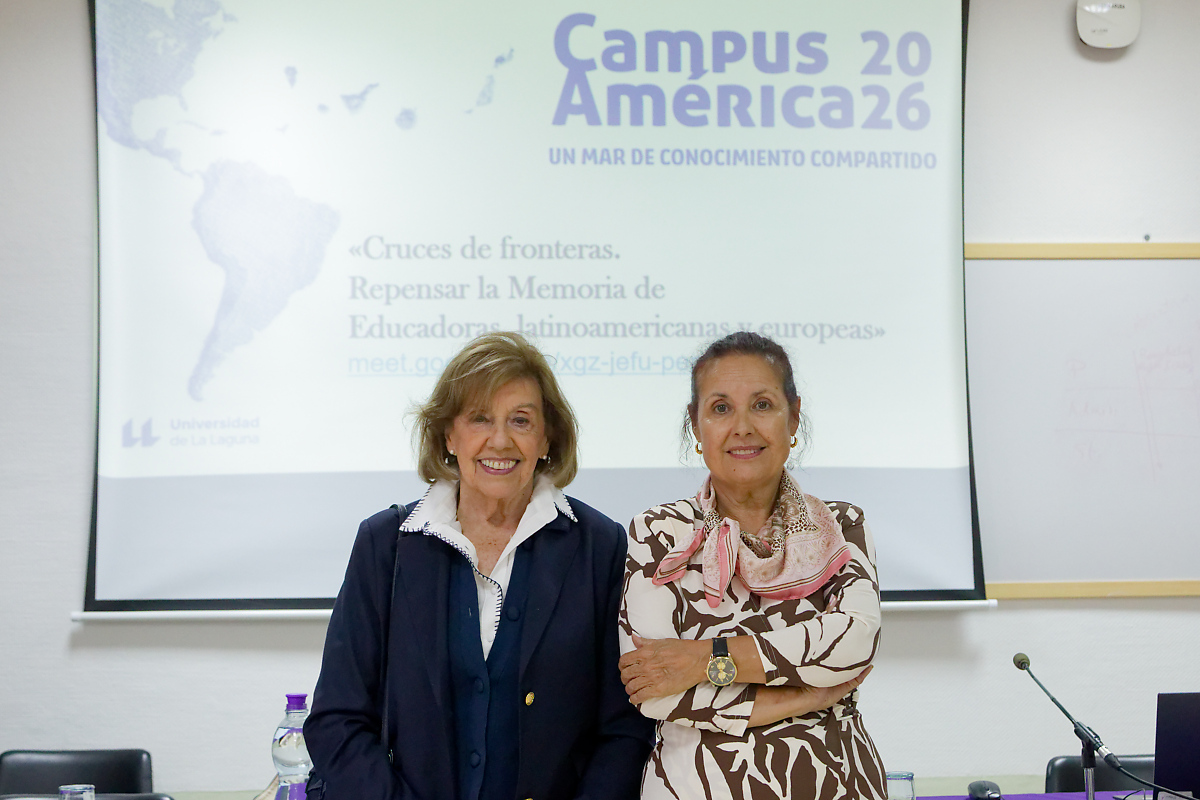
This edition of Campus America celebrates the seminar «"Crossing borders. Rethinking the Memory of Latin American and European Educators"», which takes place on October 21 and 22 under the coordination of Teresa González Pérez, Professor of Theory and History of Education at the University of La Laguna. These conferences aim to offer a fresh perspective through the analysis of key figures in education on both sides of the Atlantic and their convergence. This establishes a connection between the systems of activity and the relationships between Latin America and Europe, which resulted in mutual enrichment and an exchange of experiences and educational methods.
In her introduction to the seminar, Teresa González highlighted how the transatlantic relationship intensified in the mid-20th century, following World War II and the Spanish dictatorship, with the exile of prominent scientists and professors who fled to the Americas. However, she also noted that this relationship had existed since the late 19th century, prior to this cultural exodus.
Over these two days, some "old" and "renewed" relationships at the intersection of boundaries between teachers, schools, and children will be explored. The aim is to discuss the contributions of these educators, but above all, their legacy to future generations regarding critical thinking, the development of alternative teaching methods, and practical pedagogy.
The analysis begins with the work of Chilean Nobel Prize winner Gabriela Mistral, poet, diplomat, teacher and educator, who, in addition to her teaching practice, immersed in the world of education, published multiple articles that were disseminated in America and Europe, in which her pedagogical philosophy was reflected.
Another key theme is the New School movement, the foundation of pedagogical practices, which left a distinctive mark and influenced the educational work of various teachers, such as Maria Montessori, the Agazzi sisters, Carmen de Burgos, María de Maeztu, Regina Lago, and María Zambrano, among others. The program also addresses the contributions of women educators exiled in the Americas, who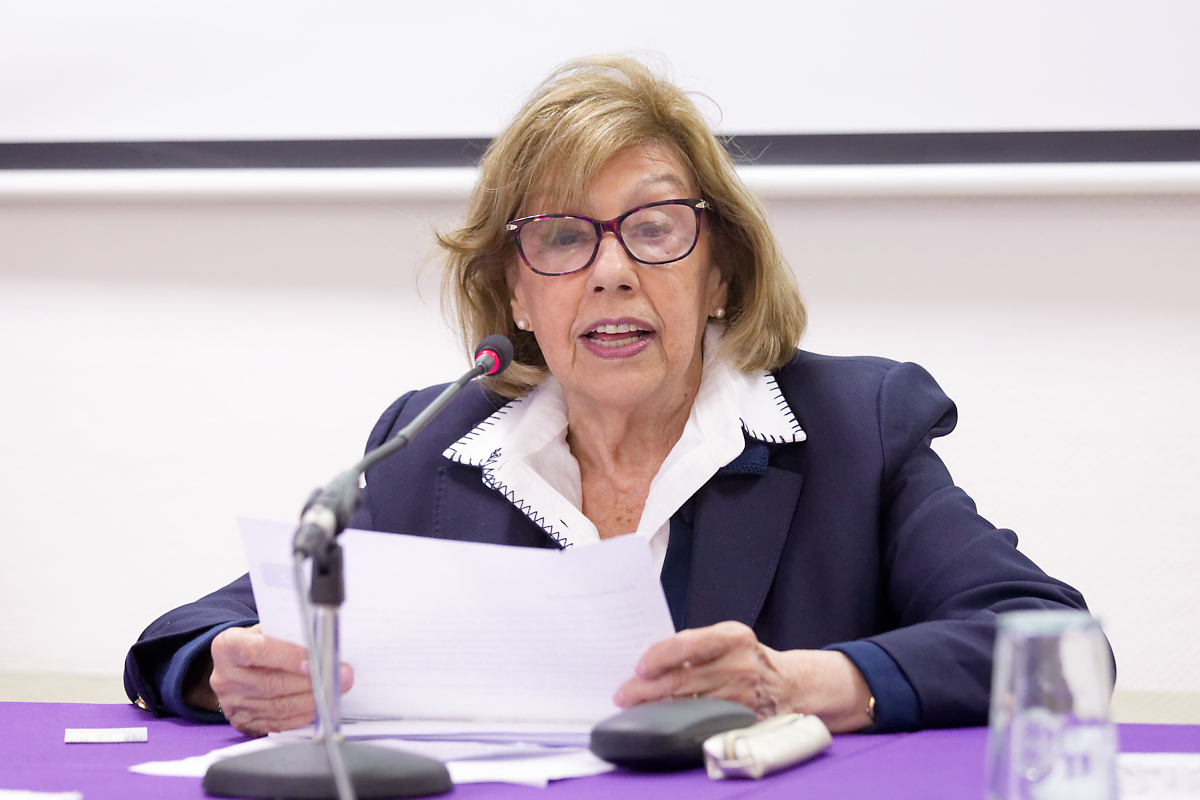 He succeeded in extending his educational ideals to new societies. Likewise, the need arises to rethink the past in dialogue with the present and to reflect on new pedagogies for contemporary society.
The keynote speaker who opened today's session, Wednesday the 21st, writer Estela Socías Muñoz, a professor of Education at Universidad Mayor (Santiago, Chile), presented "Gabriela Mistral, Universal Teacher." Socías has dedicated much of her academic work to this fundamental figure in Chilean and Latin American education, focusing on early childhood education and rural schools.
The speaker reviewed Mistral's life trajectory, spanning several periods from 1903 to 1955, from her childhood in a rural setting to her beginnings as a teacher in Chile. Of particular note was her time in Mexico between 1922 and 1924, where she focused her efforts on literacy, the creation of libraries and rural schools, and where she served as a cultural and pedagogical collaborator during José Vasconcelos's Mexican educational reform, a state project whose educational prestige remains valuable even today.
The final period, from 1924 to 1955, was when her profile as a Latin American educator was consolidated on the international stage, in both the Americas and Europe. This period was also marked by her career in public and consular diplomacy, with her contributions to the early stages of the United Nations, beginning with the League of Nations. Her life abroad was marked by war, intellectual exile, and the deterioration of international institutions between the wars. It was also during this time that she won the Nobel Prize in Literature (1945), becoming the first Latin American woman to receive it, in recognition of her poetic work, full of lyricism and inspired by powerful emotions.
Socías highlighted the Chilean educator's concern for ethical content, defining the teacher's public responsibility, which extends beyond the classroom through interactions with families and the community, as both an intellectual and moral responsibility. Mistral also emphasized the educational value of the surrounding environment, with the school serving as a bridge between local learning, art, and citizenship. Furthermore, she argued that education and well-being are not isolated fields, but rather influence territorial justice and social inclusion from a socio-emotional and rights-based perspective.
Her promotion and critical reflection on reading, nutrition, and health in a resource-limited environment foreshadowed the educational policies of the 1980s. She also established children's poetry as a laboratory for local language. Socías invited us to recognize the singularity and vulnerability of Mistral's figure in an inclusive way, not only from a maternal perspective, with concepts like tenderness, but also from her more critical work that led to innovation in the educational system and the training and education of women in Latin America.
The speaker outlined the limitations of Mistralian discourse, which remain relevant to its impact on the present day, opening a critical dialogue with problems that persist today: inequality, the devaluation of teachers' work, the reduction of early childhood education to mere productivity, among others. Her contribution to pedagogical thought and teaching experience, as well as the dignity of both learners and teachers, includes a reflection on active teaching and learning methods.
Teachers who revolutionized education between two shores
The following presentation, entitled “European Women Teachers and Pedagogues: Exchange of Experiences and Educational Methods. From Maria Montessori to Rosa and Carolina Agazzi,” was given by Juana Rodríguez Gómez, Professor of Theory and History of Education at the University of La Laguna. In it, Rodríguez aimed to explain and engage the audience in exploring how the history of education in Latin America and Europe is deeply intertwined, particularly in the shift from traditional schooling to the definition of the New School in 1921, which transformed the educational landscape. She addressed the reciprocal influence of educators exiled to Latin America on the New School movement itself, which had a significant impact on kindergartens, emphasizing the importance of autonomy as a process. Furthermore, this development originating in Latin America was projected onto the European context, where it remains prevalent today, with methodologies for learning situations still applied in teacher training programs.
The seminar coordinator, Teresa González, will lead the next presentation, “Between Two Shores: Teachers Who Have Left Their Mark: Regina Lago García, Carmen de Burgos, and María de Maeztu.” The morning's presentations will serve as the basis for the day's final debate, entitled “Rethinking the Past of Education in Dialogue with the Present.”.
Thursday's session, which will run from 10:00 AM to 2:00 PM, will begin with a talk entitled "Impact of the New School on Public Education: Confluences from North to South," presented by Elisa J. Pérez Rosales, professor in the Department of Theory and History of Education at the University of La Laguna. This will be followed by "María Zambrano: Relevance and International Dimension," presented by Andrés González Novoa, professor in the same department at the same university.
Midday, the guest speaker, Jaime Caiceo Escudero, a professor at the University of Santiago, Chile, will present a paper entitled “Chilean Educators Transforming Educational Reality: Amanda Labarca, Mabel Condemarín, Beatrice Ávalos, and María Victoria Peralta.” Caiceo will highlight how Labarca, along with Caffarena, promoted women's suffrage and was the first educator concerned with women's rights, with 1952 being the first election in which women were able to vote for the President of the Republic.
The speaker indicated that the other three educators are recipients of national education awards for their significant contributions to education in Chile and Latin America. Condemarín, originally from the mining regions of northern Chile, joined a special education group in Chile to advocate for inclusive education for students with learning difficulties. Ávalos, for her part, was exiled to Wales, where she worked as an academic, after the disappearance of her brother during the Pinochet dictatorship. She later chose Papua New Guinea to establish a master's program. She returned to Chile in 1994, where she worked for a science education organization. Finally, Peralta is a prominent early childhood educator who promotes the right to education for all children from birth, both in Latin America and in Chile.
The seminar will conclude with a round table discussion entitled “Borders and Crossroads in Education: A Two-Way Journey.” Participants will include Estela Socías Muñoz, Jaime Caiceo Escudero, Juana Rodríguez Gómez, and Andrés González Novoa, moderated by Teresa González Pérez.

 Spanish
 English
 French