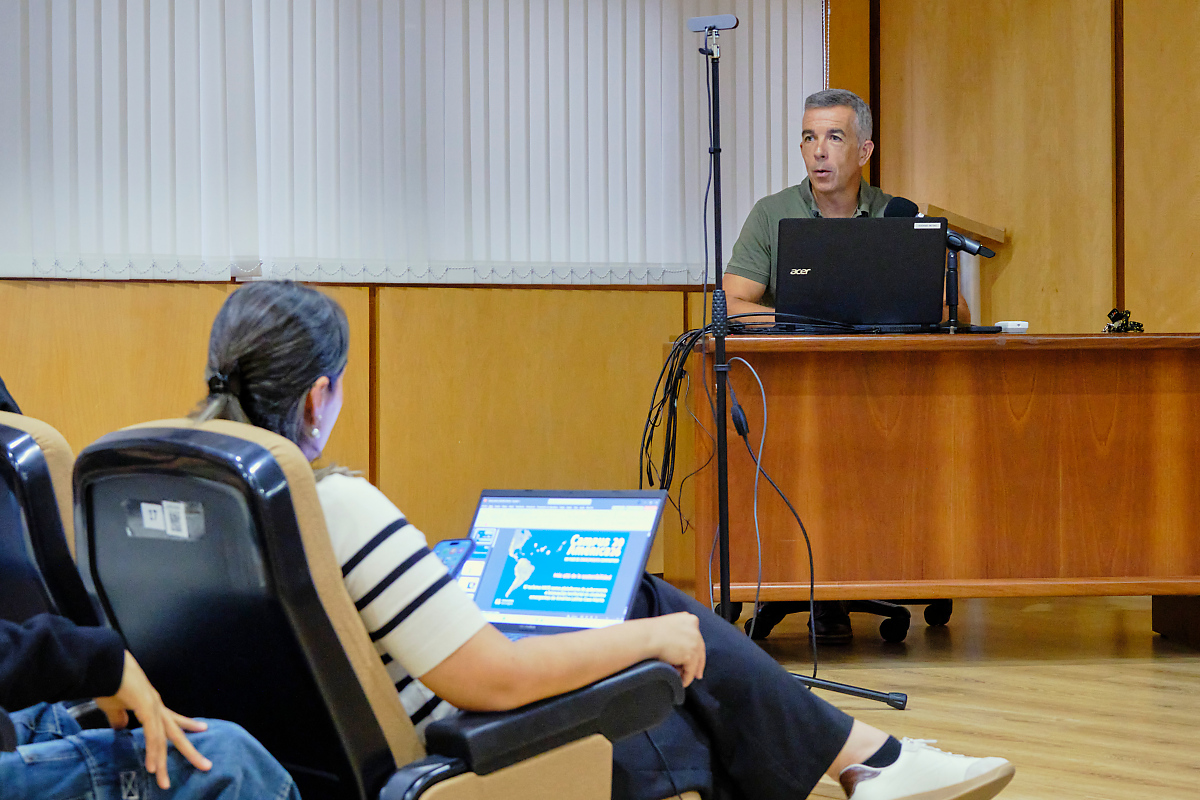
The professor Eduardo Parra he reflected on the concept of sustainability This topic, referenced in scientific publications over the last 20 years and related to tourism, is all within a context of methodological stagnation, which was analyzed today at a Campus America seminar. The expert's proposal is to move towards a more regenerative and equitable model of value creation. "Sustainability remains a central concept, but the truth is that real transformation has proven limited," he stated.
The concept has been developed through scientific publications and indicators, but it hasn't quite taken hold in practice. In fact, he commented that the agenda should be broadened because many obstacles still hinder its implementation, given that it doesn't transform the lives of communities.
The path towards more inclusive and equitable tourist destinations is therefore under study, in contrast to the current rejection of a predatory model that offers no solutions for the environment. From a research perspective, Parra maintains that while the volume of publications has increased, the concept has been stretched too thin. We have thus seen the rise of the SDGs in 2015 and subsequent years, with a concentration in the journal 'Sustainability,' which led SDG-related publications in Scopus between 2015 and 2019. We have also witnessed fragmentation, given that many articles conclude that regeneration, sufficiency, and degrowth are not integrable due to various motivations.
“The conclusion is that sustainability needs to move beyond the realm of traditional tourism and towards a regenerative model.” Parra’s contribution is situated within the framework of the Structural Inertia Framework (SIF), which seeks to demonstrate why the field of research reproduces incremental knowledge and fails to move beyond it towards new paradigms.
The MIE rests on four pillars: one concerns management, in the face of a collapsed system where nothing is transformed. If tourism generates so much, why isn't it better distributed? he asked. Another pillar delves into the narrowing of the concept, when sustainability is restricted solely to the color green. Can a destination be environmentally efficient and socially unsustainable? he questioned.
 A third aspect relates to methodology, specifically homogeneity; the problem arises when the tool fails to determine the questions we are able to formulate. Finally, the speaker pointed out a limited interdisciplinarity, since a socio-ecological problem cannot be solved from a single academic perspective.
According to the professor, research has fallen into a vicious cycle, always asking the same questions. “There has been an imbalance between flows, capacity, distribution, and legitimacy.” Tourist pressure becomes a problem when the territory loses the capacity to absorb all that influx.
Breaking the inertia
The professor put forward seven proposals to break the inertia, focusing on regenerative tourism, the purpose of digitalization, territorial justice, the circular economy, climate resilience (heat, water, fires, coastlines, aviation—all interconnected elements), the future of employment (digital skills, green skills, job quality, human-AI collaboration), and ethical governance (limited by actual decision-making capacity). “We need to study these steps to see which ones can transform the system.”.
Eduardo Parra envisions two plausible futures. One centers on a “sustainable inertia,” with more data but within the same structural model, offering greater efficiency, more tourism, and a more ecological approach. The other scenario focuses on a “systemic transformation,” more regenerative, with AI legitimized by people, and an integrated, climate-resilient community. “This debate must be faced without fear, because no one is thinking about this for the next 25 years.”.
 Can we optimize, can we reduce the damage, can we learn and adapt, or can tourism improve the territory? Parra asked what we should be measuring in 2030 or 2035: the well-being of residents, housing accessibility, biodiversity, water stress, and local value retention. “All of this would contribute to quality of work, a more equitable distribution of benefits, community agency, and regenerative additionality.”.
“It’s about sustaining and regenerating the places where tourism takes place, not just maintaining it, but connecting it with our values.” He concluded by noting that research is being conducted on the environment, community, reputation, behavior, and governance, but that “the problem isn’t the subject matter, but rather a repetition of the concept, and that way there’s no conceptual progress.”.
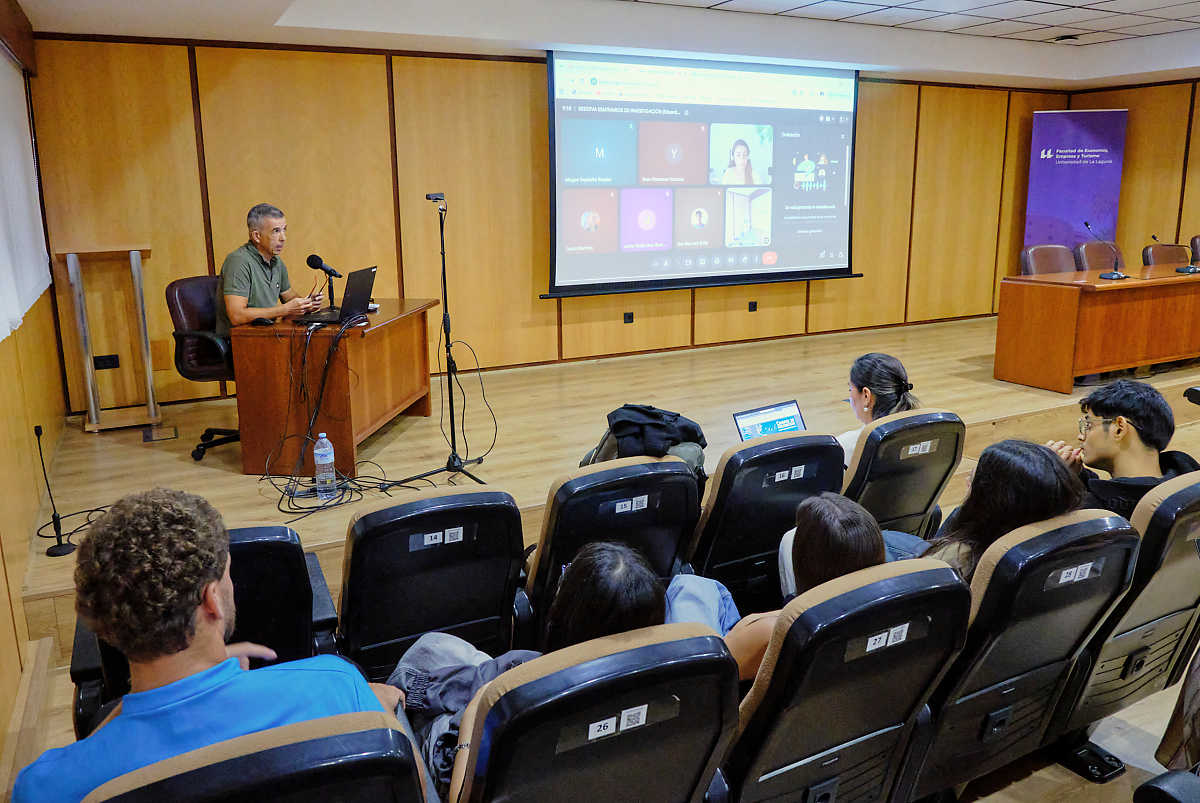
The seminar continues in a hybrid format, with many students connecting virtually and others joining throughout the morning according to their class schedules. Ecuadorian professor Leydy Cevallos and Serbian doctor Irena Travar are also participating.

 Spanish
 English
 French