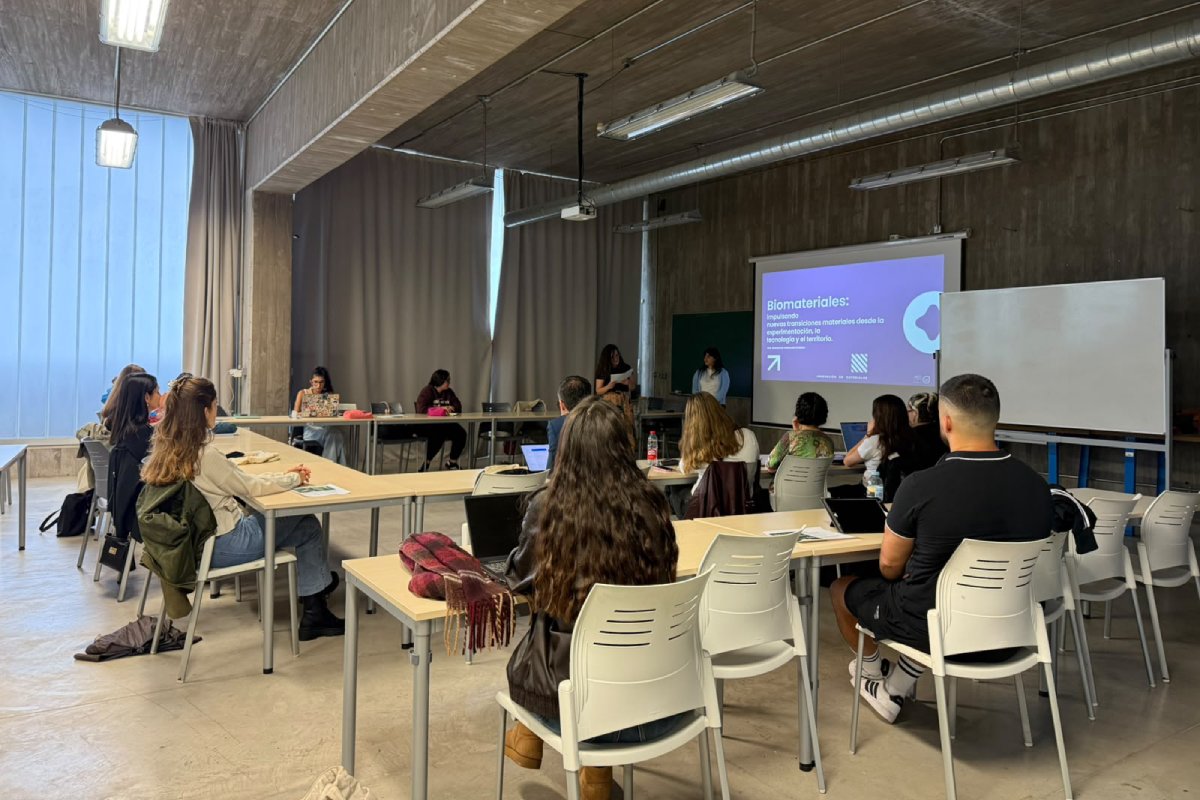
Campus América brought together researchers from Chile and the University of La Laguna yesterday, October 21, to analyze how design and biomaterials can contribute to social and environmental transformation. The seminar, “Design and Territory: Situated Practices for Social and Environmental Transformation in Chile and Spain,” was held at the Faculty of Fine Arts and combined research experiences, collaboration with local communities, and experimentation with materials.
Coordinated by Bernardo Candela Sanjuán, Dean of the Faculty of Fine Arts at the University of La Laguna (ULL), and Professor Arianna Fanio González, the meeting addressed design practices linked to the characteristics of each territory. From this perspective, resources, knowledge, and community participation are considered fundamental elements for developing proposals that respond to local needs. The seminar also addressed the valorization of tangible and intangible heritage and shared experiences developed in Chile and Spain to compare methodologies and explore new avenues of cooperation between research teams.
The day began with a brief opening ceremony in which Carlos Jiménez Martínez, coordinator of the Research and Innovation Group in Design at ULL, participated; Bernardo Antonio Candela Sanjuán, dean of the Faculty; Jimena Alarcón Castro, president of the Ibero-American Network of Research in Design (RIDID); and Arianna María Fanio González, professor at ULL and coordinator of the seminar.
Next, the Ibero-American Network for Design Research (RIDID) was presented by its president, Jimena Alarcón Castro, and Bernardo Candela himself. The presentation outlined four lines of action for the network: listening to the needs of its members, connecting them, showcasing their research, and promoting shared activities. Alarcón outlined the network's upcoming initiatives to connect teams and raise the profile of their research. These include two virtual meetings, on October 26 and 27, aimed at doctoral research groups and doctoral students, respectively. She also announced the collaboration with the Ibero-American Design Biennial and a call for submissions for RIDID members in the journal Cuadernos del Centro de Estudios en Diseño y Comunicación (Notebooks of the Center for Design and Communication Studies), which will open in December. Finally, Jimena Alarcón emphasized the role of Campus América as a platform for fostering joint scientific initiatives, expanding international participation, and establishing links with other academic communities.
The keynote address was given by Macarena del Pilar Valenzuela Zubiaur, from the Metropolitan Technological University of Chile, entitled “Biomaterials: Driving New Material Transitions Through Experimentation, Technology, and Territory.” Her presentation positioned experimentation with materials as one of the lines of work through which design can contribute to the ecological transition.
The researcher began by distinguishing between bio-based materials, made wholly or partially from biomass—such as organic waste, algae, or fungi—and biodegradable materials, which are characterized by decomposition through the action of microorganisms. This distinction allows researchers to differentiate between a material's origin and its behavior at the end of its useful life.
Valenzuela framed these alternatives within the circular economy, which proposes reducing waste from the design stage and keeping products and materials in use for as long as possible through reuse, repair, or recycling. Her presentation covered applications in packaging, clothing and textiles, and construction, with examples such as Desserto, Piñatex, and Ecovative Design. She also linked these possibilities to the challenges facing Chile, from the accumulation of textile waste in the Atacama Desert to the generation of municipal, agricultural, and forestry waste. She further highlighted the importance of exports of unprocessed raw materials, such as seaweed, to explore opportunities for transforming them into materials with greater added value.
The activity will continue on October 22 and 23 with an experimental biomaterials workshop taught by Macarena Valenzuela herself, whose stay, facilitated by Campus America, will allow for an expanded exchange of knowledge and experiences.
Continued collaboration with Chile
As explained by the coordinator, Arianna Fanio, the meeting continues the collaboration of the ULL Design Research and Innovation Group with Chilean researchers and opens opportunities to develop joint projects, stays and training activities.
The seminar has been integrated into the fifth edition of Campus America, which takes place from October 19 to 30 with Chile as the guest country and the motto "A sea of shared knowledge".

 Spanish
 English
 French