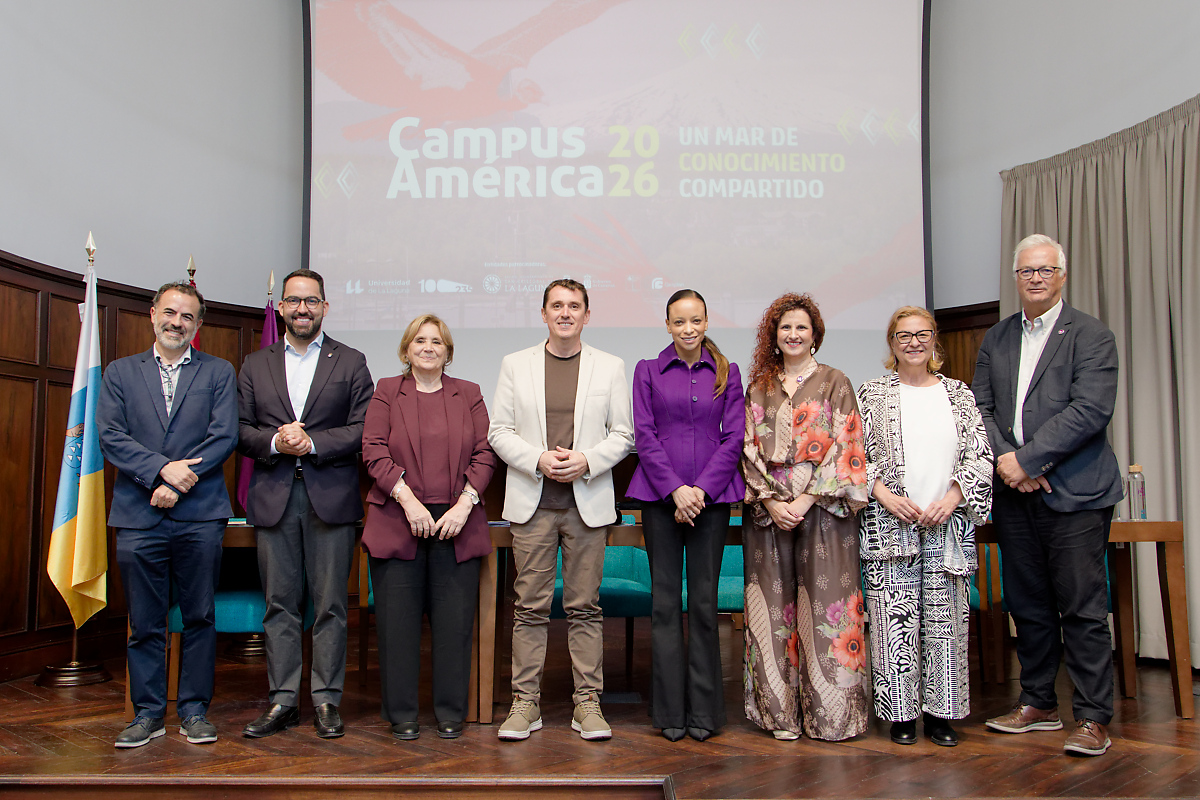
The University of La Laguna, within its program of Campus America 2026, Yesterday, October 21st, a roundtable discussion was held on the creation of the Ibero-American Chair of Cultural Routes and Itineraries. This initiative, currently underway, aims to connect research, training, and knowledge transfer regarding shared heritage. It is envisioned as a collaborative effort between the University of La Laguna (ULL), the Organization of Ibero-American States (OEI), the San Cristóbal de La Laguna City Council, and the Government of the Canary Islands. The project builds upon the initial discussions held during the previous Campus América event. Since then, the university has collaborated with various institutions to establish this chair, the agreement for which is currently being drafted. The agreement anticipates multi-year funding and the development of research lines, diverse projects, and academic cooperation activities.
The first presentation was given by Esther Kuisch Laroche, Director of the UNESCO Regional Office for Latin America and the Caribbean, with her talk “Networking Knowledge for the Sustainability of Landscapes, Routes, and Cultural Itineraries.” Her presentation highlighted the importance of inter-institutional cooperation and collaborative networks. “Sustainability begins with the quality of the decisions we can make together,” Kuisch Laroche stated, advocating for the contribution of evidence and critical thinking from universities. To illustrate this need, she pointed out that expanding access to a cultural landscape requires considering conservation, water management, mobility, tourism, and cultural practices, along with the experiences and rights of its inhabitants. “Territorial decisions are the responsibility of the competent institutions and must be developed in collaboration with the communities,” she emphasized. She then proposed connecting teams around shared questions, developing applied knowledge for management, and “researching, comparing, and returning results to the territories.” To conclude her presentation, she proposed transferring these experiences to international debates on cultural policies and exploring collaborations with chairs, networks, and specialized centers.
A panel discussion followed, with the participation of Kuisch Laroche herself; Isabel León Pérez, Vice-Rector for Culture and University Extension at the University of La Laguna (ULL); Adolfo Cordobés Sánchez, Councilor for Urban Planning and Cultural Heritage of the San Cristóbal de La Laguna City Council; Jafeth Alonso Estupiñán, Director General of Universities and Research of the Government of the Canary Islands; and Mónica García Alonso, Coordinator of the Directorate General of Culture of the OEI (Organization of Ibero-American States). The discussion was moderated by Professor José Juan Cano Delgado, Professor and Co-Director of the La Laguna World Heritage Chair.
The colloquium focused on the needs the chair aims to address, the institutional collaboration necessary for its development, and the priorities for its first two years. The session's approach positioned education and territorial development as key elements for ensuring that research and heritage management benefit local communities.
During the round of speeches, Vice-Rector Isabel León Pérez highlighted the university's main contribution as its ability to provide continuity to research and cooperation: "We are going to give stability to a space for knowledge generation." She also linked the initiative to the shared identity between the Canary Islands and Latin America and defended the chair as a tool for providing solutions that contribute to citizens' well-being through university partnerships and an interdisciplinary approach.
For his part, Adolfo Cordobés expressed the support of the La Laguna City Council: “Our commitment is to collaborate with and support this chair.” The councilor announced the approval of an initial allocation of funds to support it and indicated that work is underway to finalize the collaboration agreement. He also highlighted the city's historical connections with the Americas and the importance of preserving both the tangible heritage and the knowledge, expressions, and cultural relationships.
From the Government of the Canary Islands, Alonso Estupiñán highlighted the role of interdisciplinary research, the training of future teachers, and social innovation. He also advocated for sustained institutional cooperation to facilitate connections between the Canary Islands' public universities. In his opinion, the success of the chair should be judged by "the benefits it generates for our society," in addition to the projects developed and the participating institutions.
During her turn at the panel, Esther Kuisch Laroche emphasized the importance of linking scientific knowledge with the needs and aspirations of the population to guide local policies. “We have to think about this and truly put communities at the center,” she stated. In this regard, she warned that economic and tourism development can have negative effects if it does not incorporate the wants and needs of those who live in the areas.
Finally, Mónica García Alonso identified the need to “overcome the fragmentation of initiatives” and better connect research, training, and practical management through cultural routes. The OEI representative highlighted the complementarity between institutions and the opportunity to “work long-term, in stages, and in a stable environment.” As a contribution from her organization, she noted the coordination capacity of its national offices in 19 Latin American countries, its experience collaborating with ministries, and the possibilities for promoting joint projects and training. Furthermore, she emphasized the importance of integrating all dimensions of the vision of heritage, both tangible and intangible, especially as it relates to local communities and, in particular, indigenous communities.
Academic cooperation between Europe and America
The proposed chair is part of a collaborative effort to promote cultural routes and itineraries in the Ibero-American region. According to José Juan Cano Delgado, the coordinator of the working group, the University of La Laguna is expected to coordinate the academic aspect of this initiative, connecting teams and institutions from Spain, Portugal, and Latin America.
Cultural routes allow us to study how the movement of people, trades, ideas, and knowledge has shaped territories. Their shared nature requires cooperative approaches that involve both the institutions responsible for their preservation and the communities linked to that heritage. Their development aims to leverage the University of La Laguna's experience in international networks and strengthen its role as an academic link between Europe and the Americas. Thus, Campus América offers an ideal space to foster these relationships and advance collaborative research and knowledge transfer projects.
With Chile as the guest country, Campus America will continue until October 30 with a scientific, academic and cultural program aimed at strengthening the ULL's relations with the American continent.

 Spanish
 English
 French