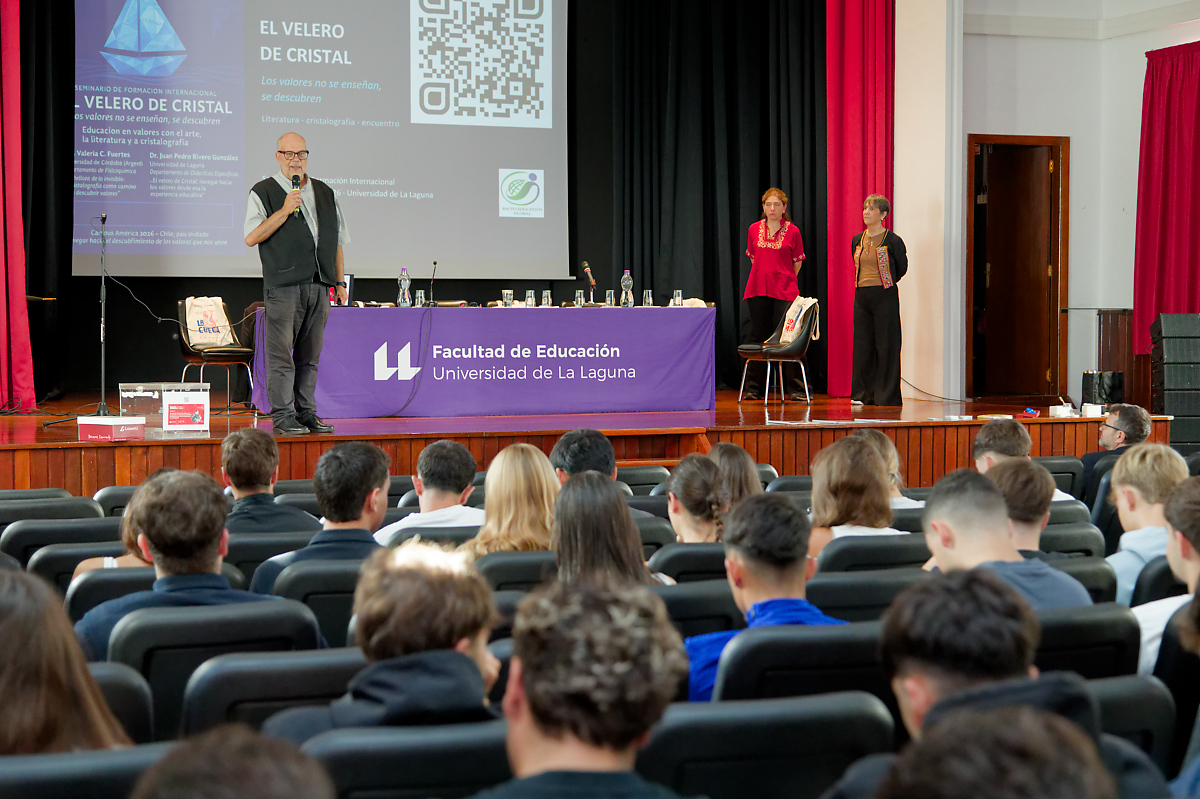
On its fourth day, the fifth edition of Campus América held the seminar "The Glass Sailboat: Values Are Not Taught, They Are Discovered: Values Education Through Art, Literature, and Crystallography," in the Auditorium of Module A at the Faculty of Education. This initiative is coordinated by Juan Pedro Rivero González, professor in the Department of Specific Didactics at the University of La Laguna. It is also promoted by Scholas Cátedras, associated with the Scholas Occurrentes network, an international social and non-denominational organization established by Pope Francis through the University of Meaning, which promotes a global educational pact. The proposal was developed in collaboration with the University of La Laguna and various institutions in Latin America.
The project originated within the academic environment of the University of La Laguna (ULL) and has been implemented in a non-profit school in Buenos Aires, offering an innovative approach to holistic education based on the literary work "The Glass Sailboat" by José Mauro de Vasconcelos. Students participated in creative activities and experiments with crystals, using science and artistic expression as a path that leads teachers and students to discover essential human values.
Presented in a morning session held both in person and online, this interdisciplinary experience links social and experimental sciences, art, and literature, demonstrating that the classroom can be a laboratory for creativity, critical thinking, and openness. Its international dimension reinforces the project's educational value, highlighting how academic cooperation transforms teaching into a genuine path of encounter and human growth.
As a guest speaker, the event featured Professor Valeria Cintia Fuertes, from the Department of Physical Chemistry at the National University of Córdoba (Argentina) and a researcher at the National Scientific and Technical Research Council (CONICET). Fuertes is also a co-leader of the Crystallography Association in Argentina and worldwide. Also present was Ana Niro, director of the Sagrada Familia School in Buenos Aires, where the project was implemented with significant involvement from the teaching staff. The participation of both women, along with Juan Pedro Rivero, provided an opportunity to share the development of the project, from its initial academic collaboration to its practical application in the classroom.
In a subsequent round table discussion, the following professors from the University of La Laguna participated: Humberto Hernández Hernández, retired professor of Spanish Language; Javier Sicilia Rodríguez, professor in the Department of Fine Arts; Sonia Plasencia Carrillo, professor in the Department of Developmental and Educational Psychology; and Juan José Marrero Galván, professor in the Department of Specific Didactics. The objective of this second part was to establish a dialogue from diverse disciplines that would enrich the reception of the project.
To conclude the morning, the students answered a series of questions written on a ballot inside an envelope and placed it in a ballot box, simulating an election. The same envelope containing the ballot, which they had received beforehand, also held a document outlining the basic structure of the roundtable discussion with questions, and they were also able to ask further questions of the teachers who were speaking.
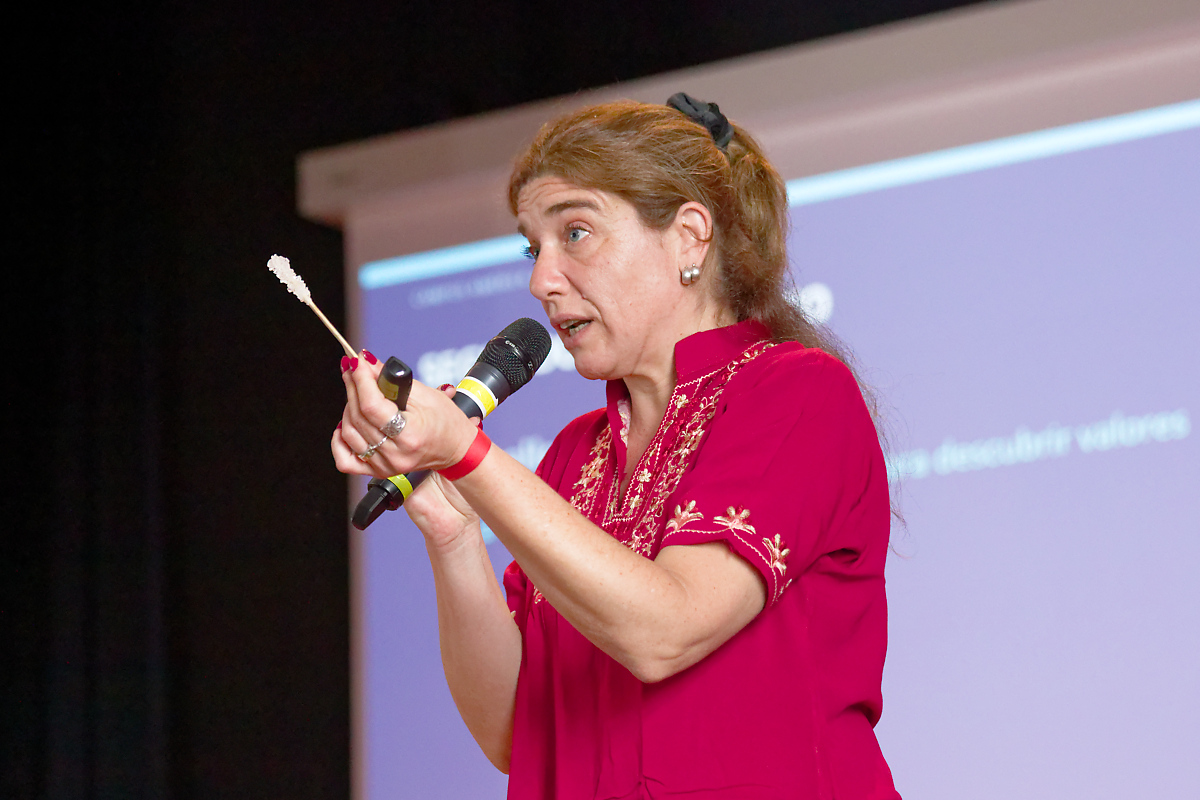
Valeria Cintia Fuertes, from the Department of Physical Chemistry of the National University of Córdoba (Argentina) and researcher of the National Council of Scientific and Technical Research (CONICET).
Project presentation
Juan Pedro Rivero introduced the initiative, a three-year educational project that culminated in a scientific article, currently under review in a Q1 journal. The professor indicated that attendees could view sample materials on the stage in the Auditorium: the teaching guide, some images, a crystal sailboat made using crystallography, crystal growth products, and Vasconcelos's novel itself.
Rivero explained the birth of “The Glass Sailboat”, whose germ was in the Social Sciences Didactics classroom of the Primary degree at the University of La Laguna, in which he himself thought about how to approach the last topic of the subject, dedicated to values, to approach it in a rigorous, scientific and multiplying way.
An initial inspiration was the work of Alfonso López Quintás, Professor of Aesthetics at the Complutense University of Madrid, who developed a card game based on famous paintings from art history. This tool fostered learning about teamwork, creativity, and adherence to the rules of the game. At this point, Scholas was invited to participate, as part of its efforts to implement the Global Compact on Education, and Professor Fuertes also joined the initiative. This interdisciplinary project, born from a culture of encounter, emerged from their dialogue.
Rivero emphasized that the premise of the educational initiative is that values are not taught, they are discovered and need to be experienced. “A theory is not real until it is embodied in a person's life,” he added, indicating that the relationship with objects deepens through encounter, creating a new reality.
In his words, Vasconcelos's novel, which deals with vulnerability, loneliness, imagination, the desire for connection, and an inner life that transcends initial appearances, serves as a tool for learning values through experience. Rivero thus spoke of the pedagogy of discovery, which moves from a concrete reality to a reality of encounter.
Regarding the timeline, it began with implementation in Argentina, with a pilot project presented at a congress in Bucharest in 2024, as an initiative currently underway. In 2025, the nearly completed Rome project was presented, and the final version was showcased in Bali in 2026. Finally, the Scholas Chairs presented it at this year's Campus America conference.
In this initial experience, 700 students and 60 teachers participated in Argentina, and a series of surveys were established for teachers and families at different educational levels, from 3 to 17 years old, to demonstrate the real value of this initiative.
Valeria Cintia Fuertes dedicated her presentation to crystallography as a way to discover values, linked to the Scholas social movement, which has as its idea education without borders, leaving aside differences and valuing encounters, counting on participants from Latin America, Barcelona, Madrid, Miami or Israel.
The professor pointed out that crystals are part of our daily lives, like salt and sugar or cell phones, all made of different crystals. She spoke of the beauty of the visible aspects of crystals, of which we only perceive one form, leading us to wonder if that is the whole of reality or if it is greater, like a geode or all that constitutes it internally, such as atoms, ions, and molecules. In this way, a correlation can be established with the idea that my reality is much deeper than what I can perceive.
This can be linked to education, from the power of the encounter of human nature in projects like this: the relationship between atoms to order themselves in a crystalline structure is compared to the human relationship observing the same process.
Fuertes revealed that this path is built patiently, over days, drawing an analogy to someone not attending a class and learning a topic from beginning to end. This process requires recording changes and reviewing until the final product is achieved, which is more enjoyable and enriching when working as a team, observing the changes, listening to the contributions of other perspectives to help each other, and building together.
Ana Niro presented how to put theory into practice in the classroom. Starting with videoconference meetings, it became a real project implemented to address a problem at the school she leads regarding inclusion, not only for students with disabilities, but also for those from vulnerable backgrounds, with many variables. One teacher came to her concerned about how certain students were being isolated, and they began to explore how to address this at all educational levels, defining how to teach values and foster a deeper interest in student inclusion.
At the La Sagrada Familia educational center, it was applied to the preschool and primary levels, up to 12 years old, trying to transversalize the pedagogical experience in a context of vulnerability, which made it a challenge that had the goodwill of the community and the professionalism of the teaching staff.
Niro outlined the project's progress at this school, which follows an academic calendar in Argentina that runs from February to December. The first month was dedicated to teacher training and establishing general agreements, adapting the project to the different educational levels. During this time, the teachers read the book, drafted the project, and adapted it to the curriculum for that year.
In March, the institutional projects were developed, complementing the possibility of implementing them level by level. In April, these projects were shared with students and their families to secure their commitment, and the first steps were taken. From May to July, the projects were implemented in the classrooms, according to the prescribed content and other variables, integrated into a broader, more comprehensive project.
In August, during the Children's Day celebration, crystal-growing kits were distributed, allowing students to explore buoyancy, light rays, and various scientific concepts. Each student sent photos of their crystal growth at home, showcasing the gifts they received. September saw science-themed celebrations, followed by a science fair in November with over 2,000 attendees. Finally, in December, an evaluation was conducted with teachers, families, and the community. For the teachers, the evaluation was more qualitative and very detailed, focusing on how the students obtained the materials due to limited resources and how they successfully grew the crystals, a process that required several attempts.
As a closing remark to the presentation of “The Glass Sailboat,” Valeria Fuertes reflected on how starting from wonder leads to courage: “Something that catches our attention awakens curiosity, which opens the door to formulating questions, and to answer it, we have to plan an experience; this leads to a situation of human encounter and a shared discovery,” she concluded.

 Spanish
 English
 French