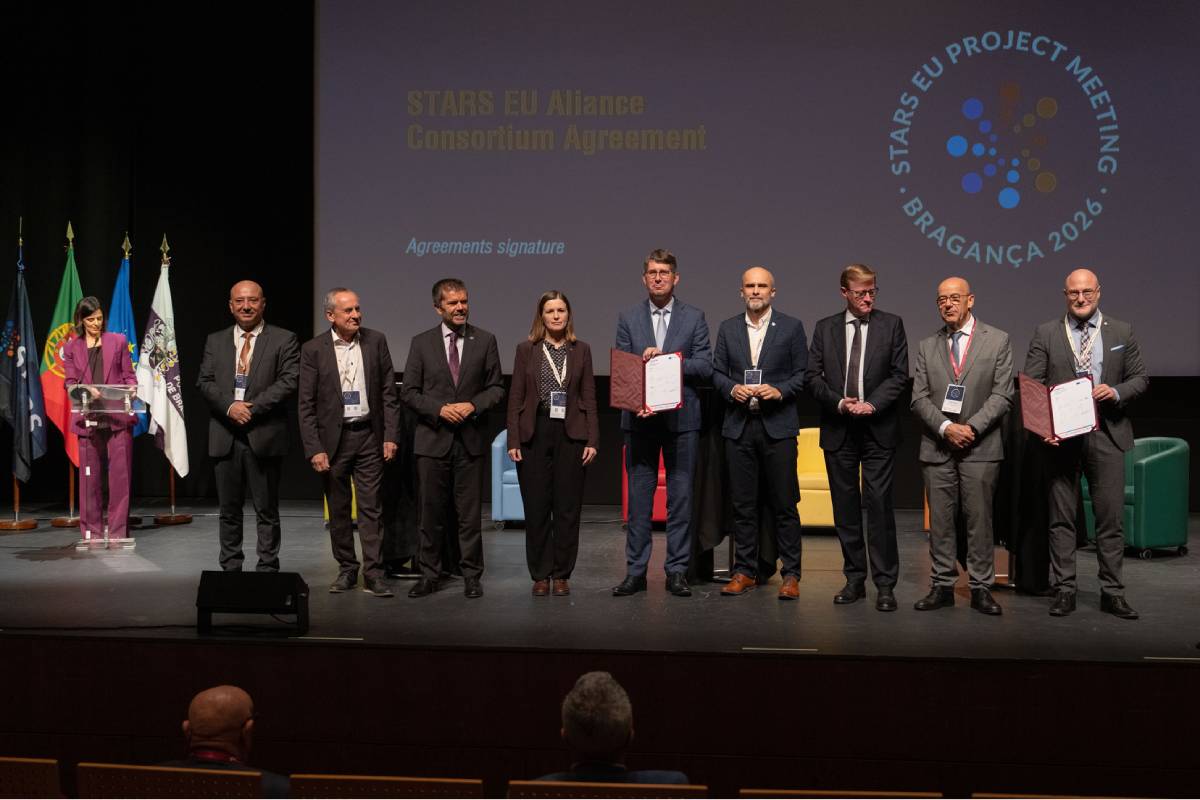
The alliance of European universities STARS EU, to which the University of La Laguna belongs, held one of its annual meetings in the Polytechnic University of Braganza (Portugal). In addition to serving to promote the work of the different working groups involved in this initiative, this meeting has had special relevance because the nine rectors of the associated institutions signed a consortium agreement to strengthen the stability of this association with a plan until 2037.
This meeting was attended by a delegation from the University of La Laguna, headed by its rector, Francisco García, and including the teachers and members of the alliance's management team José Sigut, Ernesto Pereda and Rodrigo Trujillo; the teachers and researchers Benjamín González, Cintia Hernández, Belén San Nicolás, Pearl Michel, Elisa Pérez and Noemí Peña; and the technical staff Carla García, Laura Esquivel, Beatriz Medina and Acaimo González.
The consortium agreement signed at the Braganza meeting regulates the structure of the alliance, the roles within it, its main regulations, financial aspects and also resolves issues related to confidentiality, intellectual property and data protection, in addition to arbitrating a system to settle possible disputes between the associated institutions.
This agreement stems from a five-year Strategic Plan for the alliance, developed by a team coordinated by Professor Ernesto Pereda of the University of La Laguna, with input from both STARS EU members and external experts. The purpose of this long-term planning is to enable the alliance to more effectively fulfill its core mission: accelerating the development of the participating regions through its four core university missions: education, research, innovation, and service to society.
The Strategic Plan is based on five pillars: education for the future, research and innovation, acceleration of development, campus, and sustainable governance. These pillars, in turn, are based on three cross-cutting commitments: education for transformation, research for impact, and cooperation for problem-solving.
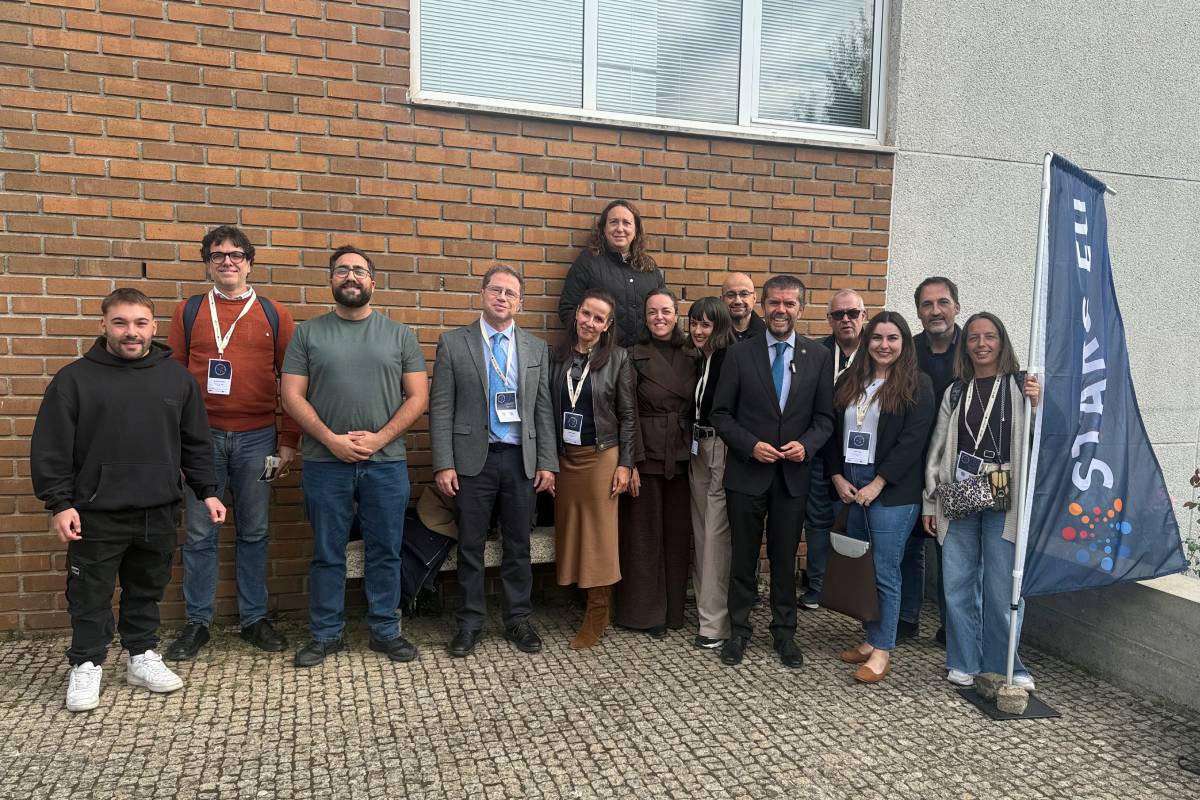
Photograph of the team from the University of La Laguna in Braganza.
One of the measures of the new consortium has been to establish a system for electing the president and vice president of the alliance from among the rectors of the member universities, whose term will last one year. In this first vote, the rector of the Hanze University of Applied Sciences (Netherlands), Dick Pouwels, as president; and the rector of the Silesian University in Opava (Czech Republic), Tomáš Gongol, as vice-president.
One of the strategies being implemented within the alliance is called STARS EU Goes Global, which follows the recommendations of the European Commission to internationalize higher education, attract talent and promote European values through all international initiatives and partnerships in which the alliance is involved.
In that spirit, the agreement was also signed at the meeting whereby the National University of the Black Sea Petro Mohyla (Ukraine) will participate in STARS EU as a Strategic Partner, an agreement signed during the meeting's opening ceremony by its rector, Leonid Pavlovych Klymenko. A particularly moving moment of the event was the screening of a video recounting the difficulties this institution faced during the war, having had to rebuild much of its infrastructure. Currently, it is the only university in the country still operating, thanks to a blended learning model.
The ceremony also served as the setting for a third important signing: the one that launches a double master's degree program agreed upon by three of the partner universities: Polytechnic University of Braganza (Portugal), Marie and Louis Pasteur University (France) and University of the West (Sweden), in Electrical and Computer Engineering, Automation and Robotics and Production Technology.
An assessment was also made of the current state of the alliance, which has been underway since 2021 and was joined by the University of La Laguna a year later. Those initial years of work to design a plurinational university model received a significant boost in 2023, when a four-year project was secured through a funding opportunity. European Universities, which provided it with just over 12 million euros to launch its structure.
The project ends in 2027, at which point an account of the results obtained will have to be given and a renewal of the project requested - although the philosophy of STARS EU is to differentiate the alliance itself from this project of the European Commission, since the express will is to maintain the avenues of collaboration regardless of whether there is a project underway or not.
To date, STARS EU has launched several research projects and published scientific papers. In the field of education, it has implemented 57 Blended Intensive Programs (BIPs), 59 joint microcredentials, and 12 undergraduate and master's degree programs across various partner universities. All of this has contributed to a positive rating in the midterm review conducted by European authorities on the ongoing project.

 Spanish
 English
 French