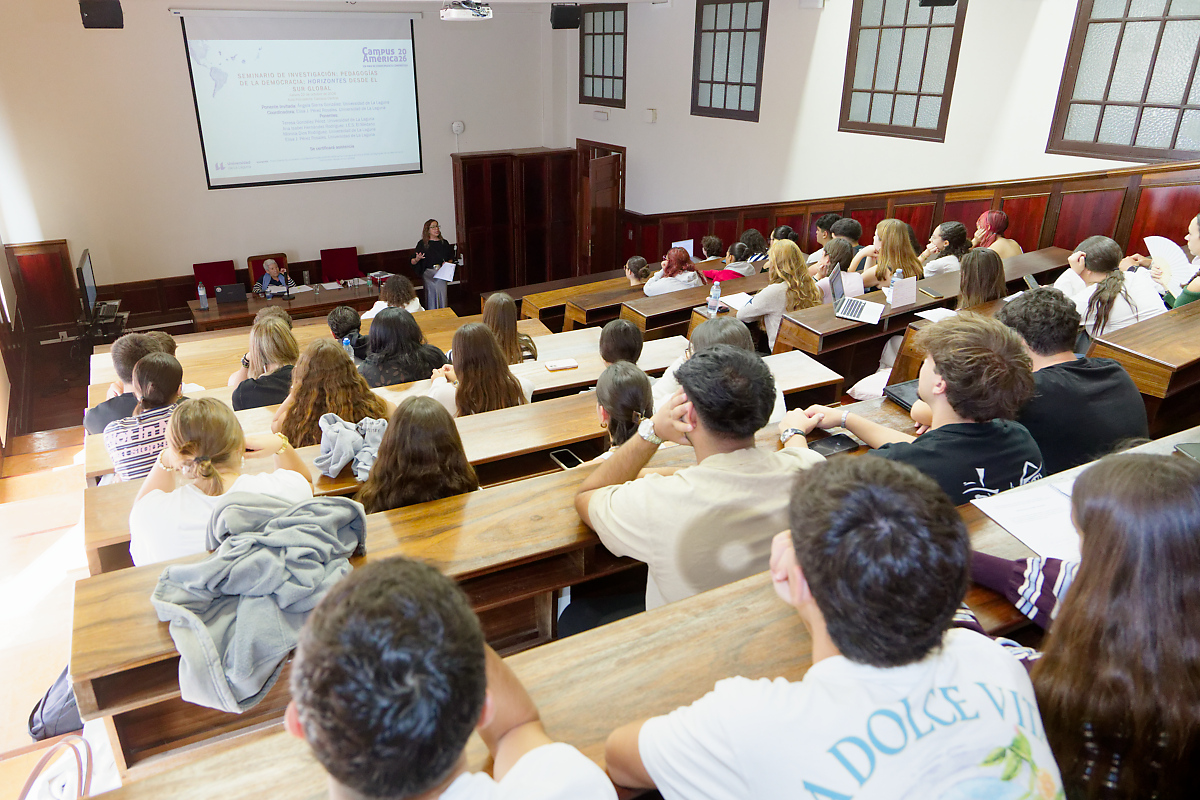
The relationship between education, civic participation, and democracy was the focus of the seminar "Pedagogies of Democracy: Horizons from the Global South," held today, October 22, in the Central Building of the University of La Laguna. The event, part of the Campus America program, explored how gender, territory, and resistance practices influence democratic processes, with particular attention to contexts marked by inequality and exclusion.
Organized by the NEXUS-ULL Research Group, coordinated by Elisa Pérez Rosales, the meeting provided a space for critical reflection and interdisciplinary dialogue on the relationship between education and democracy. Using a conversational methodology and a hybrid format, the event focused on the collective construction of knowledge and the recognition of experiences from the Global South as central to the discussion.
In her opening remarks, Elisa Pérez Rosales explained that the focus on the Global South stems from the need to understand education and democracy within the historical context of each territory, shaped by inequality, coloniality, exclusion, and patriarchy. The coordinator highlighted the pedagogical experiences developed in communities, including Indigenous ones, that challenge hegemonic models. "The aim is to broaden horizons for thinking about new ways of learning, teaching, and even living together," she noted.
The seminar examined how power relations, participation, and the recognition of diverse forms of knowledge in educational spaces influence the construction of democracy. From this perspective, democratic education implies giving voice and decision-making power to learners, while a more democratic society must guarantee equal access to knowledge and participation in its production. This connection served to examine who participates in learning processes, what knowledge is recognized, and how the conditions of each territory influence these processes. "We must focus on how gender, territory, and resistance change, modify, transform, and construct democratic processes themselves," the coordinator pointed out. From this perspective, the proposal questioned the hierarchical transmission of knowledge and highlighted the contributions of those who are usually excluded from academic spaces.
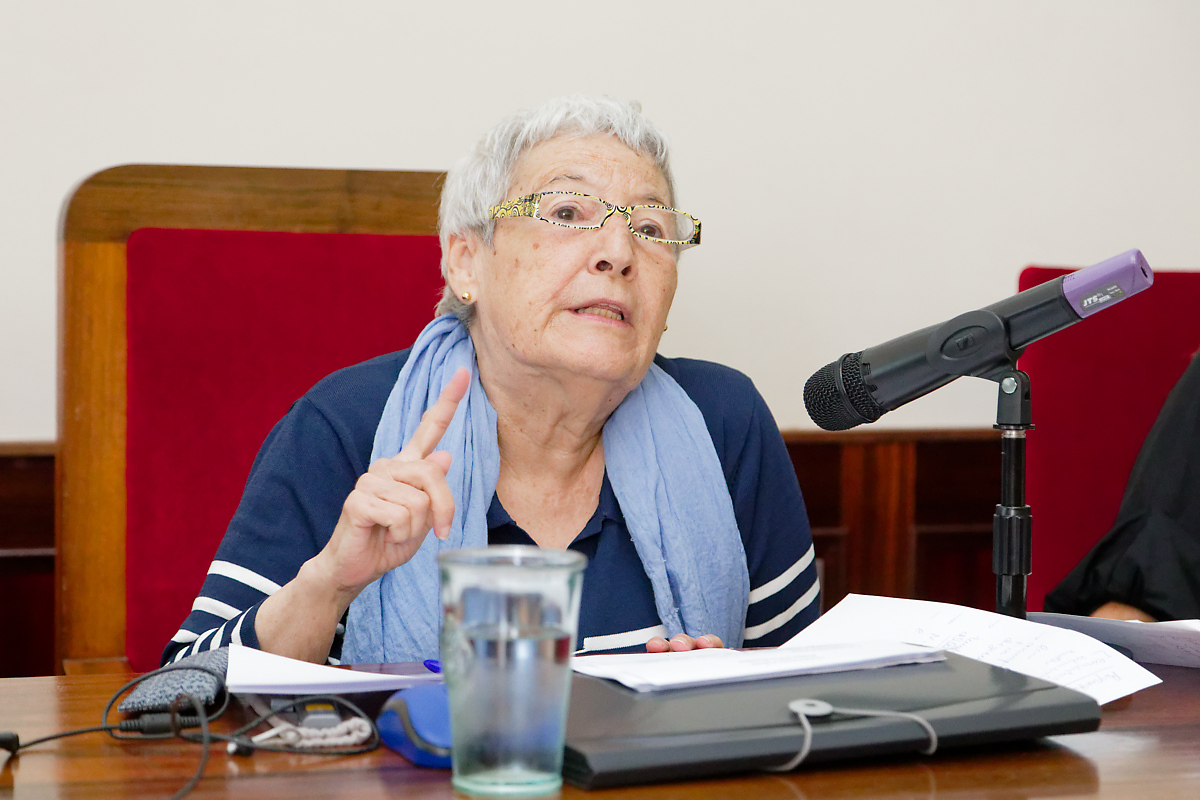
Angela Sierra Gonzalez.
The program featured Ángela Sierra González as a guest lecturer, whose presentation addressed popular and community education as a form of resistance against hegemonic models. The philosopher, former dean of the Faculty of Philosophy at the University of La Laguna (ULL) and a specialist in gender studies and Latin American thought, presented popular education as a source of emancipatory pedagogical ideas that have informed other critical currents. "Popular education is in itself a source of emancipatory pedagogical ideas," stated Sierra, who in her speech linked this pedagogical approach to building equal access to knowledge and to individual and community empowerment. The professor positioned dialogue as one of the fundamental commitments to democracy, defending the capacity for dialogue between the various majorities and minorities in a society as a condition for democratic coexistence. She also pointed out that incorporating horizontal dialogue into educational practices involves reviewing who has the authority to produce discourse, what knowledge is recognized, and how shared decisions are constructed. Thus, Sierra continued, «popular education questions the power relations that position students as passive recipients of content and proposes recognizing them as active participants in the construction of knowledge and democratic life.».
Next, Teresa González Pérez addressed education in contexts of inequality, exclusion, and conflict, while Ana Isabel Hernández Rodríguez focused her contribution on interculturality and ancestral knowledge, from a critical perspective on the dominant ways of producing and recognizing knowledge.
For her part, Mónica Dios Rodríguez addressed education as political action and democratic horizons from a local perspective. Her presentation focused on the relationship between educational practices and community life, an area from which to examine how people learn to participate, deliberate on common issues, and intervene in collective decisions. This perspective allows us to consider democracy as an everyday practice that is also built in classrooms and in spaces of community life.
To close the day, Elisa Pérez Rosales dedicated her presentation to intersectional pedagogies and how gender, territory, and resistance converge in democratic processes. These perspectives have made it possible to connect educational practices with the identities, living conditions, and forms of participation of each community.
Education and participation in the face of reactionary discourses
The questioning of democracy and the rise of reactionary rhetoric also featured prominently in the meeting. Pérez Rosales warned that "many reactionary discourses call into question the legitimacy of democracy" and stressed the need to analyze these trends from the diverse perspectives of Europe and Latin America.
«These spaces for reflection are necessary right now, more necessary than ever,» the coordinator stated. In this regard, she advocated for the exchange of ideas and approaches to contribute to democratic, egalitarian, fair, and equitable public policies. Academic cooperation has also been presented as a crucial avenue for sharing knowledge and addressing common problems affecting different regions.
The seminar has been integrated into the fifth edition of Campus America, with Chile as the guest country and the motto "A sea of shared knowledge".

 Spanish
 English
 French