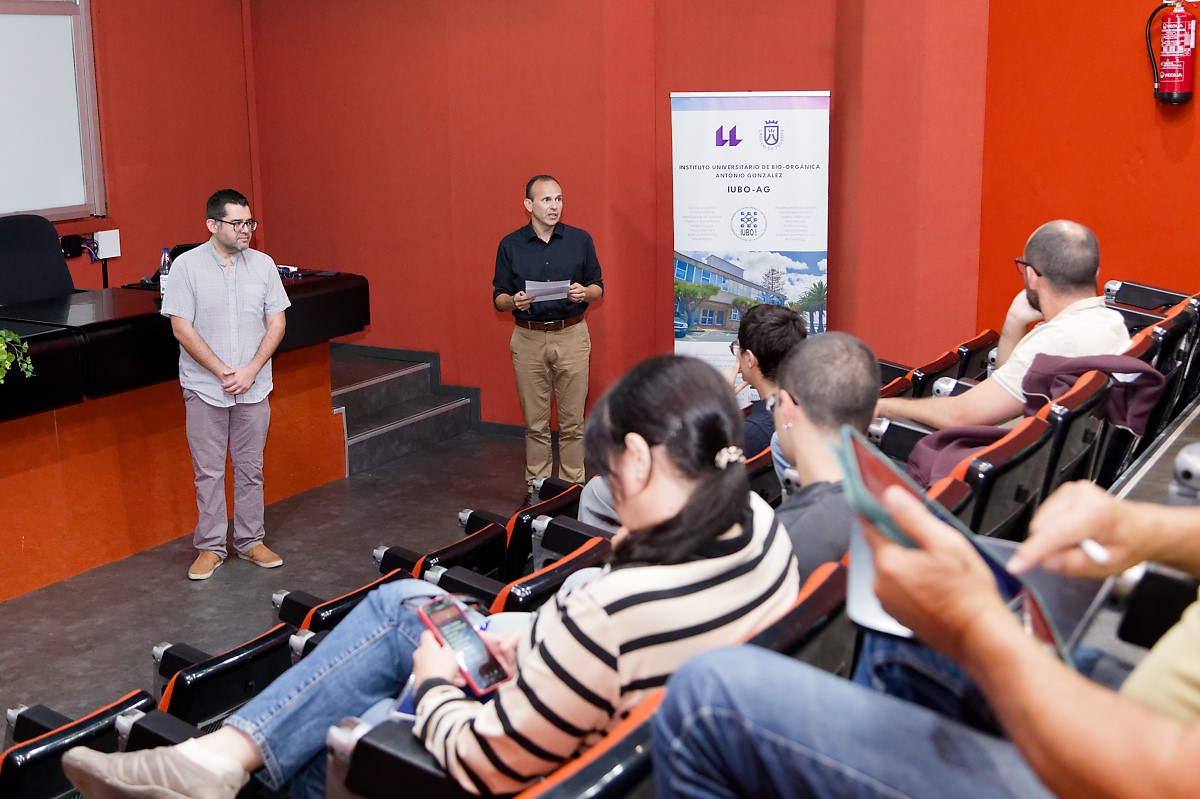
The Antonio González University Institute of Bio-Organic Chemistry at the University of La Laguna hosted the opening of the seminar "Innovation in Sustainable Polymeric Materials for Technological Applications" today, October 26, as part of Campus America 2026. The session presented research developed in Chile that seeks to address environmental and production challenges through the use of materials capable of retaining pollutants, capturing fog water, or utilizing agro-industrial waste.
The meeting featured César Saldías, an academic from the Department of Physical Chemistry at the Pontifical Catholic University of Chile, and David Díaz, Professor of Organic Chemistry at the University of La Laguna (ULL), who introduced the event. The seminar will continue until tomorrow, October 27, with two sessions dedicated to exploring materials with environmental, agricultural, and industrial applications.
The conference began by exploring Chile's diverse geography and production systems to present the problems that motivate this research, including water scarcity and quality, mining activity, the generation of agro-industrial waste, and the use of forest biomass. It then showcased various possibilities for transforming available resources into materials with specific functions that meet the needs of the region.
In his presentation, Saldías addressed the evolution of the relationship between universities and the Chilean productive sector. Following the efforts dedicated to protecting research results through patents, he identified the current challenge as ensuring that this knowledge reaches industry and meets the country's needs. "Universities are now engaging in more dialogue and trying to transfer knowledge to industry," he noted. He then explained how the selection of components and their structural organization allow for the design of materials for specific functions, such as retaining contaminants or capturing water, resulting in films, hydrogels, or nanofiber networks with different properties and applications.
Saldías also presented research on films and membranes for desalination applications. Examples included materials designed to retain molecules or contaminants and nanofibers for collecting fog water. The conference also covered systems that respond to light through optical or thermal changes, as well as research on transparent wood and photoactive materials.
Utilization of agricultural and industrial by-products
Another topic discussed was the utilization of by-products, specifically the possibilities of using residual glycerol to produce polyhydroxyalkanoates, a family of polyesters known as PHAs, focusing on how production conditions influence the molecular characteristics of the material obtained.
The conference then shifted its focus to specific sectoral problems. For example, in the wine industry, researchers are studying cellulosic-based materials and modified surfaces to control sulfur compounds without indiscriminately removing other useful components of the wine. In the agro-industrial sector, studies were presented on utilizing potato and lemon peels in agricultural applications. Initial trials with potato peel extracts on strawberry plants yielded promising results, and research with lemon peels demonstrates their potential effectiveness against the fungus Botrytis cinerea. The use of pig hair to obtain microfibers for incorporation into concrete was also discussed, although this application still requires experimental validation.
Evaluate the effectiveness and environmental impact of new materials
The session underscored the importance of distinguishing between a scientific possibility and a validated application. As explained in the presentation, designing a material with promising properties is only a first step that must be accompanied by measurements and tests under optimal conditions for its intended use. This criterion extends to sustainability, since the natural or residual origin of a raw material does not, in itself, guarantee a lower environmental impact. Its evaluation must consider the material's usefulness, durability, production conditions, and its final destination.
The conference concluded by highlighting the collaborative nature of this research and the contribution of interdisciplinary collaboration between universities and productive sectors. Ultimately, the seminar allowed researchers from the University of La Laguna (ULL) and the Pontifical Catholic University of Chile to exchange findings on materials design and waste utilization within the framework of this fifth edition of Campus América, which features Chile as the guest country.

 Spanish
 English
 French