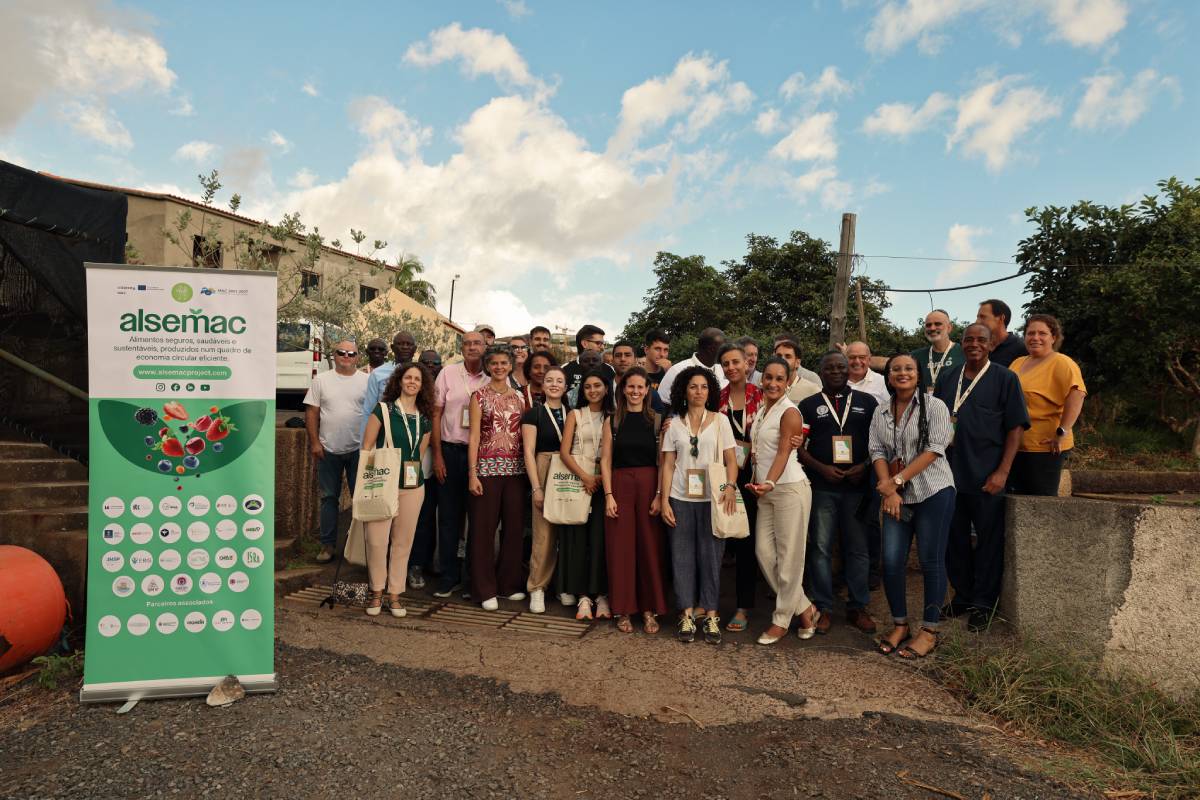
The first results of the international research project ALSEMAC They begin to see the light, thanks to the annual meeting The project partners held a meeting in early October. This scientific initiative focuses on the responsible production and consumption of safe, healthy, and sustainable (triple-S) food within a circular economy framework. It is co-financed by the European Regional Development Fund (ERDF) through the Interreg VI-D Madeira-Azores-Canary Islands (MAC) 2021-2027 Programme.
The meeting in Madeira brought together universities, research centers, public administrations, agricultural sector organizations, and social entities from Macaronesia and West Africa. It served to share progress in ALSEMAC's three main areas: food safety and composition analysis, the development of more sustainable agricultural practices, and the study of public perception. It also allowed for the comparison of methodologies and the coordination of the next phase of work in Macaronesia and West Africa.
Food safety and composition
One of the main highlights of the event was the results of the analysis of hundreds of samples of plant and animal-based foods marketed in the Canary Islands and Madeira, which did not show levels above those established for contaminants or pesticides.
However, the results indicate the need to continue monitoring exposure in certain foods and population groups. To this end, the project has adapted and validated specific methodologies to analyze this type of food.
A preliminary characterization of rare earth elements in foods of animal origin was also presented. This is still an initial approach that needs to be supplemented with a larger number of samples before a comprehensive assessment of exposure and potential risk can be carried out.
Sampling efforts are also being extended to Cape Verde, Senegal, Ghana, and Ivory Coast. In these countries, partner organizations are making progress in collecting samples of plant- and animal-based foods, including dairy products, and preparing them for subsequent analysis.
Citizen perception and communication of food security
The sessions also served to share the results of food risk perception surveys conducted in the Canary Islands, Madeira, the Azores, Cape Verde, and Ivory Coast. The 2,706 responses collected allow for cross-referencing information between people's food choices, risk perception, and the information ecosystem, identifying existing gaps between public concern and the information they receive.
This line of research has already led to a first article scientific study on urban consumers in Ivory Coast.
Sustainable production, biological control and waste utilization
Trials of alternatives to reduce the use of pesticides were also featured in Madeira. Work was showcased on monitoring pests that affect certain foods, as well as a study on transforming agricultural waste and other local organic materials into biochar, compost, bokashi, and vermicompost. These products are being tested on specific crops, while training activities and field trials with different fertilization strategies are also underway.
ULL participation
The Canary Islands have an important role in this initiative, which involves the University of La Laguna, the Technological Institute of the Canary Islands, the Institute of Natural Products and Agrobiology of the Higher Center for Scientific Research (IPNA-CSIC), the University of Las Palmas de Gran Canaria, the Canary Institute of Agricultural Research (ICIA), Canary Islands Bananas (ASPROCAN), and the Cabildo of Gran Canaria through the Department of Primary Sector, Food Sovereignty and Water Security.
In the specific case of the University of La Laguna, five researchers participated in the meeting, three of whom presented papers: Ángel José Gutiérrez Fernández, who is the principal investigator of the project, and Javier Darias Rosales, both from the Toxicology Area; Barbara Socas Rodriguez (Analytical Chemistry); and Jesús Santiago Notario del Pino y Ainoa de León Adrián (Edaphology).
In the Azores, the project is being carried out in partnership with the University of the Azores and the Gaspar Frutuoso Foundation. Madeira is represented through the Regional Secretariat of Agriculture and Fisheries of the Regional Government.

 Spanish
 English
 French