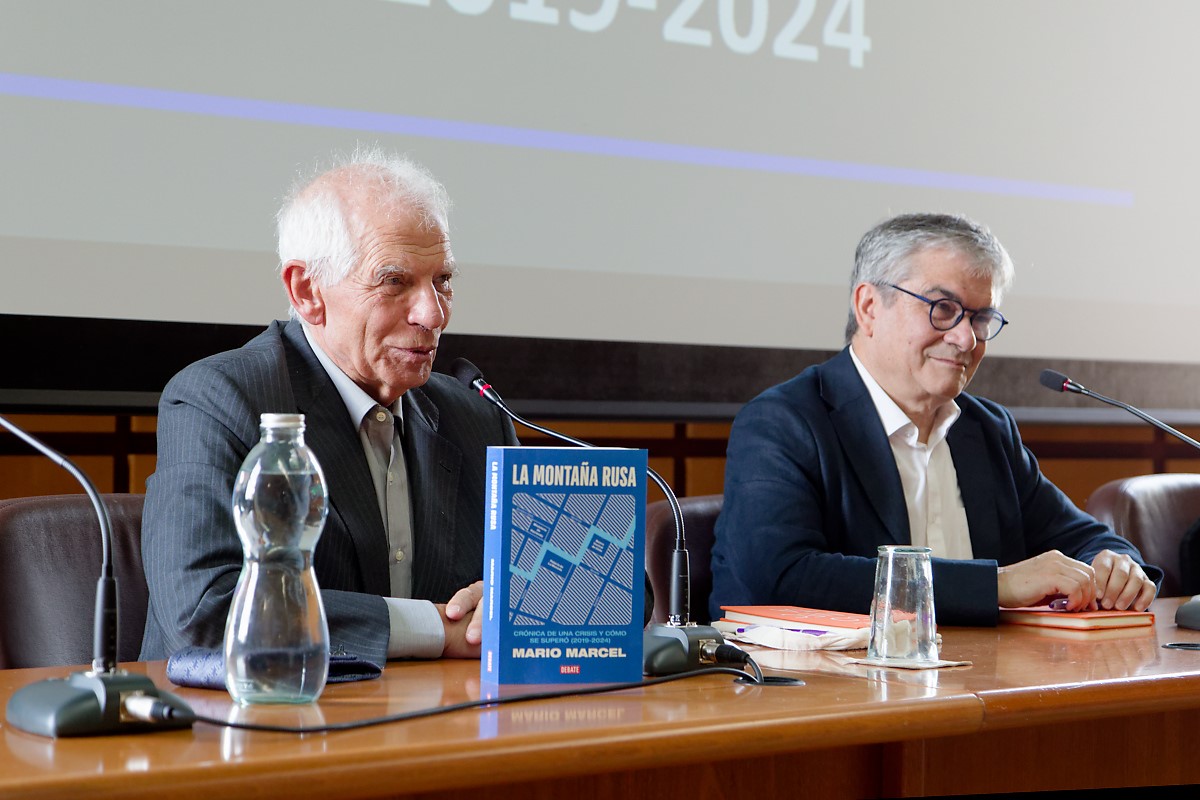
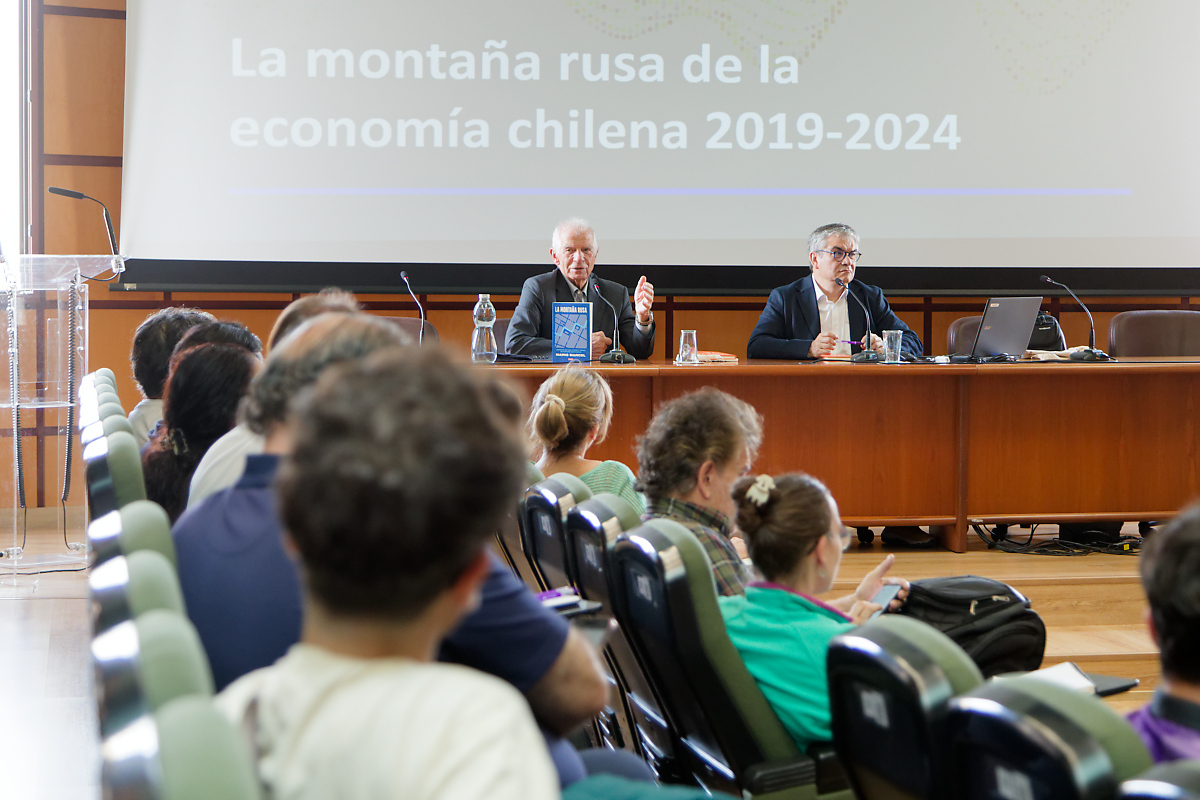
The professor Mario Marcel, The former Minister of Finance under Gabriel Borich, and also Governor of the Bank of Chile, presented his book 'The Roller Coaster of the Chilean Economy, 2019-2024' today, October 27th, at the University of La Laguna, as part of Campus América. The book features a foreword by the former High Representative of the Union for Foreign Affairs and Security Policy. Josep Borrell. “He was excellent at both places,” the latter noted about the first, and recalled that he was named banker of the year by his colleagues.
In this volume, Marcel recounts his experience in the turbulent years of Chile, when in 2019 a popular explosion was brutally repressed, and which led to an election that brought Gabriel Borich to the Palacio de la Moneda, at only 39 years old.
“Today, Chile is governed by the far right; I had the opportunity to write the prologue to this book, which traces that rollercoaster ride through various crises, trying to draw a parallel with Spain. The truth is that the economy has not been able to respond to social demands, and that happens in every country,” the author of the prologue stated at the Faculty of Economics, Business, and Tourism.
“I started this book the day after leaving the government and didn’t stop until six months later,” explained Mario Marcel, who recalled that Chile, since regaining democracy in 1990, experienced a period of growth for more than fifteen years, with its GDP tripling, such that the incidence of poverty was reduced from 40 to 151%. But from 2019 onward, everything changed, and the country would face the greatest economic challenges in several generations.
<
The former Chilean minister stated that Latin America is the most unequal region in the world, and this pattern is repeated within the country itself. The middle class had expectations of advancement, but the fear of debt was growing. From 2019 to 2024, several historical extremes occurred, marked by significant economic turbulence, but fundamentally stemming from three key events: the social uprising (October 2019), the Covid-19 pandemic (March 2020), and the populist spiral (August 2020).
The extremely serious riots of 2019 resulted in the looting of more than 200 supermarkets, the burning of 20 subway stations, the closure of businesses, and widespread social unrest. All of this brought the economy to a standstill, triggering panic in the financial markets. Just a few months later, in 2020, the pandemic crisis hit, and Chile lost almost two million jobs, the author recalled. In August of that year, workers were allowed to withdraw up to 20% of their pension funds, a decision that was repeated twice more the following year. Mario Marcel explained that these measures were adopted by Parliament, overriding the opinion of the central government.
This meant that a large part of the population received more income than they were losing, which boosted consumption. As a result of these massive subsidies, a huge imbalance arose in the balance of payments, an issue that the Borich government had to address upon taking office. The speaker noted that these three milestones were met with macroeconomic policies, many of them unprecedented.
The Chilean economy was successfully brought back to its previous absolute levels of activity, and even reached the economic levels that the trend would have indicated had these events not occurred. On balance, the Chilean economy grew more than the Latin American average between 2022 and 2025. “This suggests that the effort made to contain the crisis was worthwhile.”.
The speaker shared some lessons learned on all of this. Crises happen and often have an unexpected origin, and they usually have financial consequences, even if they didn't originate in the markets. He also indicated that it's important to distinguish between the temporary and permanent elements of a shock, as well as the importance of responding quickly with real-time data.
The professor emphasized the importance of positively surprising the markets, given the risk of falling short. In this context, the coordination of fiscal and monetary policy is crucial, and it's also important to consider that high volatility creates a changing environment that makes projections difficult.
When asked about foreign trade, Marcel maintained that copper and lithium play a very significant role, with substantial mining exports. China is the main trading partner, followed by the United States, two trading partners currently at odds with each other. “We shouldn't align ourselves with either of these competing economies, but rather with others more similar to our own,” he suggested.
However, it wasn't the economy that caused the country to shift to the right, but rather the perception of insecurity. “People voted for parties that presented themselves as being tough on combating violence. Although Borich's government confronted organized crime, the public perception was different, compounded by the influx of migrants from Haiti, Colombia, and, of course, Venezuela. Once again, right-wing parties showed themselves to be clearly hostile to immigration.”.
In just eight months, it has become clear that the current government lacked a genuine agenda on the issues that brought it to power. Therefore, “there was great disappointment regarding public security policies, in addition to the current economic downturn,” he concluded.

 Spanish
 English
 French