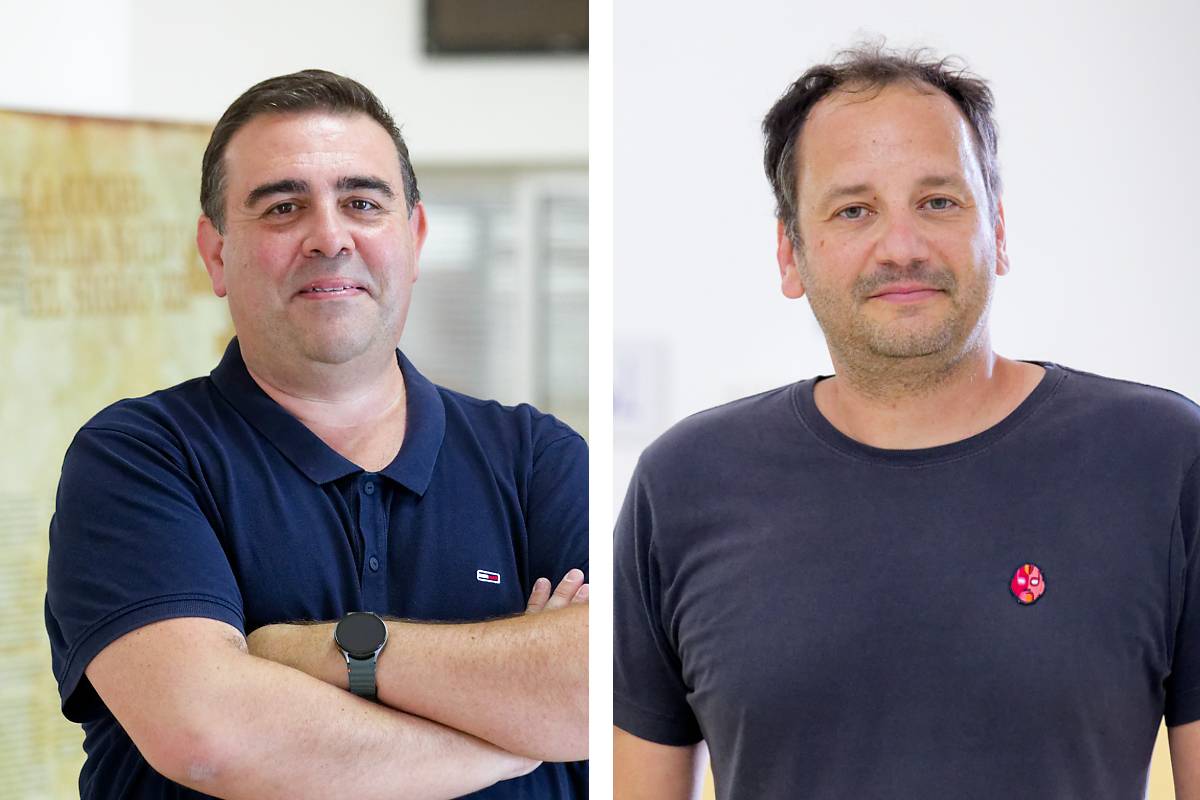
Last Friday, October 23, the creation of two was formalized before a notary. spin-offs recently approved by the Governing Council of the University of La Laguna: TENET LightKey, promoted by the Professor of Physics Jorge Méndez, and Robotserv, promoted by the professor of Computer and Systems Engineering Jonay Tomás Toledo. With this procedure, the process of establishing these technology-based companies born within the academic institution in 2026 concludes.
TENET LightKey relies on an innovative technology based on luminescent materials that allows for product authentication through an invisible light signature. This solution can be applied to a wide variety of materials and surfaces, from offset printing to glass, ceramic, plastic, or resin, without altering their appearance or leaving any visible trace. In this way, it offers a tool for protection against counterfeiting without modifying the product's aesthetic characteristics.
This light key can be customized for each material, creating a unique and extremely difficult-to-reproduce identity. When illuminated with a small, low-cost infrared device, the material emits a coded light signal that can be detected by specialized reading equipment. The system thus functions as an invisible optical barcode, capable of verifying the product's authenticity.
One of TENET LightKey's key differentiators is its high level of security. The technology allows for increased signal encoding capabilities compared to other commercially available light-based security dyes, thus strengthening the identification and authentication capabilities of protected products.
TENET LightKey's technology is the result of 25 years of research in photonics and nanotechnology, during which the team has worked on developing luminescent materials based on rare earth elements, initially focused on renewable energy applications and, more recently, on advanced security and authentication solutions. With the creation of the spin-off company TENET LightKey, its researchers are taking another step toward transferring this knowledge to the market, aiming to promote its application in strategic sectors.
For its part, the spin-off Robotserv focuses its activity on the development of autonomous mobile robots capable of performing repetitive agricultural tasks, such as weed removal using mechanical or laser methods, as well as the preventative application of plant protection products. This technology aims to facilitate and automate certain agricultural tasks in traditional crops of the islands, through robotic solutions adapted to the specific conditions of farms in the Canary Islands. With this initiative, Robotserv aspires to contribute to reducing the use of plant protection products in certain crops and improving workplace safety by minimizing workers' exposure to hazardous situations.
Robotserv's technological development relies on reducing the costs of sensors and actuators, as well as on advances in artificial intelligence, especially in algorithms based on neural networks. The combination of these advances facilitates the integration of advanced capabilities into robots that can adapt to changing work environments and respond to the needs of agricultural operations. Thanks to these technologies, robotic systems can identify fruit, detect potential crop diseases, and autonomously perform tasks related to agricultural treatment and processing.
Robotserv's initiative aims to transfer its years of experience developing autonomous mobile robots for various applications to the agricultural sector. While banana cultivation is its primary initial market, the company plans to extend this technology to other strategic crops in the Canary Islands, such as vineyards and avocado orchards. In this way, the company is committed to automation as a tool for advancing towards more efficient agriculture, better adapted to the needs of the region. This strategy will allow robotic solutions to be tailored to the specific requirements of different crops across the archipelago, expanding their potential applications in the primary sector.
Knowledge-based enterprises (KBEs) or spin-offs They constitute one of the fundamental instruments for transferring university research to society. Through these business initiatives, the scientific and technological advances generated in research groups can be transformed into products, services, or solutions with practical applications and potential economic and social impact. TENET LightKey and Robotserv thus join the spin-offs already established at the University of La Laguna Wooptix, Formaché, Kaizten Analytics, EnergyRIS, and BIOGAS. Additionally, another company spin-off The area designated ZONE 1 is currently completing its processing.

 Spanish
 English
 French