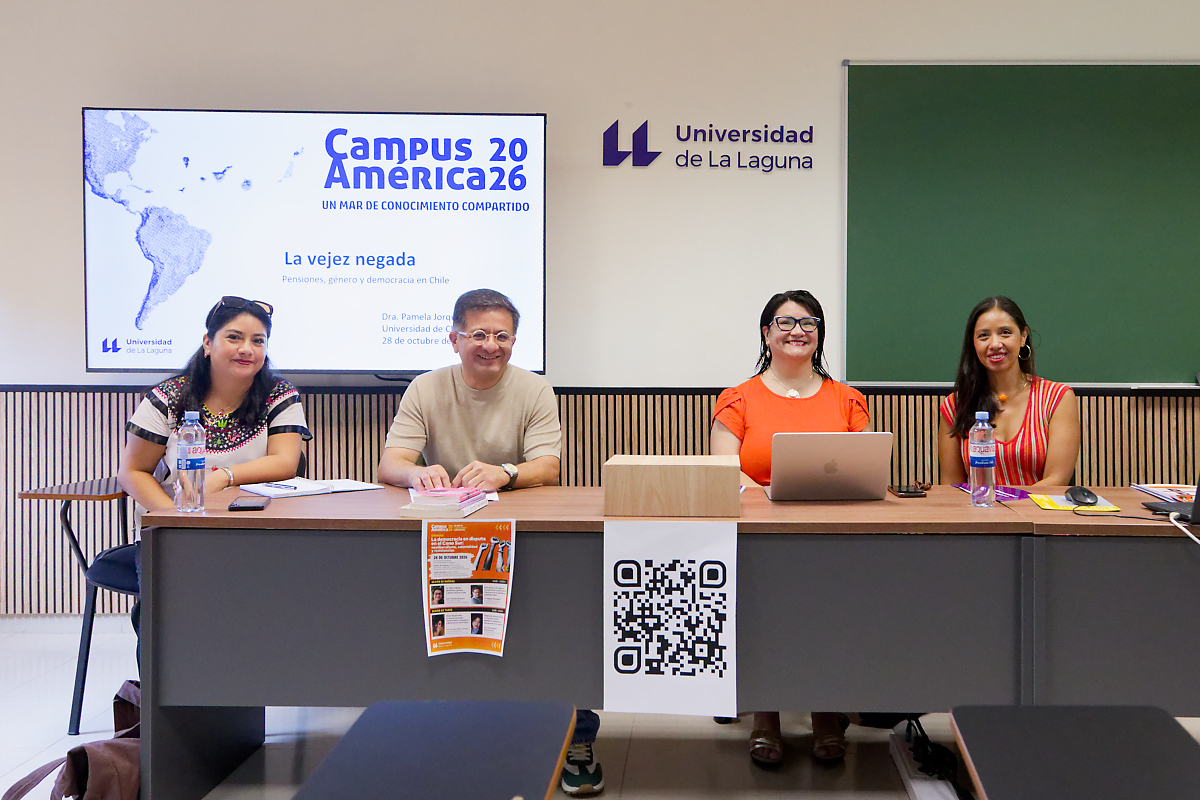
The University of La Laguna hosted the seminar "Democracy in Dispute in the Southern Cone: Neoliberalism, Coloniality, and Resistance" today, October 28th. The seminar was a day of reflection on the political and economic transformations in Latin America and their effects on the lives of its people. The event paid particular attention to the situation in Chile, from the implementation of neoliberalism during the dictatorship to the social mobilizations and constitutional processes of recent years.
Coordinated by Professor Silvia Zelaya Álvarez of the Interdisciplinary Group for Social and Political Research at the University of La Laguna, the seminar brought together specialists from Chilean and Spanish universities to address issues such as pensions, debt, extractivism, and the rights of indigenous peoples. The event took place in two sessions, one in the morning and one in the afternoon, in the Philosophy Department of the Faculty of Humanities.
The seminar focused on Latin American thought regarding the democratic crisis affecting various regions. Chile served as a starting point for examining the relationships between the economic model, social inequalities, and the possibilities for political participation. Responses to these problems that have emerged from different movements and communities were also addressed.
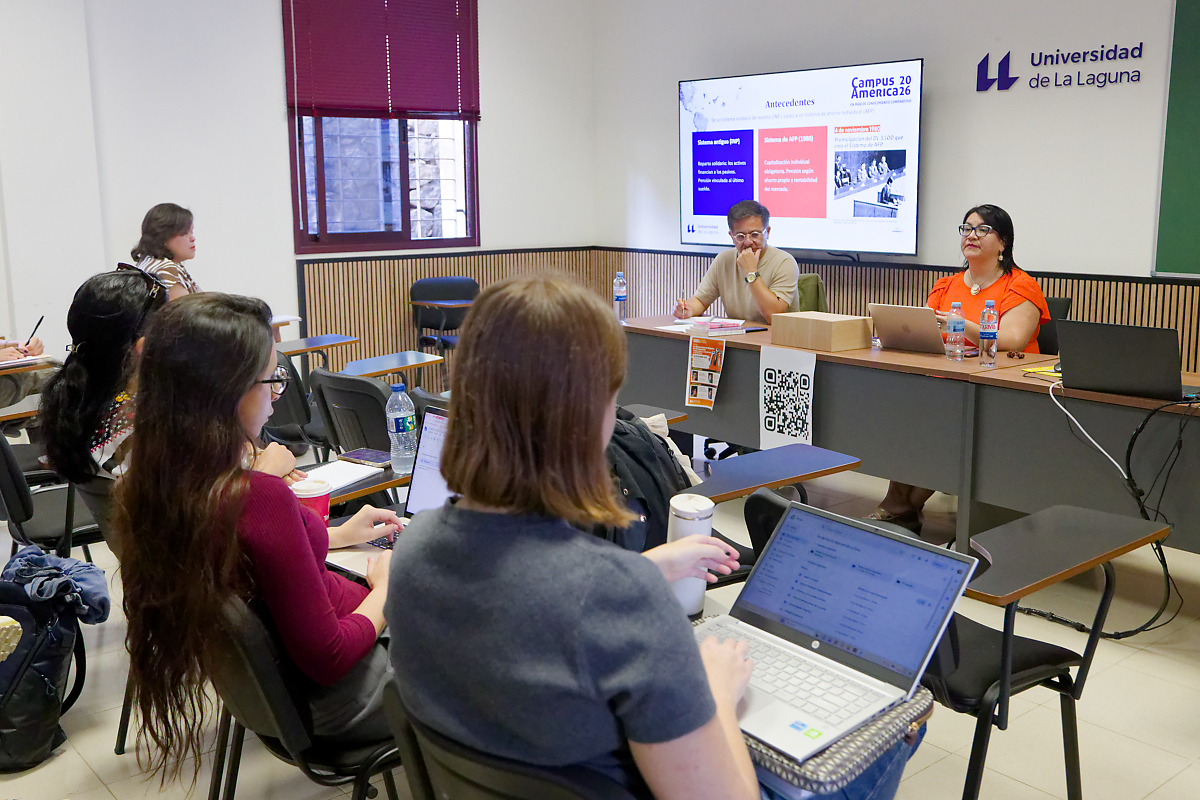
The day began with the lecture "Denied Old Age: Pensions, Gender, and Democracy in Chile," presented by Pamela Jorquera, an anthropologist from the University of Chile. Her presentation examined the consequences of the Chilean pension system based on individual capitalization and its unequal impact on women and the working class. Her analysis revealed how inequality linked to the organization of the system can come to be perceived as a natural condition of old age.
Specifically, Jorquera presented her research with a group of retired teachers from Santiago, highlighting that their years of work, education, and caregiving have not guaranteed them a dignified old age. She linked this situation to the shift in social security from collective bargaining and public services toward individual savings and the imposition of market forces. She then reflected on the gap between recognizing the political causes of precariousness and the capacity to transform them collectively. "Habitus changes more slowly than political consciousness," she noted, explaining how dispositions internalized over decades condition the retirees' responses to the inadequacy of their pensions.
Next, Miguel Mandujano Estrada, PhD, a tenured lecturer in Moral Philosophy at the Department of History and Philosophy of Science, Education, and Language at the University of La Laguna, presented his paper, "On Debt and War: Financial Extractivism and Authoritarianism in Contemporary Capitalism." In his presentation, he addressed a view of debt as an instrument of political control and linked financial dynamics to the transformations of neoliberalism and its effects on democracy. He also pointed out that precariousness and indebtedness compromise both living conditions and the capacity to organize collective responses. "What the crisis generates are the conditions for survival, the conditions for reproducing struggles," he stated. From this perspective, he connected the pursuit of small returns on financial platforms, the extension of working life, and private pension funds with an individual management of uncertainty that demands dedicating ever-increasing time and resources to securing the future.
 Territories, extractivism and resistance
The afternoon session focused on territorial conflicts and community responses. Carolina Meloni González, from the University of Alcalá, presented her lecture, "Desire for a Future in Southern Lands: Extractivism, Colonialism, and Sacrificial Democracies." Her presentation centered on so-called "sacrifice zones" to reflect on the consequences of extractive policies and the forms of resistance that arise in response.
The day continued with Celia Ramírez Santos, from the Complutense University of Madrid, and her presentation, «Indigenism of Yesterday and Today: A Case of Epistemic Justice.» Using the play “La perra cimarrona” (The Wild Dog) as a starting point, she offered a reflection on the transformations of Latin American indigenism and the right of peoples to recover and interpret their own history.
This seminar has presented an analysis of Latin American experiences, offering perspectives for reflecting on problems also present in the Canary Islands, such as wealth distribution, the capacity of communities to participate in decisions affecting their territories, and the economic interests that shape their ways of life. The dialogue has also included the relationship with the aboriginal past and questions about who constructs historical narratives, whose voices are excluded, and how these interpretations influence the identity of contemporary societies.
Similarly, the focus has been on South-South dialogue and knowledge production from Latin America. This perspective is part of the work developed by the coordinating research group and has found in Campus América a space to connect its questions with those of specialists from both sides of the Atlantic. The activity has been integrated into the fifth edition of the event, which has Chile as its guest country.

 Spanish
 English
 French