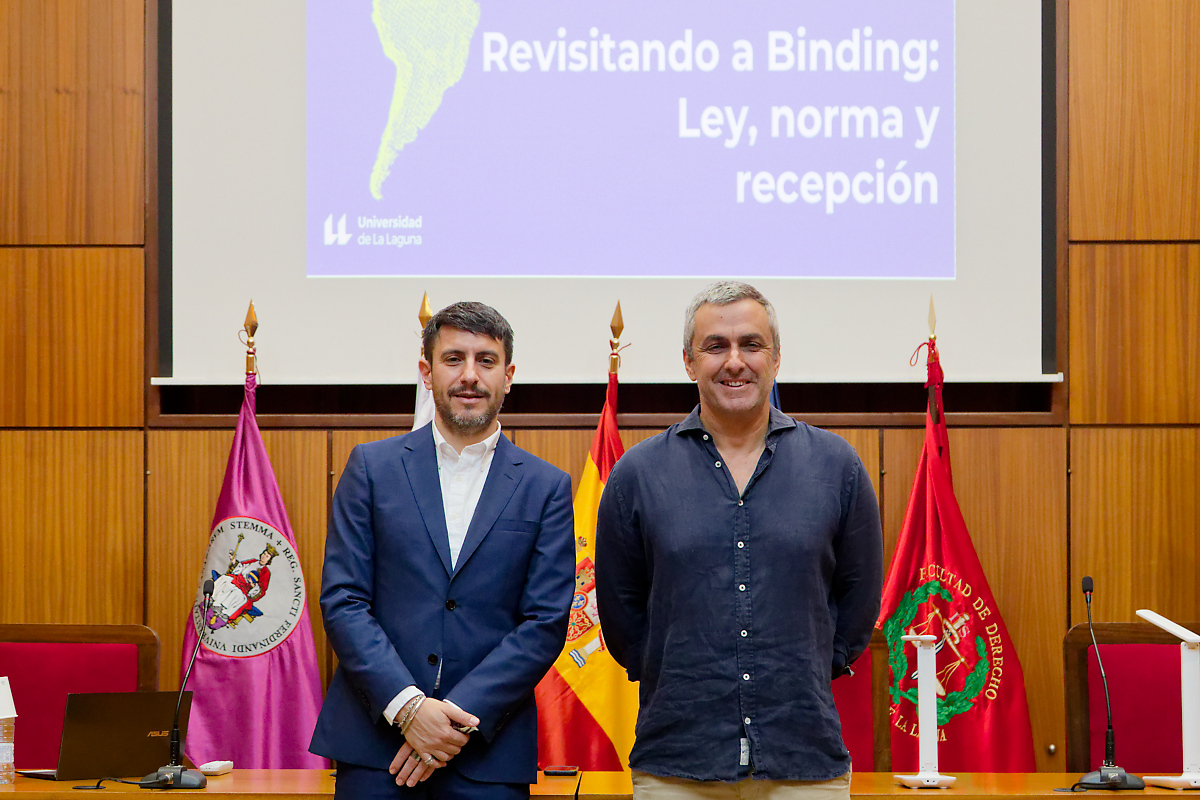
The Professor of Criminal Law at the University of Laguna Fernando Guanarteme Sánchez Lázaro He directed the Campus America seminar "Democracy, Law, Communication," in which he also participated as a speaker alongside Juan Pablo Mañalich Raffo, a jurist and professor at the University of Chile. From the perspective of strict legal theory, this forum involved a reflection on criminal law conceived as a communicative act and, rather than a series of lectures, was structured as a dialogue between the two participants.
This line of research on communication and criminal law has occupied both authors for several years and has fostered a fruitful collaboration, including a forthcoming book.Analysis understands that criminal norms constitute a process of transmitting a message that must be studied from the perspective of communication sciences, in addition to legal reflection.
Thus, it can be understood that every legal action has an issuer, which is the legislator, and a clear message, which could be, for example, an article of the Penal Code such as 138.1: ”Whoever kills another shall be punished, as guilty of homicide, with a prison sentence of ten to fifteen years.” As for the recipient, it is the one who has committed the criminal act, although other theoretical interpretations suggest it could also be society as a whole.
Another factor in this communication process is the reception of the message, which in this case is “you must not kill.” According to some theorists, there are “good reasons” for this perception, since for them it is coherent to understand the criminal law norm “as an imperative that seeks to influence its recipients with the preventive mission and to guarantee.” Sánchez Lázaro objected to this theoretical interpretation because, in his opinion, it does not take the context into account.
According to the legal expert from the University of La Laguna, the circumstances surrounding the reception of a message condition its interpretation. Thus, the clear message "you must not kill" will be understood with that notion of "good reasons" by a theorist in their office preparing a dissertation on the law; however, that interpretation will not occur when the recipient is someone holding an axe about to commit an act of aggression. The message is the same, but the situation and the brain activity itself are completely different.
Sánchez Lázaro cited as an example of the problem of how the law is received the results of surveys conducted by his team in 2021 and 2024 among the male and female inmates of Tenerife 2 prison. The questionnaire included questions about their understanding of the sentence they received, whether they believed it would deter them from committing further crimes, and whether they considered it proportionate. The surveys found that, in some cases, the message that both the law and the sentence are supposed to convey—don't commit crimes—not only fails to be received, but actually fosters greater distrust in the system and even leads to outright rejection of it.
Therefore, it is worth asking how to present and transmit legal messages, since the aspiration is that they all have a general and understandable interpretation for all people in a more or less homogeneous way.
Communication in the legal field is not limited to textual messages; it also involves the body language of legal professionals and even the spaces they inhabit, such as the courtroom. Does the design of these spaces align with the intended message? All of these factors influence the recipient's understanding.
Prior to his presentation, Chilean professor Mañalich Rafflo paused to explain his field, the theory of criminal law, and how, over the last two centuries, a line of thought has developed that has led to the question of to what extent and with what consequences punishment—that is, the punishment the State administers to a person—should be considered a means of communication. “There are very different approaches to this,” he said. “One could even go back to Hegel, for example, if one were tracing the issue within the field of legal philosophy. Or one could turn to much more clearly empirical approaches, which are currently showing promising development and which, in a way, aim to clarify how this communication is organized and carried out.”.
When asked how these theoretical approaches could be applied to the reality of different national legal systems, the Chilean expert clarified that this was a question beyond the scope of this seminar, which was more focused on the theoretical aspect. However, he added that it would involve entering the field of comparative law, analyzing the differences between the legal systems of the Anglo-American legal tradition (the Common Law) and the orbit more of the tradition of continental European law, which he explained is, to some extent, applicable to Latin America.
In any case, laws must be adapted to the sociological and political realities of each state, which greatly influence their development. “For example, we can look at the differences in the Spanish Transition process after the dictatorship, compared to the subsequent situation in Chile, which emerged from a dictatorship that is comparable in some ways and very different in others. All of this has repercussions in the field of criminal law, regarding how to address what happened in a politically turbulent past. I think there are some lessons to be learned there.”.

 Spanish
 English
 French