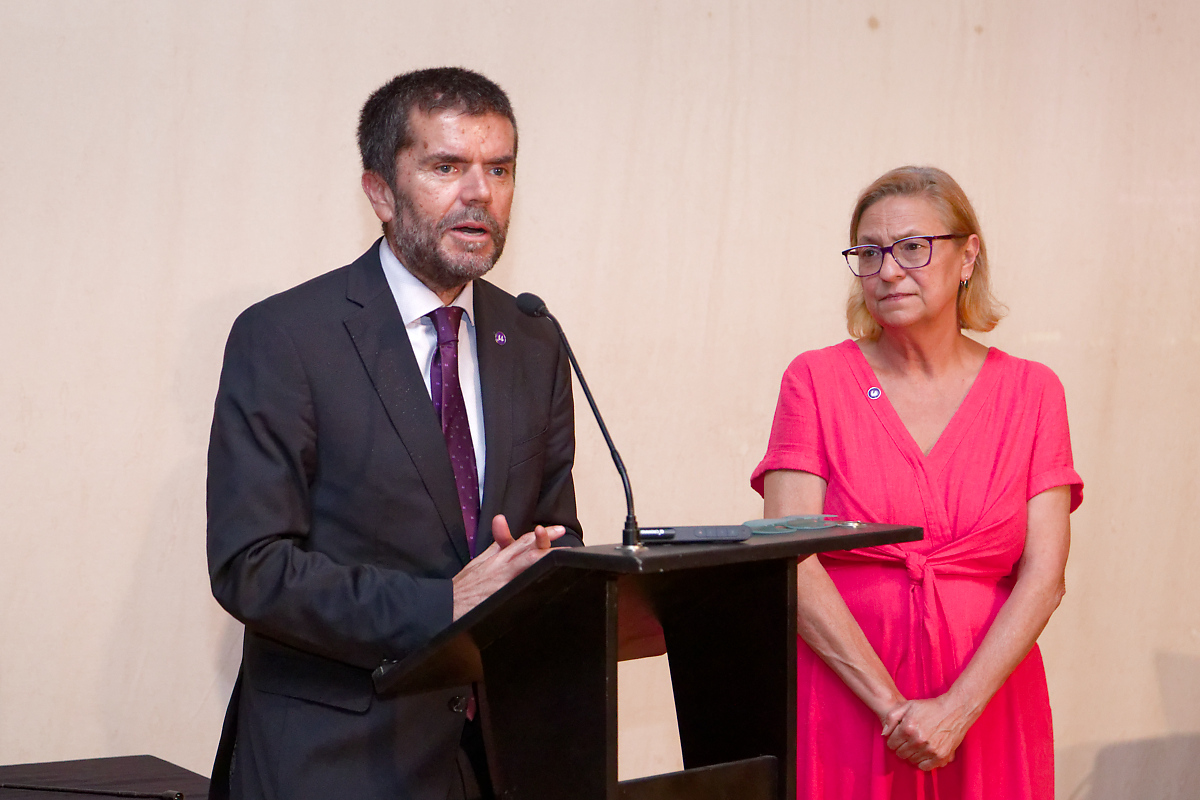
The Campus America 2026, dedicated entirely to Chile, concluded today, Friday, October 30, in the Chamber Hall of the Teatro Leal in La Laguna. For two intense weeks, the University of La Laguna and the city that hosts it have hosted thirty research seminars, several thematic exhibitions, working meetings, business and institutional networking opportunities, and a wide-ranging program of events featuring 300 speakers from 56 universities and 14 countries.
The Rector of the University of La Laguna, Francisco García, closed the ceremony, noting that the effort and fatigue involved in organizing the campus had been worthwhile. He recalled that the importance of the event was demonstrated by the presence at its opening of dignitaries such as the President of the Canary Islands, Fernando Clavijo, and the Chilean Ambassador to Spain, Juan Antonio Coloma. He also highlighted that this forum served as the setting for a bilateral academic summit attended by 42 rectors from Chile and Spain. The Rector also acknowledged the significant collaboration of the Chilean community in Tenerife, whose visibility has increased thanks to this gathering.
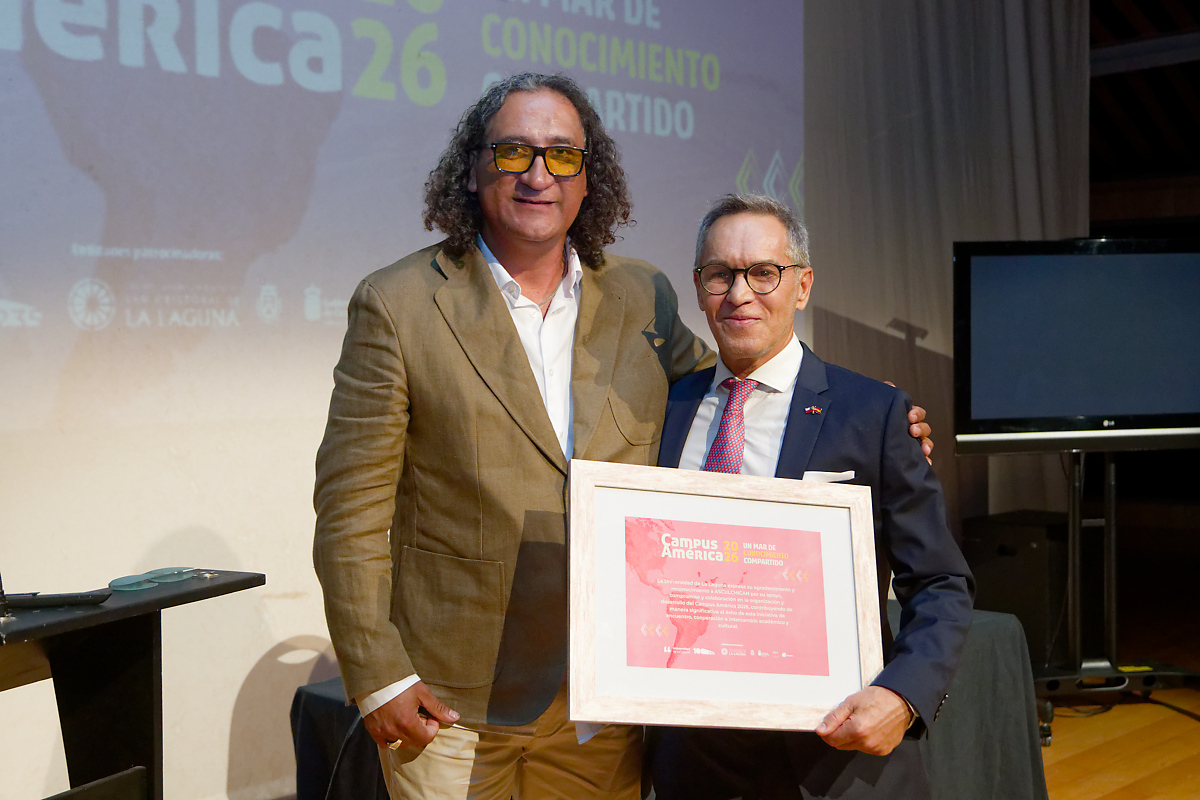
Rafael Alfaro (left) receives the recognition from the hands of Consul Rafael Montet (right).
Recognition to ASCULCHICAN
The honorary consul of Chile in the Canary Islands, Rafael Montet del Pino, was in charge of presenting the institutional recognition to the Association of Chileans living in the Canary Islands (ASCULCHICAN), one of the key entities for the development of cultural activities at Campus America 2026. The distinction was accepted by the director of the entity, Cristian Alfaro Corrales, who described the award as the association's "birthday present," since it had celebrated its sixteenth anniversary in October.
Alfaro acknowledged Montet del Pino's work in building a strong bridge between the Chilean Embassy in Madrid and the Chilean community in the Canary Islands. He described this group as the "invisible neighbors" who, thanks to the Campus America culture, crafts, and gastronomy fair held on Saturday, October 24th, in the Plaza del Adelantado in La Laguna, "have shown their faces," and promised more surprises to come.
For his part, the consul shared some reflections that arose from his conversations with Alfaro, the first of which was that for Chilean emigrants, “belonging to the Canary Islands does not mean ceasing to belong to Chile,” since identity can “expand and enrich itself.” Emigrating does not mean abandoning a physical space, but rather a daily world that will remain in memory and in small, everyday acts.
Montet reflects that "a community exists long before an association," centered around a meal or a song, but that when it becomes institutionalized as ASCULCHICAN has done, it acquires responsibilities and ceases to be a space where culture is preserved, becoming a space of accompaniment, solidarity and help to a community that often needs assistance in procedures and other ordinary matters.
He acknowledged that the Canary Islands and Chile share a common history of emigration, and noted that over time there has been a new generation of Chileans who were not born in Chile, but in the islands. “But they are Chileans with a dual identity. Chile is the place they know through family history and celebrations.”.

Diego Navarro, composer of the soundtrack for 'Winnipeg, the ship of hope'.
Masterclass by Diego Navarro
During the closing ceremony of Campus America 2026, culture was present thanks to Diego Navarro, a composer from Tenerife responsible for the original score of the film 'Winnipeg, the Ship of Hope', an animated film co-produced between Spain, Chile and Argentina that tells the story of the month-long journey from the French coast to Chile of a ship chartered by Pablo Neruda to offer a new opportunity for life to 2,500 Spanish passengers who escaped the Civil War.
Regarding the film's theme, Navarro pointed out that it is the story "of an act of generosity that, although set in the 1930s, could not be more relevant" in current times when the migrant drama remains very much in the news.
The composer explained that he has been involved with the film since 2019 and that, even before the contract was signed, he composed a theme used for the teaser which the producers used to seek financing. At that point, he clarified that he doesn't normally write anything before having a contract in place, but in this particular case, the project had excited him so much that he didn't hesitate to commit.
As is well known, the pandemic broke out in 2020, and Navarro composed the main theme for films during lockdown. The composition process lasted a total of four weeks and six days, “practically one performance per day,” and was able to develop with great unity thanks to the use of advanced software that allowed him to write the score by hand on a tablet and have it played back immediately using musical instrument libraries.
Throughout his talk, Navarro presented the different musical themes that make up this work and showed clips from the film to illustrate their dramatic effect. In fact, to demonstrate the power a score has over the image, he projected a fragment with sound effects and voices, but without music, which was very challenging for the viewers and came to life once the music was added.

 Spanish
 English
 French