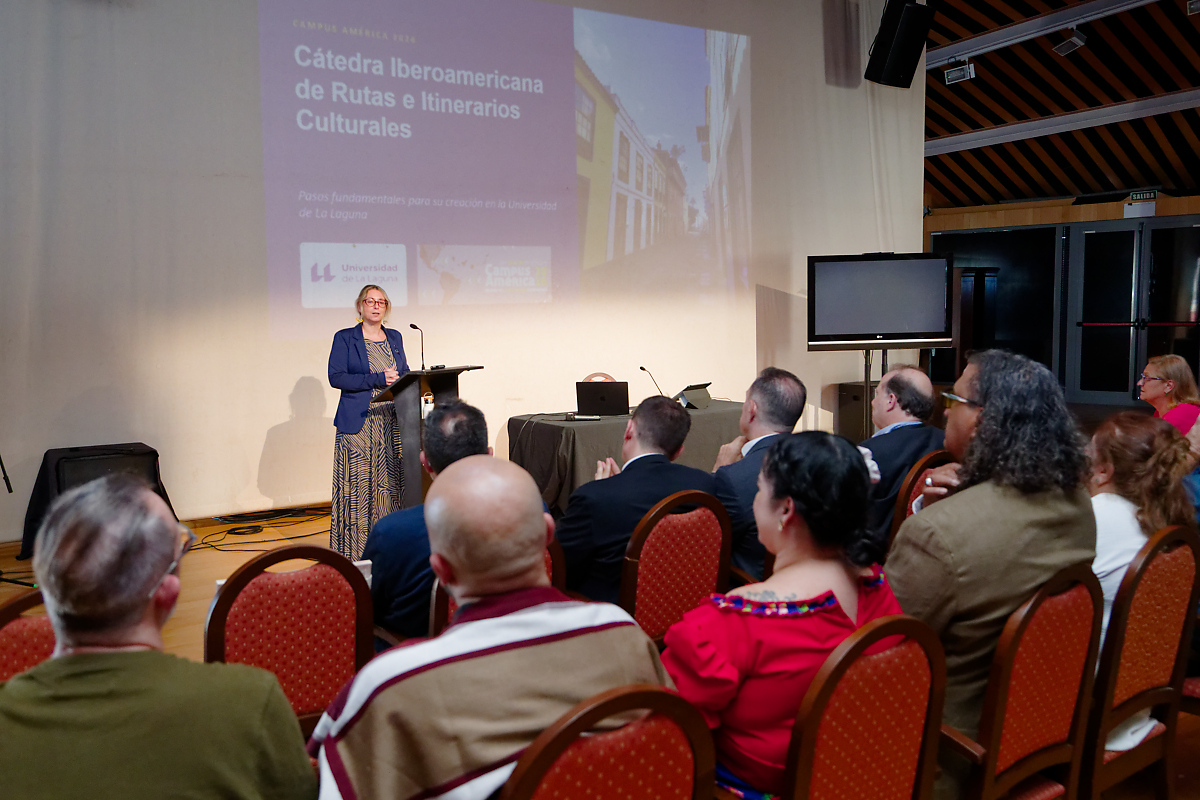
In its final session, Campus America concludes with the presentation of the Ibero-American Chair of Cultural Routes and Itineraries, soon to be created, an initiative promoted by the University of La Laguna itself, the City Council of La Laguna, the Government of the Canary Islands and the Organization of Ibero-American States (OEI).
The event took place in the chamber hall of the Teatro Leal with the participation of representatives of the institutions that are part of the Chair, intended to create new links through knowledge of the land, its cultural assets and its heritage.
The session was attended by the rector of the academic center, Francisco García; the general director of Heritage, Miguel Ángel Clavijo; the councilor for Heritage of the City Council of La Laguna, Adolfo Cordobés; the co-director of the La Laguna World Heritage Chair, José Juan Cano, and the director of Culture of the Organization of Ibero-American States, Raphael Callou.
Sara González, Director of Internationalization at the University of La Laguna and Academic Coordinator of the Campus America program, recalled the cultural highlights of these two weeks, including the concert by the Chilean singer-songwriter Manuel García, the culture and gastronomy fair in the heart of the city, the three photographic exhibitions at Casa Anchieta, the Canary Islands premiere of the animated film 'Winnipeg, the Ship of Hope', in addition to the university's meetings and collaborations with Chilean institutions, universities and companies.
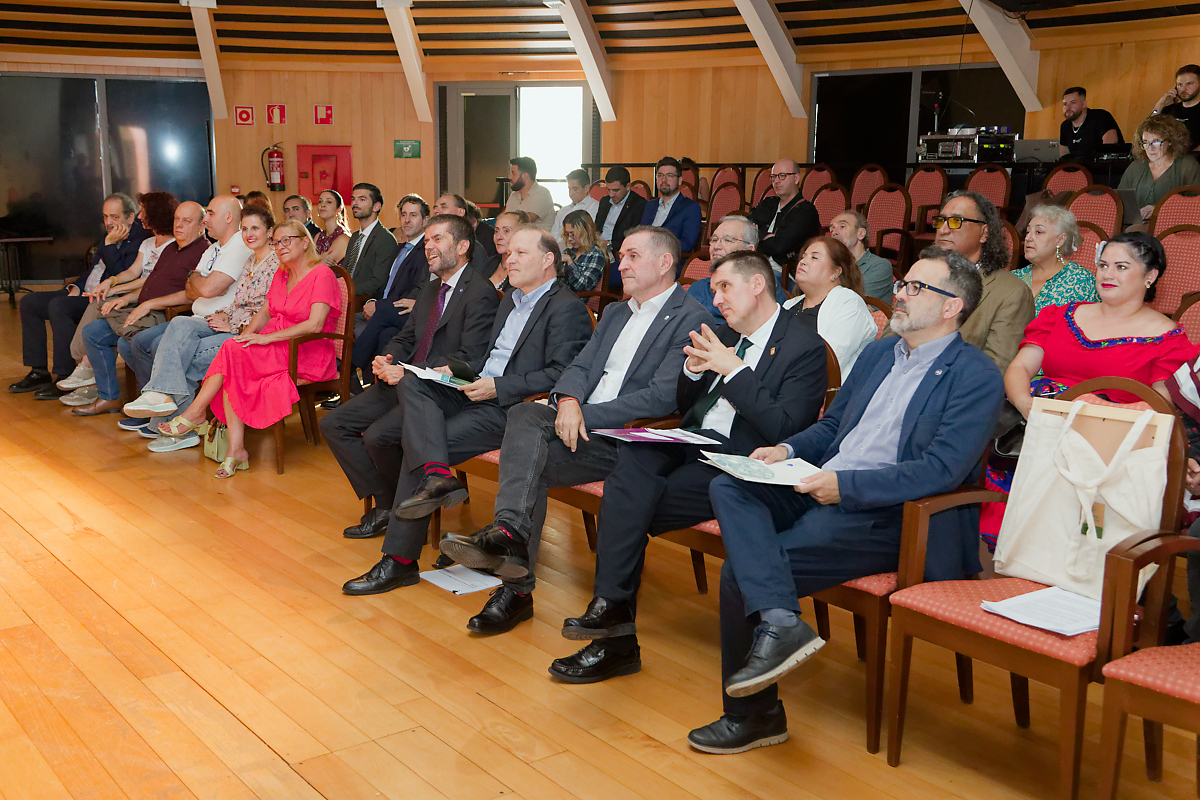
Authorities present at the event.
“Chile is very close to the Canary Islands,” stated Rector Francisco García, a remark made at Campus América, where new collaboration agreements were signed and new avenues for collaboration among researchers were explored. With the establishment of this chair, he added, a new space for collaboration and joint work is created. “Cultural routes connect territories and peoples,” he noted, referring to this collaborative initiative between the government, the city council, the university, and the OEI (Organization of Ibero-American States).
For his part, the councilor of the La Laguna City Council pointed out that the chair originates from a public university, fully committed to its environment, and framed within Campus America. The Director General of Heritage for the Government of the Canary Islands focused on the extraordinary importance of the Hispanic world to the Canary Islands. “The people of the Canary Islands have a historical debt to Latin America, a place that offered many opportunities. This region, the Canary Islands, is a haven of coexistence, something that must not be broken,” he added.
Raphael Callou, Director of Culture of the Organization of Ibero-American States, spoke remotely to point out that it will be a key space strengthening a common framework to certify cultural routes in the Ibero-American space.
José Juan Cano, co-director of the World Heritage Chair at La Laguna, spoke about the triad of research, teaching, and knowledge transfer embodied in this chair—three pillars that strengthen regional development. He noted that nine universities on both sides of the Atlantic were already working on cultural routes and itineraries, all before the creation of this chair. The aim now is to consolidate scholarly publications with leading Spanish publishers in the humanities.
Therefore, the chair would join the Ibero-American PRICI network, through the creation of an expert diploma in the development of Ibero-American cultural routes and itineraries, also including academic mobility.

Alfonso Urresti, Chilean senator.
Ecological transition and sustainable development
Next, Chilean Senator Alfonso Urresti presented a paper on the current challenges of the ecological transition and sustainable development. The country first faced a transition from dictatorship to democracy in the 1990s, opening itself to the world with clear and equitable rules. This transition then led to a just ecological transformation, to guarantee the right to a life in a healthy environment with a future.
It is therefore pertinent to address the push for profound reform, the senator argued. The 2000s saw the rise of controversy surrounding environmental decisions and their vulnerability to economic pressures. This led to a citizen-led movement that revealed the State's inability to cope with environmental disasters in certain parts of the country. Consequently, Parliament had to enact new laws to meet the demands of the times, given that measures were being taken in the central region without considering the precarious ecological situation of isolated areas in the regions.
During Bachelet's administration, technical oversight bodies and environmental courts were established, and the key milestone was the enactment of a law in 2010 to provide guidelines for environmental governance. With this institutional framework in place, a political consensus emerged to address environmental challenges. Senator Urresti then called for strengthening environmental collaborations between the Canary Islands and Chile.

 Spanish
 English
 French