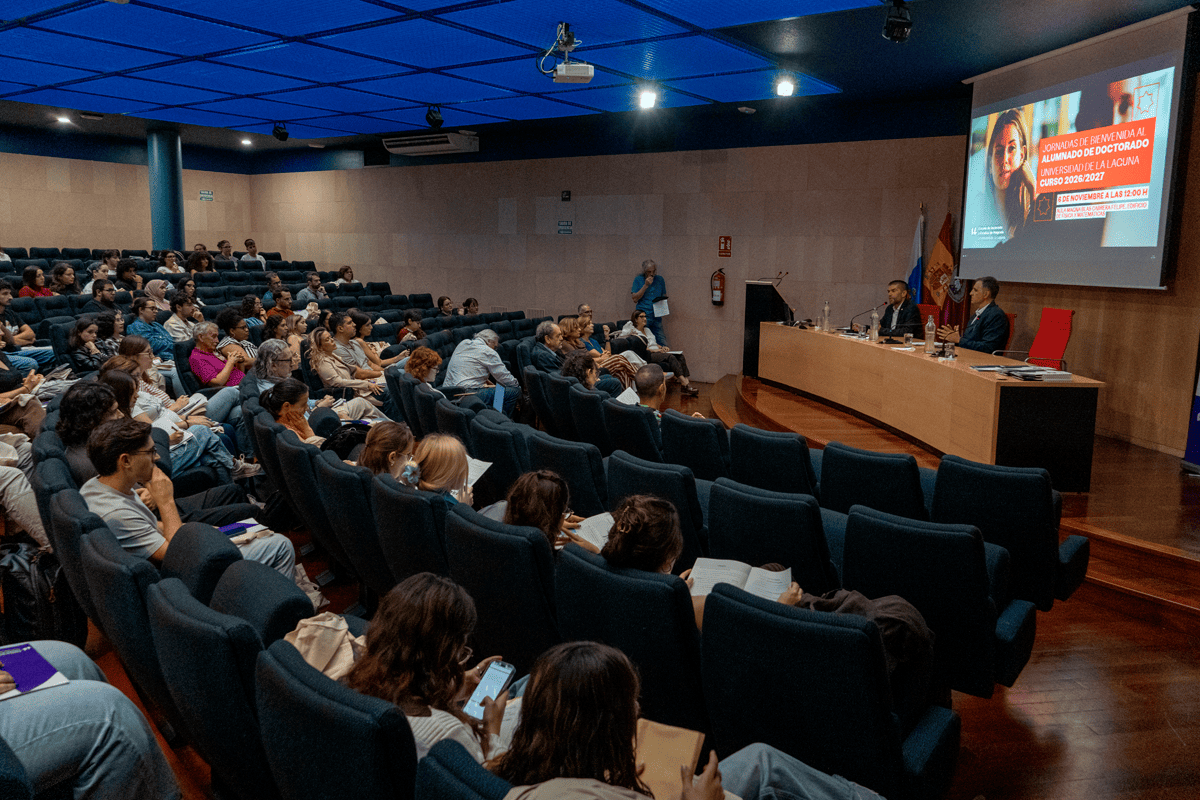
The Doctoral School and Postgraduate Studies (EDEP) of the University of La Laguna held a welcome session for its newly admitted students today in the Blas Cabrera Felipe Auditorium, located in the Physics and Mathematics Building. This event was aimed at the new doctoral students who have recently begun their postgraduate studies to obtain their doctoral theses, which confer the highest level of academic recognition. Approximately one hundred students from this group attended today's introductory session.
The rector of the University of La Laguna, Francisco García, was in charge of inaugurating this event together with Gustavo Alberto Marrero, director of the Doctoral School and Postgraduate Studies.
The rector described the doctoral thesis as a “thrilling adventure” and the gateway to the university's research activity through knowledge creation. “We do science, something that distinguishes public universities from others, to transfer it to society,” he emphasized, also noting the vital importance of having a global perspective, being familiar with mobility programs and internationalization services.
Francisco García warned of the threats posed by hoaxes, disinformation, and hate speech, which can only be combated through responsible science. He also acknowledged the support and encouragement provided by the University of La Laguna in this endeavor, based on the evidence that higher levels of education lead to greater employability.
Gustavo Marrero emphasized some of the key aspects of the first year of the PhD program, a time that requires thoughtful dedication to defining the dissertation project with a well-defined plan. He stressed the importance of “using methodologies that push the boundaries of knowledge, that don't become outdated, and being ambitious, because now is the time to be so,” reminding them of the enormous informational support, monitoring, and personal guidance they will receive from their tutors and dissertation directors.
 The director of EDEP also emphasized the importance of extensive reading and consolidating scientific literature to become leading experts in their field in the future, while cautioning that Artificial Intelligence should always be a support tool and never a direct means of generating their desired results. He also spoke about the importance of interaction and engagement with the community through seminars, conferences, and congresses, and encouraged them to speak with upperclassmen to support each other along the way.
Next, Etelvina de la Casas, Deputy Director of Quality and Training at EDEP, explained that there will be a series of basic activities aimed at all doctoral students, covering topics such as the use of AI, an introduction to Python, gender, and emotional management, which have been well-received in previous years. She also announced that students will be able to take English courses through the Language Service, where they can also have their proficiency level certified.
Sara Darias-Curvo, Deputy Director of Doctoral Studies at EDEP, focused her presentation on three key doctoral thesis modalities: those with international distinction, those under international joint supervision, and those with industrial distinction. The international distinction requires a minimum three-month research stay outside of Spain at a prestigious higher education institution or research center, with reports and participation on the examination committee of international doctoral examiners. The international joint supervision is carried out under the co-direction of researchers from two universities, one of them the University of La Laguna (ULL), and another from abroad, within the framework of a specific agreement that allows for a dual degree or mutual recognition. Finally, the industrial distinction is applicable when the thesis is developed in collaboration with a company, industrial sector, or public administration, linked to an industrial research or experimental development project.
Alejandro Armas Díaz, International Mobility Coordinator at EDEP, provided further information on the importance of internationalization in this final stage of their studies. Following this, the participating doctoral students learned about the various services available to them during this new phase of their university studies, such as Information and Guidance, ICT Resources, and the Library, which this year has expanded its required hours and credits.
The event concluded with remarks from Rubén Barroso, student representative on the Doctoral Committee, who shared his experience and offered advice as a current doctoral candidate. It was also announced that further information sessions will be held on November 12th, where deadlines, academic standing regulations, a summary of the different study options, and administrative procedures will be explained in greater detail.

 Spanish
 English
 French