A study involving researchers from the University of La Laguna suggests that some cranial interventions performed during prehistory may have constituted an early form of cranial decompression. The study analyzes evidence from various prehistoric populations around the world, as well as injuries documented in the Canary Islands.
The article, published in World Neurosurgery, is made by Leandro Castañeyra, from the Department of Pharmacology at ULL and the Children's Research Institute (CHOC), and Emilio González, From the Department of Internal Medicine. Specialists from the Historical Heritage Service of the Gran Canaria Island Council, the Surgery Service of the University Hospital of the Canary Islands, and the Face Lab at Liverpool John Moores University are also participating in the research.
Trepanation involves intentionally creating an opening in the skull and is one of the oldest known surgical procedures. Its possible uses include the treatment of trauma, the management of certain symptoms, and ritual practices, although its purpose remains a subject of debate due to a lack of conclusive evidence.
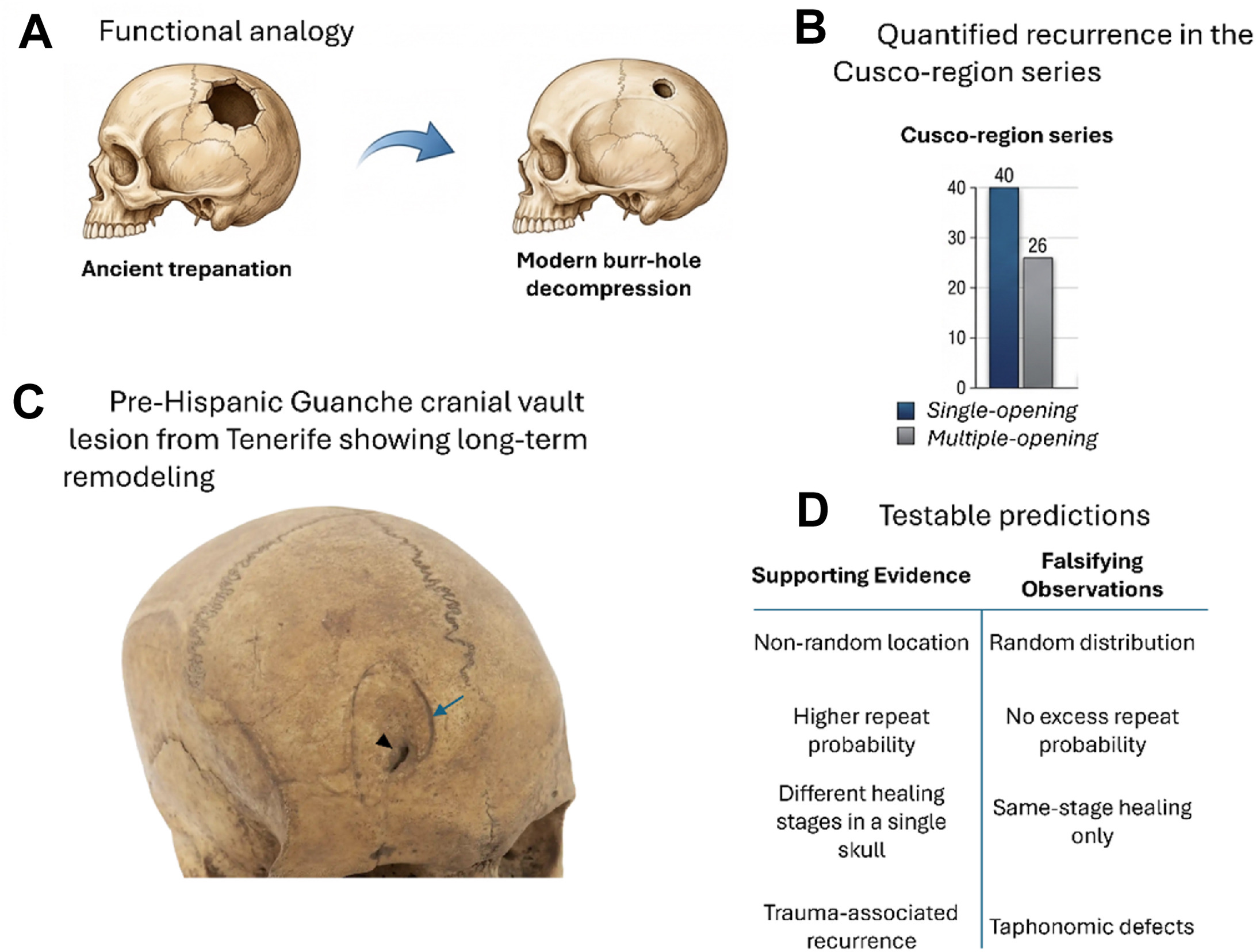
Among the evidence analyzed are two large lesions identified in the skulls of two adult individuals from the Barranco del Agua de Dios site in Tenerife. Both show signs of remodeling and prolonged survival after sustaining injuries. Researchers suggest that these lesions could be related to partial trepanation.
However, there is insufficient evidence to confirm that these interventions had a therapeutic purpose in the Canary Islands. The injuries could be related to trauma, intentional procedures, or other subsequent modifications. The researchers also cite a study on violence in the pre-Hispanic population of Gran Canaria that identified cranial trauma in 696 individuals. Of these, 596 presented healed injuries and 100 unhealed injuries, with no conclusive evidence of intentional trepanation found.
The article's proposal is also supported by remains from other prehistoric populations, especially from the Cusco region of Peru, where 109 cranial openings have been documented in 66 individuals. Approximately 83% of the cases showed signs consistent with survival after the intervention, and 26 individuals had multiple openings.
One of the most striking arguments in favor of a possible therapeutic purpose is the presence of multiple trepanations in the same individual. Some people survived an initial procedure and, some time later, underwent trepanation again. This pattern is reminiscent of current pathologies, such as chronic subdural hematoma, in which an initial decompression may be effective, but recurrence may require further intervention. While other motivations, such as ritualistic ones, are not ruled out, the repetition reinforces the possibility that some trepanations were genuine surgical treatments to relieve intracranial pressure.
Based on this evidence, the authors suggest that some communities may have developed these practices by observing the progression of trauma in individuals. This would not imply that they understood the modern concept of intracranial pressure, but rather that they observed that certain individuals worsened after an injury and, in some cases, improved after a cranial surgery.
The research proposes using techniques such as computed tomography to distinguish intentional interventions from injuries caused by trauma, disease, or postmortem processes. Furthermore, it suggests that trepanation may have represented, in certain contexts, an experience-based surgical response to cranial problems. However, it emphasizes that the available evidence does not allow for the conclusion that the interventions documented in the Canary Islands were cranial decompression treatments.

 Spanish
 English
 French