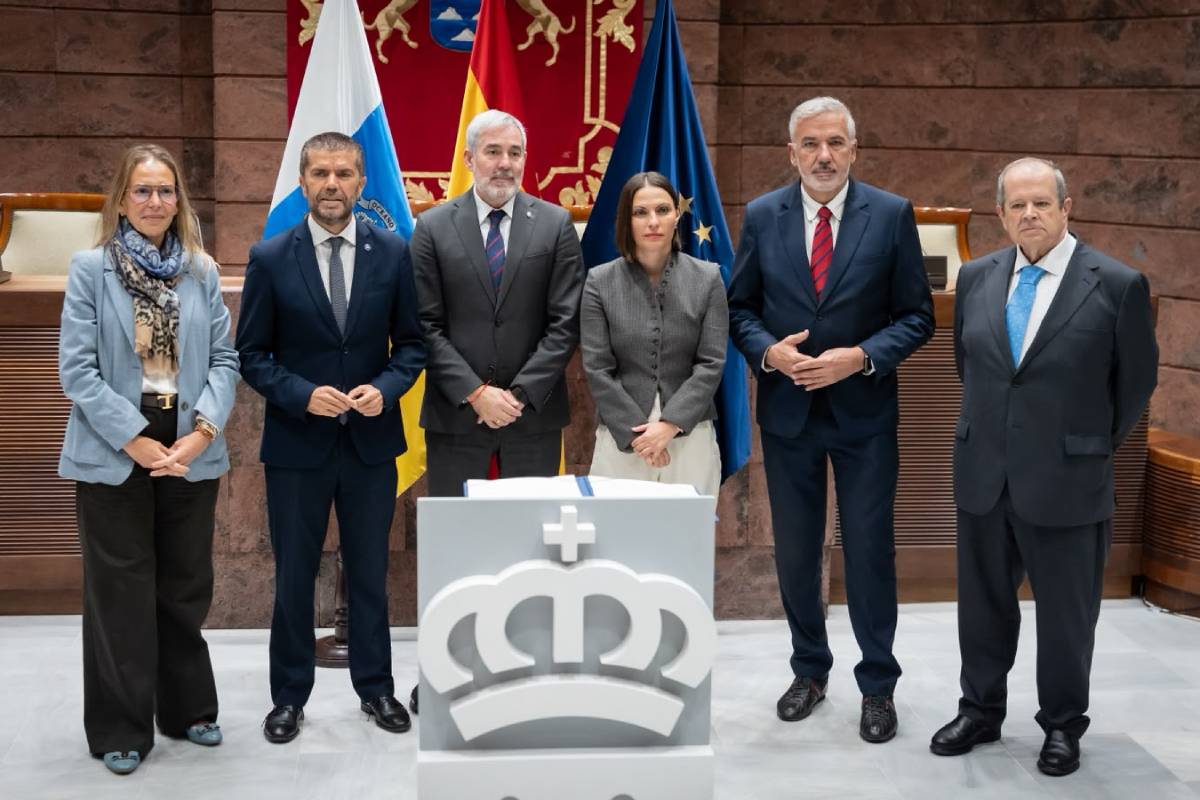
The Government of the Canary Islands, through the Ministry of Universities, Science and Innovation and Culture, has reached an agreement with the University of La Laguna and the University of Las Palmas de Gran Canaria (ULPGC) on the basis of their funding for the period 2027-2030. The funding plan includes a total contribution of 1.346 billion euros over the four years and establishes a resource forecast that will allow both institutions to organize their activities with greater stability.
The agreement was signed in the Parliament of the Canary Islands by the President of the Canary Islands, Fernando Clavijo; Regional Minister Migdalia Machín; the Rector of the University of La Laguna, Francisco Javier García Rodríguez; and the Rector of the University of Las Palmas de Gran Canaria (ULPGC), Lluís Serra Majem. With their signatures, the institutions formalize the consensus reached and commit to advancing the processing of the funding instrument until its final approval by the Government. Also present at the signing ceremony were the President of the Social Council of the ULPGC, Ana Suárez, and the President of the Social Council of the University of La Laguna, Francisco Vicente Almeida.
Fernando Clavijo emphasized that this agreement is not the end of anything, but rather the beginning of many things. "From the start of this legislative term, we have been clear that our public universities must be an engine for generating knowledge and transferring that knowledge to our economic, productive, and social fabric. Today, we are taking a fundamental step to provide them with the peace of mind and stability they need to conduct research, generate knowledge, and contribute to the growth and improvement of the Canary Islands.".
The president expressed his special gratitude for the involvement of the rectors and the governing boards of both universities, whose role he considered crucial in reaching the agreement. “It has not been an easy road. There have been difficulties, skepticism, and moments of uncertainty, but we have all remained steadfast in our shared objective. I want to thank the rectors for their patience and demanding approach, and the governing boards for their work in making possible an agreement that will provide stability to our public universities for the next four years,” he stated.
Councilor Migdalia Machín explained that the agreement culminates the work begun in September 2023 with the universities and their social councils, along with the Universities and Finance teams. "We have worked to ensure that the needs of both institutions have a concrete financial response and are based on clear criteria. That has been the priority since the beginning of this legislative term," she stated.
Machín emphasized that "the funding plan will allow us to see how public resources translate into better results for students and a greater contribution from universities to the Canary Islands. Annual monitoring will provide us with the information needed to make any necessary adjustments, while fully respecting the autonomy of each institution.".
The Rector of the University of La Laguna, Francisco García, pointed out that the signing of this agreement, concerning a funding mechanism for the Canary Islands' public universities for the period 2027-2030, represents a historic step. "We are advancing the financial security and predictability of both institutions, thus improving their capacity to fulfill the important missions they perform in our society.".
«"It's important to remember that the last multi-year funding instrument for the Canary Islands universities was the program contract covering the period 2009-2013, which resulted in an almost immediate default by the Canary Islands Government in the context of the financial crisis that began in 2008," the rector recalled. "Therefore, almost two decades have passed during which the Canary Islands universities have lacked the capacity to plan for their future beyond the next fiscal year.".
«The agreement we are signing today guarantees core structural funding for both universities for the next four years,» García explained. «What remains is to implement the funding mechanism and monitor the financial commitments made, as well as to finalize the specific funding and complete the development and application of the results-based funding.».
He also recalled that in his inaugural address he stressed the urgent need for a broad social pact for public universities in the Canary Islands, one that would look beyond electoral cycles and work towards strengthening one of the region's key drivers of transformation. "I believe today's agreement is a positive step in that direction," he said, "because in addition to being an agreement between public universities and the Government, we are fulfilling a need shared by the entire parliamentary spectrum, as has been demonstrated on numerous occasions in the university committee of our regional parliament.".
For his part, the Rector of the University of Las Palmas de Gran Canaria, Lluís Serra, also commented on the agreement: “Today we reached an agreement that was highly desired by both parties and that helps build the future of the Canary Islands' public universities from a regional perspective. ULPGC and the University of La Laguna are not competing for resources, but rather working together in their rational use. This agreement allows us to plan our management for the coming years through a multi-year funding model that guarantees structural operation, although it still needs to be finalized, maintaining a spirit of dialogue and a commitment to strengthening our universities. All of this is aimed at recognizing the growth needs and the role of public universities in the transformation of our archipelago. The funds we will receive to address the accommodation needs of our students through the construction of new residences and housing, which represent a priority for our public university system, as well as the modernization of teaching and research infrastructure, are still pending.”.
The presidents of the Social Councils acknowledged the signing of this new funding framework for public universities. Ana Suárez, head of the Social Council of the University of Las Palmas de Gran Canaria (ULPGC), noted that “this agreement is a firm commitment by the Government of the Canary Islands to knowledge and talent as drivers of transformation and opportunity for our region.” Meanwhile, Francisco Almeida, president of the Social Council of the University of La Laguna (ULL), emphasized that “today is a day of satisfaction” for finalizing an agreement that is essential for the public universities of the Canary Islands.
The economic plan anticipates allocating €311.47 million in 2027, €335.82 million in 2028, €344.82 million in 2029, and €353.92 million in 2030. By the end of the period, the annual contribution will be €67.72 million higher than in 2026, representing a 23.66% increase. These amounts will be specified in the regional budgets for each fiscal year.
The funding plan addresses the need for universities to make decisions with a multi-year perspective. Until now, their contributions depended primarily on allocations in each annual budget. The new plan provides a framework for organizing staffing, scheduling academic programs, and developing scientific projects.
The funding combines resources allocated to university operations with others linked to achieving specific objectives. These include reducing student dropout rates, expanding lifelong learning opportunities, and developing degree programs that combine university studies with on-the-job training. Research outcomes and their application to the islands' economic and social activity will also be considered.
 Alongside this performance-based funding, universities will undertake improvement commitments linked to structural funding, which covers their day-to-day operations. These commitments will be detailed in their financial plans, developed with the participation and approval of their governing boards. They will include measures to improve the organization and use of public resources, as well as increase their own revenue and progressively reduce their financial dependence on the Autonomous Community.
From 2028 onwards, the plan also includes up to three million euros annually for technological infrastructure, distributed equally between the two universities and linked to the achievement of specific objectives. The document also outlines the possibility of funding extraordinary investments on the campuses, the allocation of which will depend on the availability and authorization of the corresponding financial instruments.
Monitoring of the agreement will be the responsibility of a commission comprised of representatives from the Regional Ministry, the universities, and social councils. Each academic institution will be required to prepare a financial plan for the period and provide annual justification for the funds received. Furthermore, the findings of the study commissioned from the Independent Authority for Fiscal Responsibility (AIReF) on university spending will serve to guide potential improvements to the model.

 Spanish
 English
 French