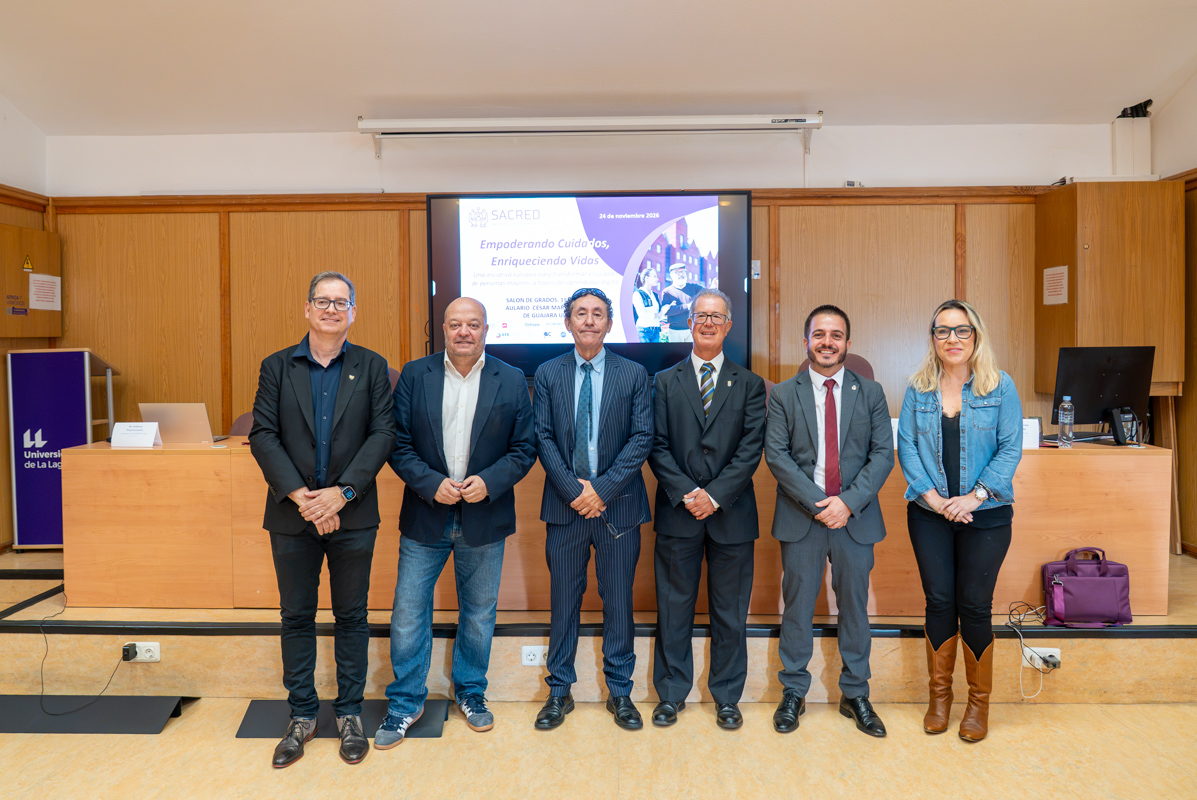
The lecture hall of the César Manrique General Classroom Building is hosting a European meeting of the Erasmus+ project from today, November 24, until Thursday, November 26. Sacred, organized by the Faculty of Psychology and Speech Therapy of the University of La Laguna. This initiative seeks to create an online learning platform (e-learning) for students and professionals in health sciences, focused on the care of elderly people with dementia, disabilities and comorbidities.
The project, which runs from December 2024 to November 2026, leverages digital tools to provide accessible and comprehensive education, equipping future caregivers across Europe with evidence-based best practices and knowledge to achieve immediate and long-term improvements in elderly care.
The Rotterdam City Council, under the coordination of Anthony Polychronakis, advisor and public policy manager specializing in social policies, health and European affairs, is leading this European initiative that brings together nine partners from the Netherlands, Belgium, Greece, Italy, Spain and France.
Specifically, from Spain, San Cristóbal de La Laguna participates, coordinated by the expert in Clinical Psychology, Rita Martín Caballero, through the ANRIMAC project, in collaboration with the Faculty of Psychology itself, which she leads. Juan Manuel Bethencourt; and Valencia, through the Polibienestar research institute of the University of Valencia, and the European network for local inclusion and social action ELISAN.
 The inauguration was attended by the dean of the Faculty of Psychology and Speech Therapy, Juan Manuel Bethencourt Pérez; the general director of Public Health of the Government of the Canary Islands, José Díaz Flores; the general director of Mental Health of the same entity, Fernando Gómez Pamo del Río; the councilor of Education of the City Council of La Laguna, Sergio Eirola; and the head of Services of the General Directorate of Dependency of the Government of the Canary Islands, Cristina Pérez Castañeda.
The first speaker was Cristina Pérez Castañeda, who highlighted Sacred's relevance to her area based on the reports and results it has obtained. Pérez hopes the day will provide insight into the program's current status and how the knowledge gained can be used to improve care within the Canary Islands' long-term care service.
Sergio Eirola emphasized the importance of continued collaboration in providing care for people with dementia, working together to build solutions and highlighting the role of education in values-based training. He listed some of the latest municipal initiatives in health and well-being, concluding by wishing the project success and expressing his hope for future collaborations with the Canary Islands and the municipality itself.
Fernando Gómez Pamo del Río recalled how Rita Martín introduced him to Sacred months earlier, requesting the involvement of the Mental Health department. He emphasized the importance of aging in Europe, where approximately 221% of the population is 65 years of age or older. “Therefore, this work is crucial for training those who will care for the elderly, who will require appropriately trained care, and we have access to innovative educational approaches here,” he concluded.
José Díaz Flores emphasized the importance of promoting health in areas such as dementia. “We are aware of the aging population and the need to address emerging health problems,” he stressed. He listed some of the actions being carried out, including in collaboration with the Ministry of Health, to address the challenges society faces in this area, seeking early detection through an intersectional professional approach to maintain the capacity and well-being of patients.
Finally, Juan Manuel Bethencourt Pérez emphasized the Faculty of Psychology and Speech Therapy's commitment to human development, inclusion, and innovation through its involvement in this initiative, which in turn contributes to the advancement of the European Higher Education Area. He also highlighted the role of the local team in developing the program in collaboration with the University of La Laguna.
Next, Anthony Polychronakis introduced the Sacred project through a presentation entitled “Sharing and Caring for Older Adults with Intellectual Disabilities.” He began by thanking the regional government, the La Laguna City Council, the University, and organizations such as Acufade, the Association of Caregivers, Family Members, and Friends of People with Dependency, Alzheimer's, and other Dementias, for their involvement. He also clarified that intellectual disabilities and dementia in older adults can overlap, especially in how they affect cognitive decline.
 The coordinator of this international initiative indicated that the work plan was carried out over three years in four phases: initiation, thorough preparation of all outcomes, e-learning production, and the development of five pilot projects in different languages across the five participating countries, with one hundred people participating in testing. Specifically, the program was developed in the five official languages of the participating countries: Spanish, Italian, Dutch, French, and Greek.
Polychronakis also listed the expected results of the project: a report of evidence-based interventions, with good practices; a needs assessment and gap analysis report; a database with 20 good practices across Europe; a co-created e-learning platform and a final Europe-wide awareness campaign on dementia and multimorbidity.
Professor Ernesto Suárez Rodríguez, from the Department of Social Psychology, took over the program and implemented it at the University of La Laguna. Among the actions undertaken, in December 2025, 15 psychology professionals from the Master's Program in General Health Psychology were involved. Twelve students actively participated in the e-learning program, helping to strengthen their preparation for the real-world challenges of caregiving. More recently, in February 2026, the program was presented to 20 nursing students, highlighting the importance of psychosocial approaches in healthcare and supporting their integration into academic training.

 Spanish
 English
 French