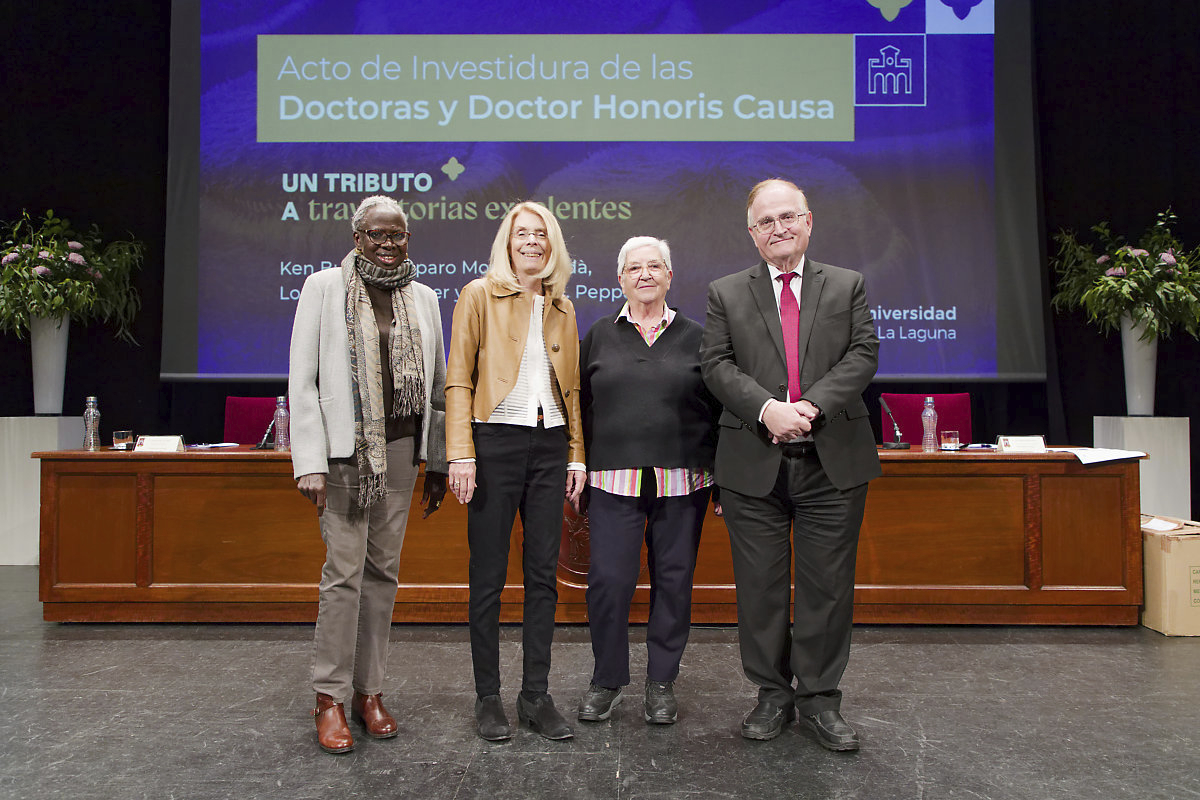
The writer Ken Bugul, the communication theorist Amparo Moreno, and the scientists Londa Schiebinger and Nicholas A. Peppas have joined the list of honorary doctorates from the University of La Laguna, a distinction awarded to the brightest minds, those who know how to create a school of thought and transmit to their disciples the knowledge, values, and best practices so that social progress is unstoppable.
They have enlightened us with their teaching, their humanity, and their approachability. Moved by the extremism and the drifts of global geopolitics, which seem to offer no hope for the future, the University of La Laguna is proud to forge an alliance with these four individuals, leading figures in their respective fields. We have had the opportunity to speak with each of them, and this is what they told us.
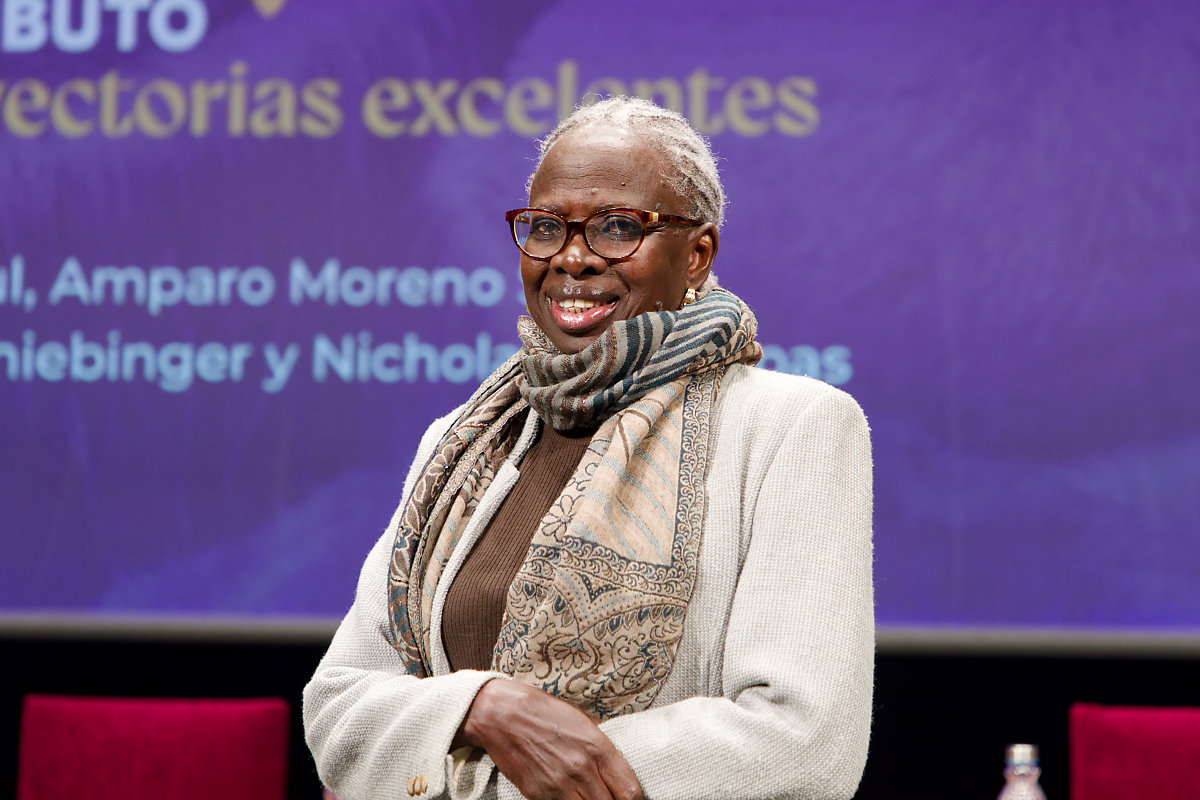
Ken Bugul.
Ken Bugul: The strength of the African woman
We spoke with novelist Mariètou Mbaye Biléoma about the challenges faced by African women. This Senegalese writer, who is currently working on her twelfth novel, describes how Islam and later French colonization have profoundly shaped her country and offers her personal perspective on the causes of African youth emigration.
She is also known by her literary pseudonym Ken Bugul, Ken Bugul, whose name in Wolof means "The One Nobody Wants," is the youngest daughter of a polygamous family in which no one cared for her. She grew up alone and suffered abandonment by her mother when she was very young. After her university studies in Dakar, she went on a scholarship to Belgium and then to France, where she had intense and devastating experiences. She returned to her country in the early 1980s, and everyone turned their backs on her because she came home empty-handed, without success. Ken Bugul has found in writing a way to redeem her experiences, and in fact, she has promoted therapeutic writing for the most vulnerable people. Now she is a highly acclaimed novelist with a very distinctive voice, and her works have been translated into several languages.
Our honorary doctorate recipient speaks of the enormous historical and cultural burden that weighs on African women, a burden, she says, that must be shed. She recounts how, when the colonizers arrived, four French departments were created, in which women adopted a different behavior than most Senegalese women living in the indigenous area. “They had access to school, culture, and Western ways, while the others felt looked down upon by the former, creating a schism among Senegalese women themselves.” Later, when the rest of the population was educated, the women in the indigenous area who were able to attend school took a kind of revenge. “We didn’t have French ways, but we got ahead thanks to knowledge.”.
Over time, the feminist movement also reached Senegal, where, she says, there was much confusion due to the population's diverse cultural heritage. "The problem is that a large proportion of women remain illiterate or have very little education, due to religious domination, both Islamic and Catholic.".
Unfortunately, women's political recovery and emancipation have not translated into access to decision-making positions in public life. “We have a law that seeks parity, but that's not enough, because men will always be ahead. We may be vice presidents, deputy ministers, or assistant mayors, but what we want is to lead the country, to take power,” she states emphatically, while also expressing her support for changing the legal text to force this undeniable progress. This profound desire clashes with reality: first, the resistance of men themselves, and then, of society as a whole and of religion. “It's a legacy not only of colonialism, but also of an earlier period, from the arrival of Islam in Africa.”.
The challenges faced by African women are therefore not the same as those faced by European women. “Being a woman is already a challenge, and on top of that, being Black and Muslim…oh la la, national catastrophe!” she jokes. “We share contemporary problems with Western women, of course we do, but the truth is that our educational, moral, social, and cultural references are still a colonial legacy.”.
“Africa still doesn’t have its own narrative. We constantly transmit the values we inherited from Islam and colonialism.” The author of such well-known works as 'Le baobab fou' and 'Cendres et braises' goes further. ‘Why can’t I be a feminist and a Muslim? Can’t Western women of Judeo-Christian heritage be feminists?’ she asks. ‘I’m Muslim, but I don’t wear a veil. I do what I believe is right, but I maintain my faith, and that doesn’t prevent me from living like a Westerner.’.
At 78, Bugul is a born activist who has broken the mold in her country. “We have allowed politics and men to manipulate a global movement that could have provided common solutions for all of us,” she asserts. “We must revise our strategy for struggle, which cannot be based on confrontational radicalism, but rather on an intelligent strategy, exactly as men do. We need to start challenging them.”.
We turned our attention to the phenomenon of polygamy, a multifaceted issue, to learn our protagonist's opinion. “It existed before the arrival of Islam, but it wasn't institutionalized. These were men and women who shared common projects, not of a romantic nature, but economic or social, to strengthen family unity and increase productivity, or even clan-based, to gain strength against outsiders. It wasn't a romantic relationship but a societal project.” With Islamization, a maximum of four wives per man was established, though reaching four wasn't mandatory, as long as they were cared for and treated equally.”.
With French colonization, the system was perverted. The colonizer found that polygamy benefited him in every way: it provided him with more labor through the birth of enslaved children and increased his economic output. These were human beings he could sell to other plantations and trade; he systematically raped enslaved women and maintained more or less official mistresses in addition to his wife. A large part of the mixed-race population of the United States and the Caribbean is the result of these abuses, he argues.
Thus, what began as a societal project has devolved into the use of women as mere objects of consumption. Once they have been exploited, they are abandoned and another is taken. What has happened to cause certain women, even in the Western world, to reach this point? The media has played a role, objectifying women instead of promoting their personal development, argues Bugul.
When asked about migration, she discusses its evolution and offers a little-known perspective. While 20 years ago emigration was primarily economic, this phenomenon has changed. “It’s a problem of existential emptiness, a lack of role models. Now a virtual civilization predominates, one of isolated individuals. Most young Africans lack cultural values because what exists is a cult of money and image. Young people live helplessly in a context of social pressure that demands success, a competition for material possessions.” Emigration is no longer a way to earn a living, “it’s a kind of suicide to escape all that social pressure, the pressure from families on their children when they see others succeeding abroad.”.
This is compounded by the breakdown of the family system due to a massive exodus from rural areas to large cities. “It’s rampant urbanization, with cities completely overwhelmed, which has led to increasing violence and aggression. There’s nobody left in the villages.”.
Ken Bugul is currently working on his twelfth novel, centered on the biblical figure of Mary Magdalene, to highlight that women are at the origin of all beliefs, even though this universe is also dominated by male figures. “Man’s problem is his fear of women, that’s his problem. We’re going to take advantage of that fear to reverse the situation and gain power, including in the religious sphere, because one way or another, religion dominates the world. Human beings cannot exist without believing in something.”.
Amparo Moreno Sardà: Journalism for social change
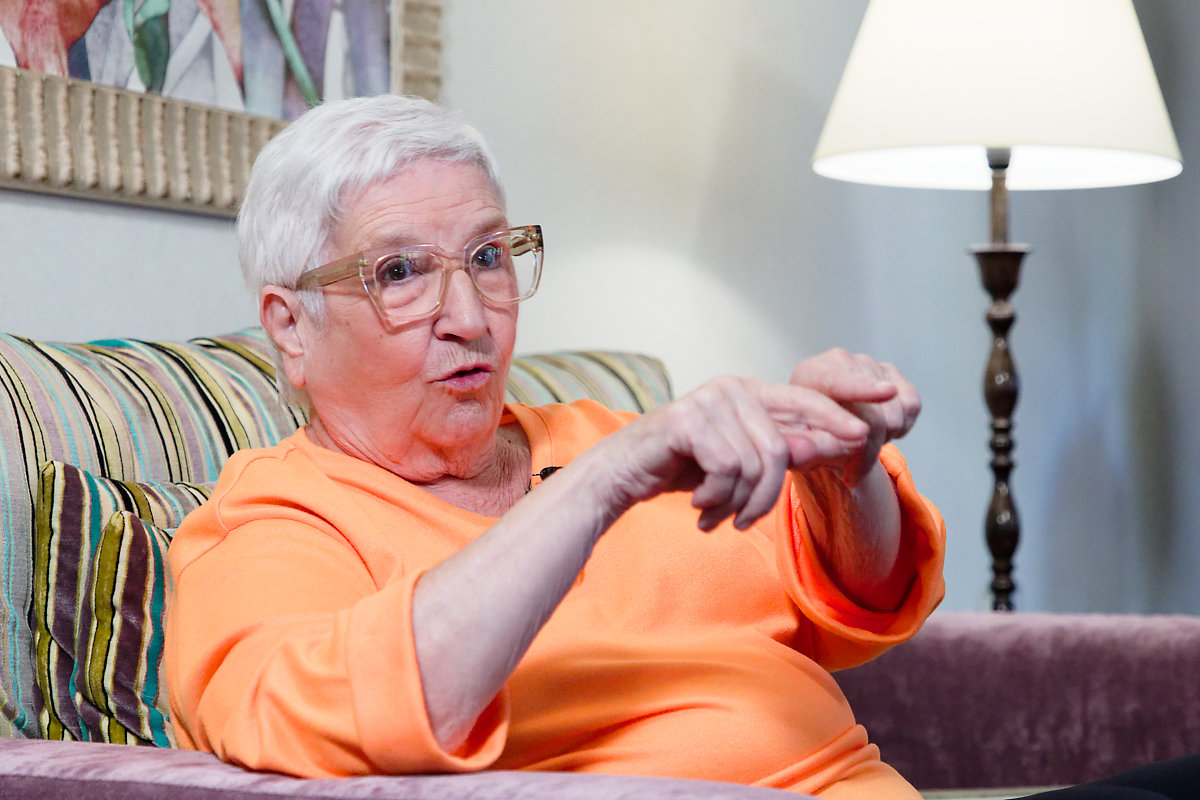
Amparo Moreno Sardà.
The city of Barcelona, at the beginning of the 1970s, established itself as the starting point in the professional career of the communicator Amparo Moreno Sardà. Still under the yoke of Despite the Francoist repression and the fact that the dictator's death was approaching, the journalist, born in Teruel, moved to a place that in just under thirty years had experienced enormous population growth, going from one to almost two million inhabitants. This development was not uniform and forced a large part of the population to live in overcrowded, shantytowns, or substandard housing without basic services. This unequal landscape was the backdrop against which Moreno Sardà began her journalistic work on the ground.
Being a woman and wanting to report on topics considered "men's issues" at the time quickly led her to clash head-on with the androcentric power that controlled the media. "The first time I went to ask for a job at a newspaper, the editor told me that the fashion section was already covered and that I couldn't do the political news section," she recounts. She continued knocking on the doors of other publications, something she finally achieved in The Catalan Post, which at that time had been acquired by a young Jordi Pujol. However, her criticisms of the political management gradually left her without a place in the journalism of the time and culminated in her dismissal, a drastic change that led her to focus on her career as a teacher.
The Autonomous University of Barcelona has been her home since 1974, where she has trained thousands of students in Communication Studies, and where she is now an emeritus professor. Decades of teaching and research, but above all, of critique of the establishment and of journalism. “The media today depends heavily on information sources, especially those within public administrations, which have become professionalized precisely to distort information,” she points out. Furthermore, she encourages journalists to embrace the challenge of breaking with existing routines because failing to do so only leads to the precariousness of the profession.
The introduction of the internet at the beginning of the 21st century allowed public administrations to radically change how they provide certain information to the public. E-government enabled societies to access matters of interest simply and quickly with a click, a change that wasn't reflected at all levels. "The problem is that political leaders don't want to lose their positions and are holding information hostage," says Moreno Sardà. This climate of secrecy then falls on journalists, who "have become professionals of institutional sources. And what does a professional of that source do? They reproduce what their boss tells them.".
Journalism today has undergone a profound transformation with the rise of technology companies and social media. Traditional media outlets such as newspapers, radio, and television have been forced to join these digital platforms to retain part of their audience and continue their journalistic work. More information channels, which in theory should democratize and make communication more accessible, in practice produce polarization and dehumanization. “They reduce everything to numbers and a series of clichés that serve to polarize public debate, because that is what interests policymakers or large tech company owners,” notes the emeritus professor.
At a time in history when the role of social media is so crucial that it can tip the scales in favor of one candidate or another in a nationwide election, the credibility of journalism is at an all-time low. Fake news and disinformation are infiltrating public opinion and damaging the journalistic profession, creating enough confusion for people to lose faith in the work of the media. Only one in three Spaniards trusts the news, as this reflects. the report prepared annually by the Reuters Institute. “"This is what works well for them, but not only for the big tycoons; any mayor in office can also do without journalists and use social media directly to say whatever they want.".
The journalism profession has been under scrutiny for many years, and the future doesn't look promising if things continue on the current path, acknowledges Amparo Moreno Sardà. However, this communications expert doesn't focus solely on the use of social media as a source of information, but rather on how that information is transmitted. "There's a clear dehumanization; people repeat clichés, and confrontations are fueled." It's precisely at this point that change lies: in complex and diverse societies, communication must work to construct more pluralistic explanations.
In the midst of this totum revolutum In a context where power influences journalism, and journalists then convey that influence to the public, Moreno Sardà doesn't distinguish between men and women, but rather expresses concern for the future. “Those of us in positions of power may want to preserve our privileges, but we must be able to understand our responsibilities and therefore also use these positions to realize that this way we're getting nowhere, only to disaster. It doesn't lead us to any enviable position; we have to change it, that's what's needed.”.
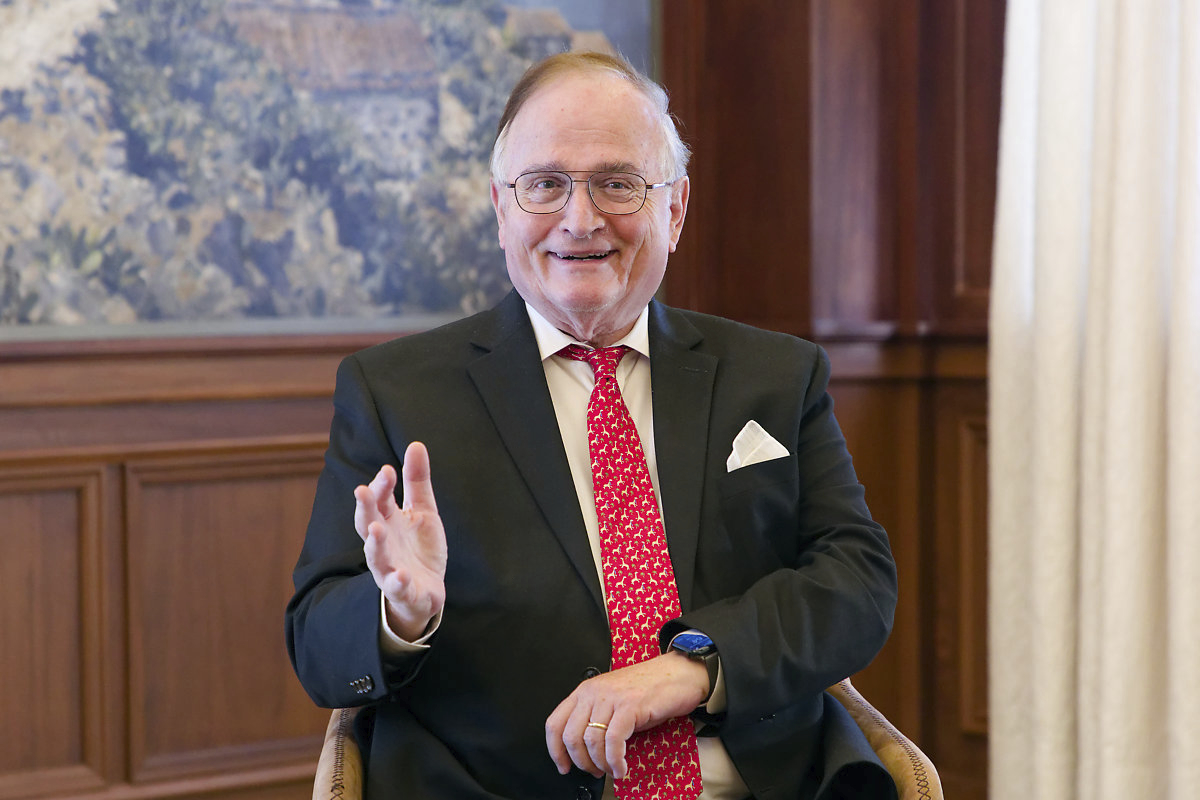
Nicholas A. Peppas.
Nicholas A. Peppas: 50 Years of Improving Health
At 22 years old, the Greek chemical engineer recently graduated from the National Technical University of Athens Nicholas A. Peppas He moved to the Massachusetts Institute of Technology, where his doctorate in 1973 marked the beginning of a fruitful scientific career of international standing that has led him to expand his field of action towards biomedicine, leading cutting-edge research in bio and nanomaterials applied to controlled drug release devices and the development of cartilage, vocal cords and artificial organs, among other inventions.
Such a curriculum vitae has earned him distinctions such as membership in 18 scientific academies and 15 honorary doctorates, the most recent of which is ours. “Yes, there have been a great many recognitions worldwide, but for me, the emotion comes from the recognition of the research we have conducted, the results we have achieved, and the people we have been able to treat and help with everything we have done,” he says.
He acknowledges that his engineering mindset leads him to focus his work on solving problems, in this case biomedical ones. “For me, the chemical plant and the human body are the same thing. In the chemical plant, we process something to turn it into something else. In the body, we do the same: we take a sweet product, put it in our body, and it changes our glucose levels, so we can't process it and we have to take insulin to avoid diabetes. It's the same process in mathematics, chemistry, physics… the difference is that in one case it's an inanimate object, and in the other, it's the real body.”.
Throughout his career, he has witnessed the unstoppable evolution of science and technology. For example, when he began his work, nanotechnology was barely known to a few specialists, whereas now it is widespread. He recalls, for instance, that 50 years ago people with kidney problems had to resort to artificial kidneys and long periods of dialysis, and now all those processes have been miniaturized and simplified.
Peppas is known for his contribution to drug delivery devices. “I started 53 years ago because I was interested in helping people take their medication more conveniently. Like many others, I didn't like injections. I preferred something simpler, but I knew that something simpler would be very difficult for the body to absorb and transfer into the bloodstream.”.
His background in chemical engineering allowed him to develop polymers that made it possible to incorporate drugs, peptides, and proteins into the body and help it function. “And since I’m an engineer, I also developed the necessary mathematics for all of this, which became very, very popular. Many people still remember some of the original equations I used, which were used to design new projects and products.”.
In his opinion, the current medical challenge lies in the multitude of cancer forms, but also in autoimmune diseases, which are very difficult to diagnose. “For example, multiple sclerosis leads to disability in those who suffer from it, and it takes years to resolve. The issue isn't simply finding a solution, but finding the best solution. Do you find a cure that requires five injections a day? I'm glad it exists, but it's inconvenient, especially if I'm a worker or someone who owns a business, studies, etc. Can you find a system that works once a day? Or once a month? Once a year? I think we're moving in that direction, to make treatment easier.” The problem is more complex because it doesn't exclusively concern science: political decisions are fundamental, since ultimately it will be institutions or insurance companies that finance the treatments.
Peppas also recalls the University of La Laguna's contribution to some of his projects. “One of my former research associates, Professor Edgar Pérez Herrero [Peppas's sponsor at the investiture], has become a professor here and has developed a number of very interesting technologies for treating a variety of diseases, especially a particular type of cancer. We still work and publish together, and there are other professors at this university that I know, so it's a global interaction; there are no longer any barriers, and we all try to work together to save lives.”.
This mention of other researchers is very typical of Peppas, who peppered his acceptance speech with references to collaborators from all over the world, and some of his Spanish colleagues even traveled to La Laguna to support him from the audience. “I greatly value the networking. I was born in Greece and went to the United States. I feel very international; for me there are no barriers. Whether you're Spanish or Chinese, you have the same cells.
In that same speech, the Doctor Honoris Causa emphasized his status as an immigrant. “I stressed this point because politically, both in Europe and America, we have many questions about immigrants and what they contribute. I personally worked in the United States for 54 years. I haven't felt excluded, but I've maintained good ties with Europe. I've visited Europe many times, as well as China, Japan, and Singapore, and I've always tried to understand the other side. I think this is important. I believe some people get a little tired, or have other responsibilities, and forget the main objective, which for me—and I apologize if I'm repeating myself—is to save lives and find solutions that improve the quality of life for our patients.”.
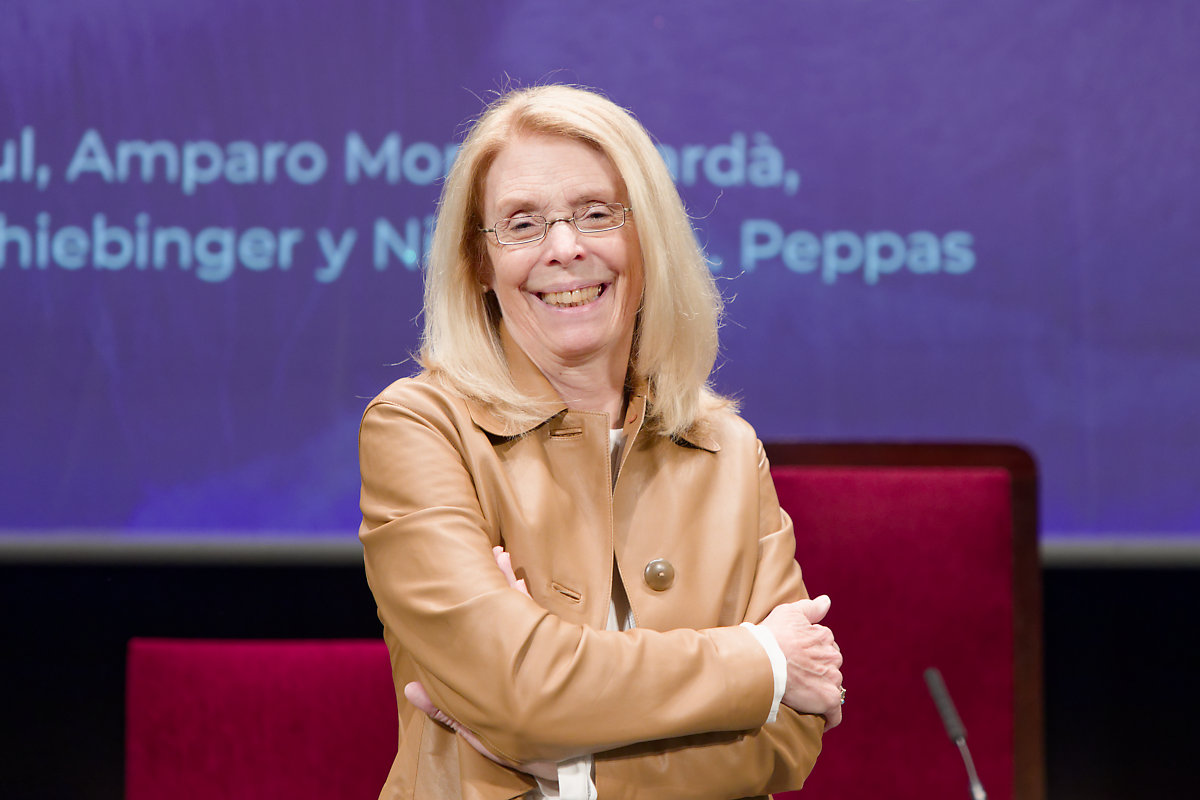
Londa Schiebinger.
Londa Schiebinger: Without inclusive science there is no future
The teacher Londa Schiebinger She is a professor of the History of Science at Stanford University and holds a doctorate from Harvard University. Since 2009, she has also directed a program on gender innovation in science, medicine, engineering and the environment, funded by the European Commission and the United States National Science Foundation.
The University of La Laguna awarded him what is now his sixth doctorate Honorary Cause, for her significant contribution to the understanding and improvement of social and gender inclusion in science and
Technology. This essential contribution has links to the history of the Canary Islands: Schiebinger has written books on topics as diverse as women in the origins of modern science in the 17th and 18th centuries, the time of the first founding of the University, or biodiversity and medicine in relation to colonialism and slavery in the Atlantic World.
The American researcher recalls that Carina González, professor in the Department of Computer Architecture and Technology at the University of La Laguna (ULL), who was the sponsor of her honorary doctorate, visited her office in April 2024, and they had a conversation that led to potential future collaborations. “This is how we worked on my global project, “Gendered Innovations.” We created shared content that we published on our website through multidisciplinary collaborations to develop methods for analysis by sex, gender, and intersectionality,” Schiebinger explains.
The specialist in the History of Science explains that they work with case studies that demonstrate that these analyses bring something new to science and technology that works for everyone, in addition to being a requirement as methodological tools demanded for the funding of projects by the European Commission.
Schiebinger is convinced that a Science done well is inclusive, innovative, and profoundly human. The effects of this new paradigm are evident in the progress made in universities over the last two decades.
For this reason, she is concerned about Trump's return to the White House, "the first convicted felon elected president of the United States," and the rise of far-right political movements in the West. She warns that "we must be vigilant and consider all that we can contribute as university professors. We still have academic freedom and can teach students to develop critical thinking, as we do in the Humanities, and in the Sciences we must point out how sex is a vital variable for biological studies.".
One of the conclusions of her scientific project is that flawed research has been shown to cost lives, while good research saves them. For example, in the field of medicine, the Stanford professor emphasizes that "sex and gender analyses are vital because we are talking about life-or-death situations." Until a few decades ago, women were excluded from research with the aim of "protecting" them, but the opposite has occurred, since "women and men have metabolic and other physical differences due to their biological sex," the researcher points out.
“We must invest in researching the difference in heart attack symptoms between men and women, as was done in the latest McKinsey Health Institute study from 2024, making women’s cardiovascular disease a priority; this will save many social resources and add many years of quality life for women.” Hence the importance of intersectional studies that also take into account those with fewer resources, Schiebinger points out.
Regarding Artificial Intelligence and the implementation of algorithms, the researcher points out that facial recognition doesn't accurately distinguish darker skin tones from lighter skin tones, or women from men. "This is because the developers of these programs are white men," a problem that has recently been addressed thanks to the database expansion work carried out by Joy Buolamwini, a researcher at the Massachusetts Institute of Technology.
Citing Google's efforts toward inclusion and diversity in its algorithms, the article presents the curious case of how its image generator might suggest a Native American man or an East Asian woman as possible answers to the question of who the founders of the United States were. "This is what I call aspirational AI; they're trying to create the world we want, but the algorithm fails when we ask it historical questions, it doesn't provide the facts… While there are many reasons to be excited, we must ensure that it doesn't create greater inequalities among people," the article concludes.
Connecting the Canary Islands with environmental sustainability, Schiebinger used the example of a study she conducted on marine organisms. These organisms have six different sexes, “which is very interesting from an evolutionary perspective compared to humans, who are rather boring,” she remarked with a smile. “We must understand how global warming impacts female organisms differently than male ones so that those who draft environmental laws can implement protective measures that encompass the entire marine population; if we only save female organisms, or vice versa, the population of these organisms will collapse.” This is why the future of science and all living beings on the planet depends on an intersectional approach, not only to continue advancing but also to ensure the survival of life as we know it.
Communications Office

 Spanish
 English
 French