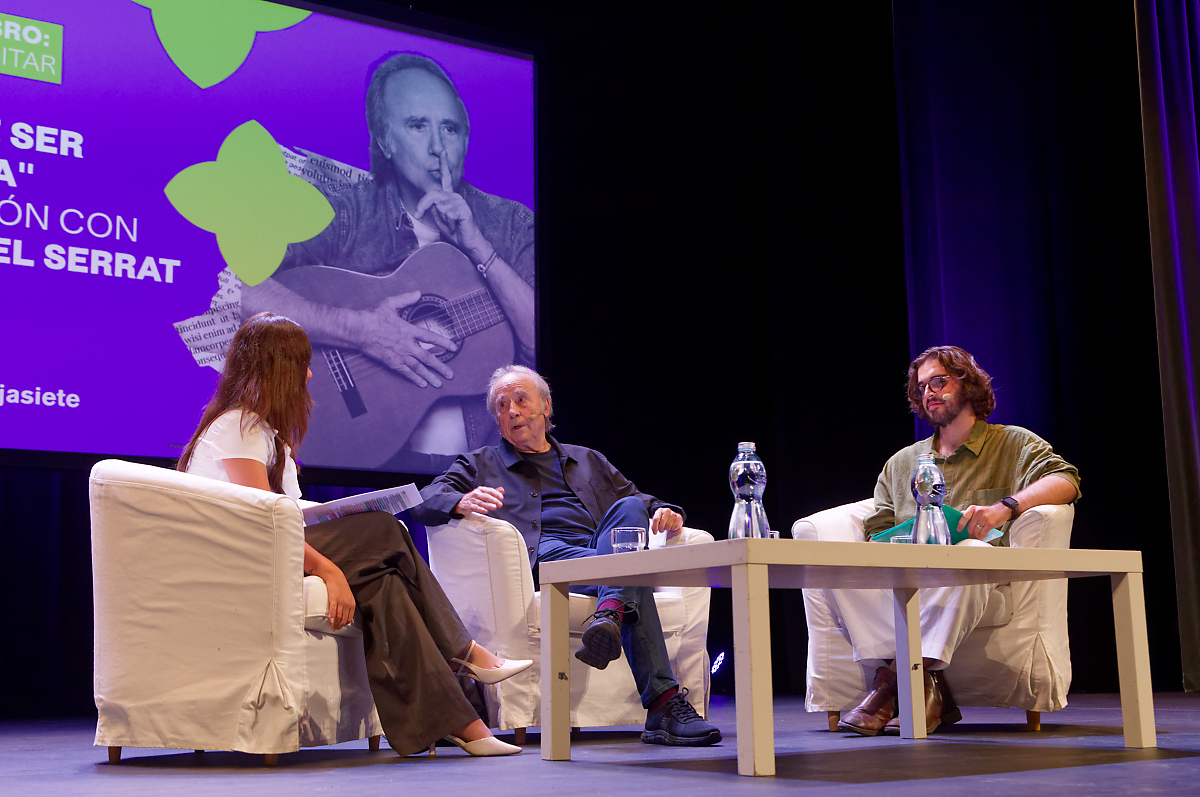
The Paraninfo of the University of La Laguna has hosted great artists throughout its history, leaving their mark on the hall's memory. Joan Manuel Serrat joined this tradition when, accompanied by the University Choir, he sang one of his most famous songs., Songs, as a closing to the conversation he held before a packed room with the students of the Philology Section of the Faculty of Humanities José Luis Saorín and Alba Rodríguez.
It was a special moment, as the singer-songwriter retired from the stage three years ago, and since then, his musical appearances have been infrequent. Although he initially only recited the lyrics, he ended up singing the final verses, accompanied by an enthusiastic audience that joined in on the chorus. It was the closing of an evening in which Serrat reviewed his career, explained details of his creative process, reaffirmed his social and political commitment, and expressed his concern about current issues such as climate change and the negative influence of technology and the oligarchs who control it.

Cervantes, in the initial performance.
Music also played a part at the beginning of the evening thanks to the group CervanTres, who performed versions of Serrat's repertoire, some of them very daring, such as Something personal with accompaniment of timple and murguero whistle, or a mEdley who merged two of his songs with women's names, Penelope y Lucia.
From university to concert hall
During the conversation, Serrat reminisced about his beginnings as a Biology student, a degree he abandoned in his third year, although it helped him develop an ecological awareness that has always been present in his thinking. “[Ramón] Margalef, who was one of the greatest thinkers our country has produced, was the one who taught me everything about ecology and our dependence on the environment. This created in me a great sensitivity towards it, and at the same time a pain and a need to constantly advocate for it.”.
During those university years, he had already released albums while pursuing his studies, and he combined both activities with a scholarship at the Pyrenean Institute of Ecology of the CSIC (Spanish National Research Council), until he realized he should focus on music. He recalled with amusement that he made this decision “much to the obvious displeasure” of his mother, although her unease didn't last long when she saw that her son was earning a good living, and also thanks to the support of his father, who helped smooth things over.
That maternal concern was not unfounded, given that her family's financial situation was far from comfortable: "You have to understand that I come from a working-class family, a humble family that had to make the sacrifice of sending their son to university." He explains that he, too, contributed to the family income by doing odd jobs and other paid work, and that income stopped coming in when he started his studies. There were scholarships and other forms of aid, but they were "meager.".
It was also crucial that one of his albums achieved great success at that time. “I think it was the first Catalan album to reach number one on the charts in Spain. And by then I was feeling a bit cocky, and I said to myself, 'That's it, goodbye, I'm going to dedicate myself to this.'‘ In that sense, Serrat acknowledged that he was fortunate that his musical career took off relatively quickly.
The political commitment
Political commitment was present from the beginning, even though the Francoist dictatorship was obviously not the most conducive period for free expression. For example, he was a member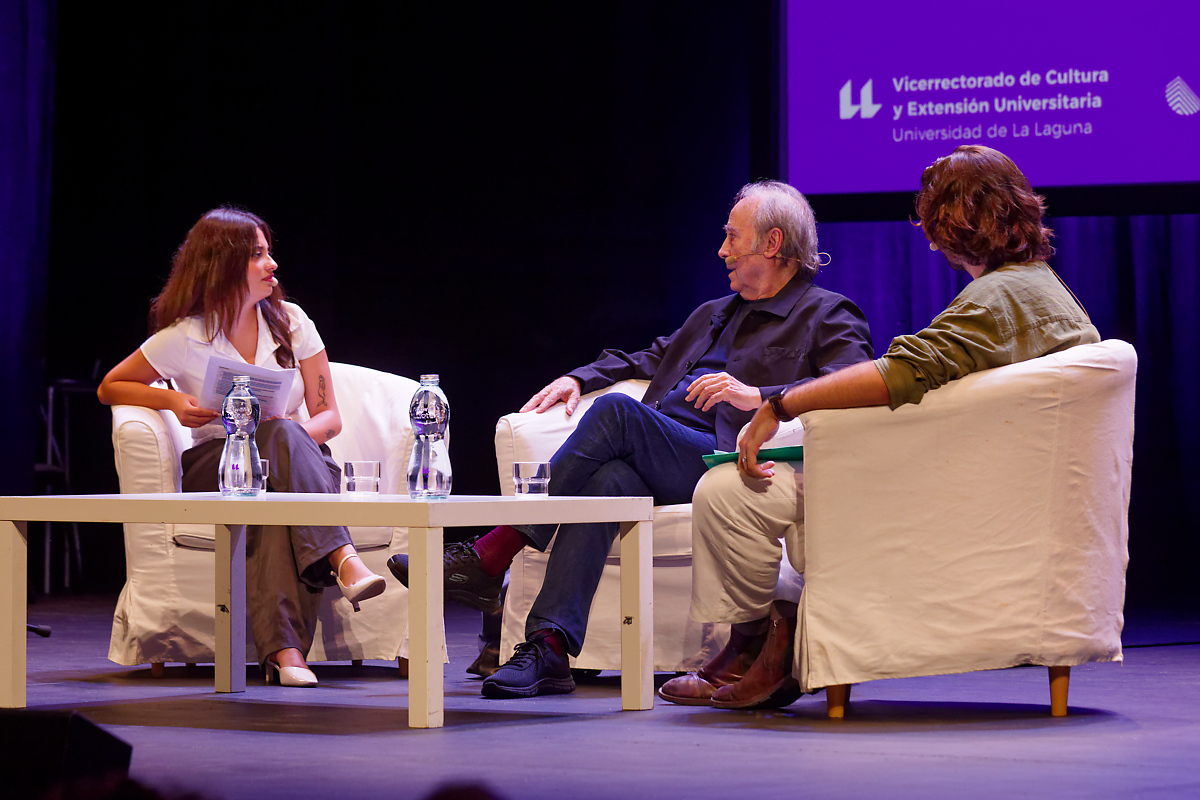 of the group The Sixteen Judges, who championed the use of Catalan beyond regional folklore, in a period when co-official languages were outlawed. Bilingualism is part of Serrat's identity, and when asked about his criteria for using Spanish or Catalan in his compositions, he explained that it's an organic process that, on many occasions, is dictated by the song's theme. For example, a song like My Carrer, which alludes to his childhood, could only be conceived in Catalan.
The singer-songwriter described the harsh conditions of pursuing a musical career during the era of censorship. “You can’t imagine how tough it was,” he emphasized before recalling how perfectly organized the censorship machinery was. Thus, on more than one occasion, the authorities demanded he change certain words in a song lyric because they accused him of, for example, alluding to the colors of the Republican flag (“And it was true,” he added). Furthermore, before each concert, he had to send the Civil Government delegation a list of the songs he was going to perform, which had to receive an approval stamp. In addition, an official would travel to the theater in question to verify that the repertoire was indeed as described.
His continued political activism during the dictatorship led to his exile in Mexico in 1975 to avoid arrest. This episode prompted the first question of the evening, reminding him of his arrival in Barcelona in August 1976 after his exile, when a journalist asked him if he was happy. Serrat explained that at that moment, “I was terrified, I didn’t know what was going to happen to me” because the Public Order Court was still active and he was still serving a sentence for insulting the Head of State. Therefore, his whereabouts during those first days after his return were kept secret to avoid being easily located by the authorities.
Given his life's journey, Serrat was very clear in stating that he finds it impossible to separate his creative side from his convictions: “I don't have one part of me that is political and another part of me that is artistic. First, because everything we do in life is political: any gesture, any attitude, any movement, any position—there's always a political stance behind it.” For this reason, he rejects the notion that there can be creators in equidistant positions: “An artist who says he's apolitical is right-wing,” he declared.
The present
Bringing the same question he was asked in 1976 into the present day, Serrat declared himself “grateful for life,” but looking at everything around him, he doesn't dare to call himself happy or optimistic. “I live with everything I see: the wars, the migrations, the problems with climate change that are upon us, which are truly very serious. We have a sword of Damocles hanging over our heads with global warming, and with the contempt with which those in power are confronting something that is a vital problem for the world.”.
The author has no confidence that current leaders are capable, or even willing, to solve these problems, as they remain stubbornly dependent on fossil fuels despite unequivocal signs such as increasingly scorching summers confirming the urgency of climate change. “They are destroying the world and they are happy, whistling and doing nothing.” fracking calmly waging war in Iran, or invading Venezuela to steal its oil.”.
Nor does he believe there are reasons for satisfaction regarding freedoms, even if there is no longer a censorship body like there once was. At least, not officially: “Censorship is always there, don't be fooled. It's in all media outlets; in the pressure they can exert through social media or digital pseudo-media. Censorship is present in imprisoning artists who sing songs that are considered vulgar or, in their view, dirty, or that disrespect institutions. Right now, there are people in jail for these kinds of offenses. In other words, don't try to fool us, censorship is real, and freedom of expression is a sham.”.
In this decidedly dystopian landscape, one can no longer rely on the certainty of words that once carried weight, such as "freedom." Regarding this, the singer-songwriter reflects that street protests continue to be repressed in many cases. "Poor freedom: in its name, how many atrocities are committed," he lamented at one point in the conversation. For all these reasons, he recapped his position. 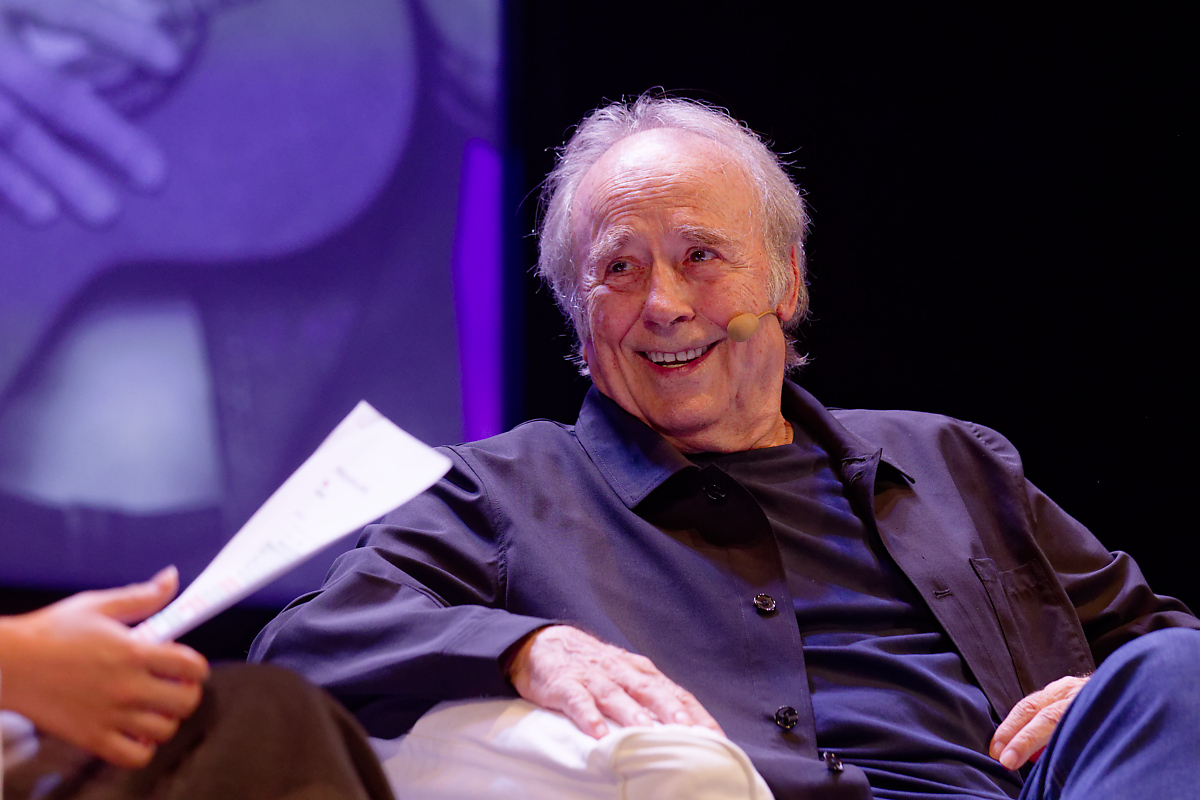 vital present explaining that he combats the pessimism of reality "with the optimism of necessity".
Ageism
At 82, Joan Manuel Serrat is very aware of the passage of time, and for that reason, among the many ills of the present he discussed, he focused particularly on ageism, that is, the discrimination against older people. “I know I’m an older person, verging on old. And it’s not that I know it because I’ve made some discovery, but because others tell me. If they didn’t tell me, I wouldn’t know and I’d be perfectly content with life,” he quipped before expressing his “pain and shame at living in a society that despises the elderly,” something he addressed in his song. Growing old, which is now three decades old and is still relevant.
The Catalan singer-songwriter links this contempt for old age to the current voracious socioeconomic model: “The elderly aren't profitable, and our society lives for profitability,” he sums up the issue with that devastating phrase. It's a model of coexistence in which the only value is money: it doesn't matter if one is successful in other facets or areas of life, the importance of doing things well isn't appreciated: the supreme value, the only one, is money. “Now, getting rich, even by stealing from public coffers, is success.”.
That's why he understands that in this materialistic environment, the elderly are looked down upon, because they represent knowledge; their wrinkles hold countless experiences and memories, a vital and intellectual wisdom that is systematically disregarded. He added that it's also shooting oneself in the foot, since everyone is destined to grow old. "That's why mistreating the elderly seems to me as absurd, ridiculous, and despicable as burning books.".
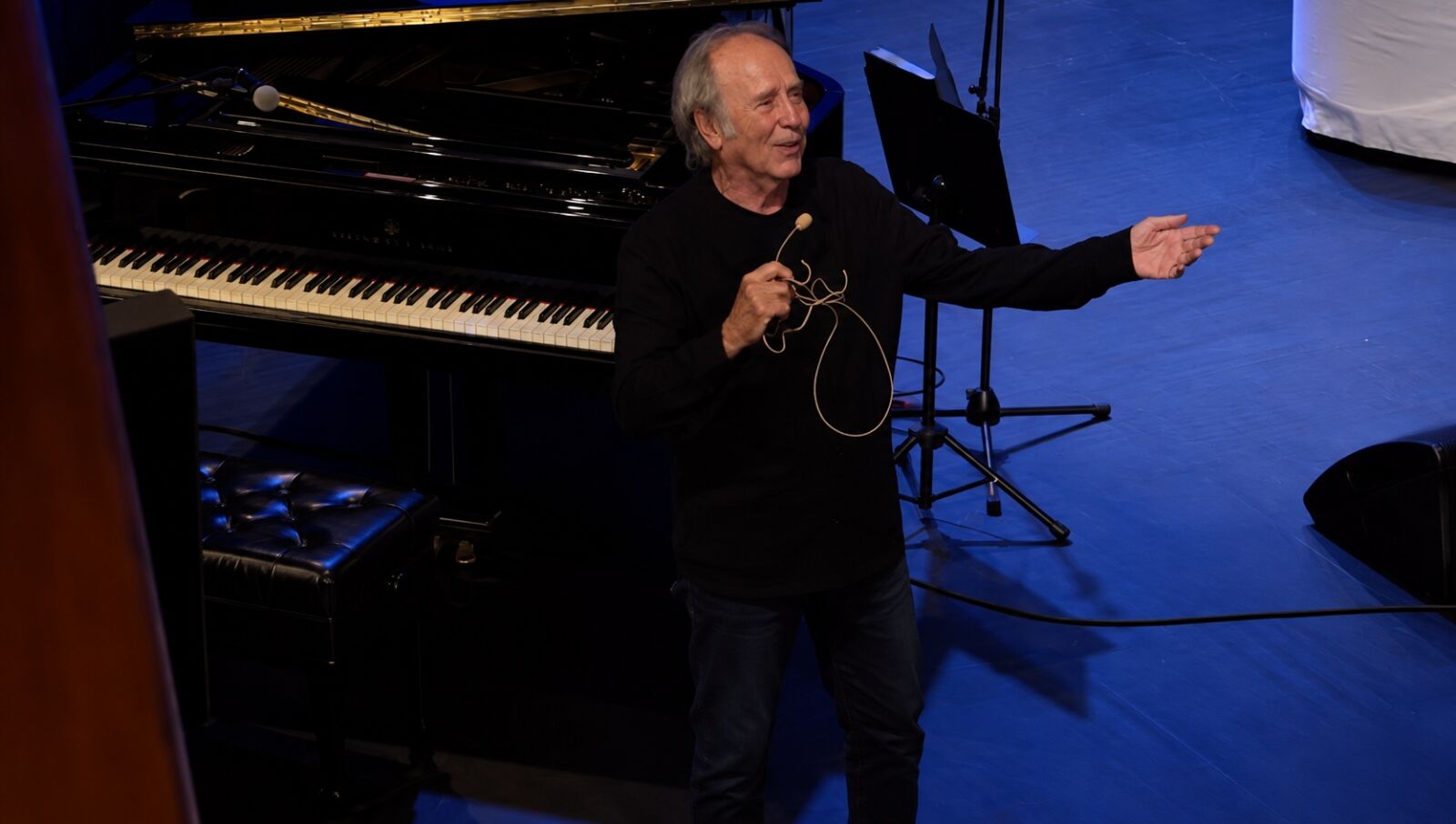
During her final performance with the University Choir.
The creative process
The dialogue with students from the Faculty of Humanities was part of the Vice-Rectorate for Culture and University Extension's overarching project, "Book Days: A Year to Inhabit the Word," which aimed to promote a love of reading. This explains why Serrat's presentation focused particularly on his literary side and, among other things, addressed his creative process.
He explained that when he's on tour, he jots down ideas that could become the seeds of a song, but developing them requires time and peace and quiet. He emphasized that his work is, above all, a craft, a job, and therefore requires hours of dedication. “I don't wait for an idea to come to me; I go after it. You have to have some talent, but without hard work, I'm sure you can't do anything at all in my profession or in any other I know that involves creation.” Days can pass between sitting down to write and finishing a song, but he explained the satisfaction he gets from seeing that in those lines that still need a lot of work, you can glimpse that “there's something there.”.
He compared the songwriting process to the mechanism of a steam engine: it starts slowly, with a very slow first revolution, then a slightly faster one, and after running for a reasonable amount of time, it finally reaches optimal speed and the process moves forward smoothly. He also explained that he doesn't write individual songs, but rather songs framed within a specific conceptual idea that has almost always resulted in a complete album, and that his lyrics always have a strong narrative component that helps him better define what he wants to express.

University choir
Poetry
Antonio Machado, Mario Benedetti, Miguel Hernández, Violeta Parra, and Joan Salvat-Papassei are some of the poets who have inspired Serrat to turn some of their works into songs. “The poet chooses me when I read them and discover that there’s a song there, something that particularly moves me and that the guitar can play,” he explains. “It’s a coincidence that I discover something that, with deep envy, I would have loved to write myself,” he explains with a touch of irony.
It often happens that when he falls under the spell of a work, he also ends up falling in love with its author: “Both Machado and Hernández are two figures who evoke in me, in very different ways and for reasons that are sometimes similar and sometimes very different, great sympathy, great empathy, and great emotion.” He also acknowledged the responsibility that comes with this type of adaptation, because sometimes the popularity of the song ends up overshadowing the poet's original work; in that sense, he recalls a review he liked that noted that “Antonio Machado was a wonderful and magnificent poet, even before Serrat sang his songs.”.
Despite this connection to literature, Serrat distinguished songwriting from poetry, making it very clear that they are very different genres even though they may have many similarities. “A good poet isn't necessarily a good songwriter, especially if they don't work with precise verse, with traditional verse, so to speak.”.
The conversation lasted over an hour, and many topics were covered in the pleasant, entertaining, and at times moving exchange: from the time he now dedicates to reading to the literary works he has recently discovered (such as Albert Camus's *The First Man*), to his concerns about Artificial Intelligence and the sinister ideology of the Dark Enlightenment championed by the tech billionaires of Silicon Valley, among others. He also reminisced about his time in the Canary Islands, highlighting highlights such as discovering the Indian bazaars, meeting Antonio Machín at a cabaret in Las Palmas de Gran Canaria, and renting a convertible on one of his first visits: “You know, wandering around here in my early twenties and under these circumstances… I had an amazing time.”.
Recording of the full meeting:
Communications Office

 Spanish
 English
 French