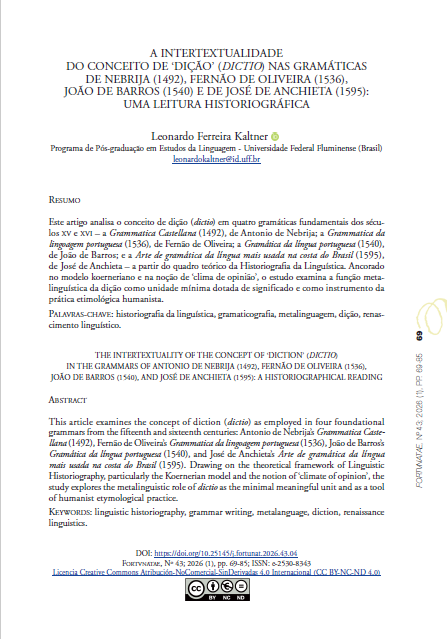
The intertextuality of the concepti or ‘diction’ (dictio) in the grammars of Antonio de Nebrija (1492), Fernão de Oliveira (1536), João de Barros (1540) and José de Anchieta (1595): a historiographical reading
DOI:
https://doi.org/10.25145/j.fortunat.2026.43.04Keywords:
linguistic historiography, grammar writing, metalanguage, diction, renaissance linguisticsAbstract
This article examines the concept of diction (dictio) as employed in four foundational grammars from the fifteenth and sixteenth centuries: Antonio de Nebrija’s Grammatica Castellana (1492), Fernão de Oliveira’s Grammar of Portuguese Language (1536), João de Barros’s Grammar of the Portuguese Language (1540), and José de Anchieta’s Grammar of the Language Most Used on the Coast of Brazil (1595). Drawing on the theoretical framework of Linguistic Historiography, particularly the Koernerian model and the notion of ‘climate of opinion’, the study explores the metalinguistic role of dictio as the minimal meaningful unit and as a tool of humanist etymological practice.
Downloads
References
ANCHIETA, J. DE (1990) [1595]: Arte de gramática da língua mais usada na costa do Brasil, A. CARDOSO, Loyola, São Paulo.
AUROUX, S. (1986): «Histoire des sciences et entropie des systèmes scientifiques», Archives et documents de la Société d’histoire et d’épistémologie des sciences du langage, (1re série) 7: 1-26. DOI: https://doi.org/10.3406/hel.1986.3346 [27/02/2026].
AUROUX, S. (1992): A revolução tecnológica da gramatização, Editora da Unicamp, Campinas.
BARROS, J. DE (1540): Grammatica da lingua portuguesa, apud Lodouicum Rotorigiu[m], Typographum, Olyssipone. http://ctlf.ens-lyon.fr/textes/3302_por_Barros_01_1540_T01.htm [27/02/2026].
BATISTA, R. O. (org.) (2019): Historiografia da Linguística, Contexto, São Paulo.
BECHARA, E. (2009): Moderna gramática portuguesa, Nova Fronteira, Rio de Janeiro.
BUESCU, M. L. C. (1984): Historiografia da Língua Portuguesa, Sá da Costa, Lisboa.
CAVALIERE, R. (2001): «Anchieta e a língua falada no Brasil do século XVI», Revista portuguesa de humanidades 5 (1-2): 11-21.
CURIEL, M. (2022): «Etimología ? dición en la obra castellana de Nebrija: los accidentes de especie y figura y su continuidad en la teoría gramatical», J. G. ASENCIO - C. Q. VAN DEN BERGHE, Antonio de Lebrixa «Grammatico» en su medio milenio, Universidad de Salamanca, Salamanca, pp. 167-201.
KALTNER, L. F. (2020): «Regna Brasillica: contextualização da Arte de gramática da língua mais usada na costa do Brasil (1595)», Revista da ABRALIN 19 (1): 1-25. https://revista.abralin.org/index.php/abralin/article/view/1379 [09/11/2022]. DOI: https://doi.org/10.25189/rabralin.v19i1.1379.
KOERNER, E. F. K. (1996): «Questões que persistem em historiografia linguística», Revista da ANPOLL (Associação Nacional de Pós-Graduação e Pesquisa em Letras e Linguística) 2: 45-70.
KOERNER, E. F. K. (2014): Quatro décadas de historiografia linguística: estudos selecionados, Centro de Estudos em Letras da Universidade de Trás-os-Montes e Alto Douro (UTAD), Vila Real.
MARÇALO, M. (2008): «Dição, vocábulo ou palavra: reflexões para umaTeoria da Linguagem em Fernão de Oliveira», Confluência – Revista do Instituto de Língua Portuguesa do Liceu Literário Português 35-36: 29-36.
NAVARRO, E. (2013): Dicionário de tupi antigo: a língua indígena clássica do Brasil, Global, São Paulo.
NEBRIJA, A. DE (1992) [1492]: Gramática sobre la lengua castellana, M. Á. ESPARZA - R. SARMIENTO, Fundación Antonio de Nebrija-SGEL, Madrid.
OLIVEIRA, F. DE (1975) [1536]: Gramática da linguagem portuguesa, introdução, leitura actualizada e notas por M.ª L. C. BUESCU, Imprensa Nacional - Casa da Moeda, Lisboa.
SWIGGERS, P. (2013): «A historiografia da linguística: objeto, objetivos, organização», Confluência – Revista do Instituto de Língua Portuguesa do Liceu Literário Português 44-45: 39-59.
ZWARTJES, O. (2011): Portuguese Missionary Grammars in Asia, Africa and Brazil, John Benjamins, Amsterdam.
Downloads
Published
Issue
Section
License
Authors retain copyright and grant the journal the right to be the first publication of the work as well as license it under a Creative Commons Attribution License that allows others to share the work with acknowledgment of authorship of the work and initial publication in this magazine.
Authors may separately establish additional agreements for the non-exclusive distribution of the version of the work published in the journal (for example, placing it in an institutional repository or publishing it in a book), with an acknowledgment of its initial publication in this journal.