eISSN: 2530-8343
ISSN: 1131-6810 (no longer active)
DOI: 10.25145/j.fortunat

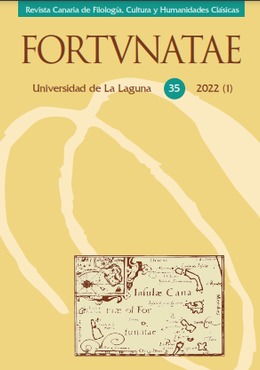
Fortunatae number 35 gathers nine articles and a review, in four different languages (Spanish, English, Italian, and Portuguese). Once again, the multidisciplinary nature, originality, rigour of the proposals, and their international focus, spearhead journal content.
In five articles that revolve around Greek philology, Evelia Arteaga focuses on the use of the term φιλοψυχία (love for life) in diverse genres of Greek literature and its concurrence in contexts with positive or negative connotations. Eirini Briakou explores Euripides’ Hecuba with an analysis from the audience’s point of view, highlighting how attention to the audience appears in the work itself. The theatre, this time in relation to metrical aspects (medial caesura) is the theme of Máximo García and Felipe Hernández’s article. The historical fact of the mutilation of the Herms in 415 BC, and its treatment from the point of view of Greek historians, biographers, and orators, is addressed by Priscilla Gontijo. The ζηλοτυπία (love-related jealousy) testified in numerous genres and sources from the Greek imperial ages is the subject of Claudia Palma’s article. Finally, from Arabic and Greek philology, Adalberto Magnelli and Giuseppe Petrantoni make a new proposal about historical events in 12th-century Sicily, based on Arabic texts and referencing Greek sources.
In studies of Latin philology, Guillermo Aprile examines the appearance and consideration of the figure of the doctor in various historiographical texts. José Medrano focuses on two paragraphs from the Naturales Quaestiones, to study Seneca’s theme of living in accordance with nature through knowledge. In the field of didactics, Eveling Garzón analyses the lexicon of the Latin texts used for university access examinations in Spain, concluding with a proposal.
This issue ends with a polished review by Nicolás Russo of the latest bilingual Italian edition of Tacitus’ Germania.

Indexed in:




This work is licensed under CC BY-NC-ND 4.0


