Against father Mariana: the historiographic censorship of his Historiae de rebus Hipaniae libri in El Árbitro de Fernando de Ávila y Sotomayor
DOI:
https://doi.org/10.25145/j.fortunat.2026.43.08Keywords:
Juan de Mariana, Historiae, Fernando de Ávila y Sotomayor, Árbitro, Historia General de EspañaAbstract
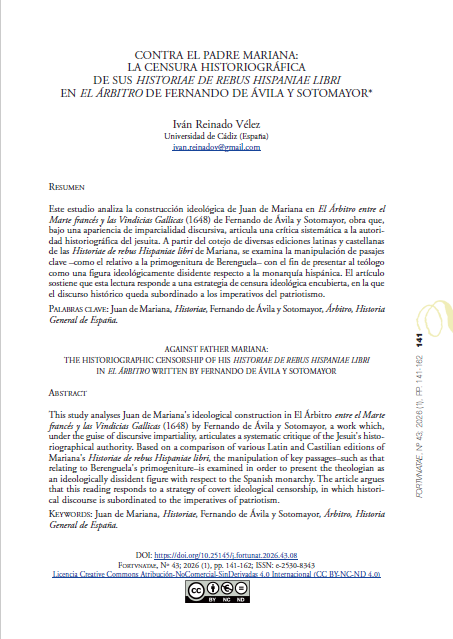
This study analyses Juan de Mariana's ideological construction in El Árbitro entre el Marte francés y las Vindicias Gallicas (1648) by Fernando de Ávila y Sotomayor, a work which, under the guise of discursive impartiality, articulates a systematic critique of the Jesuit's historiographical authority. Based on a comparison of various Latin and Castilian editions of Mariana's Historiae de rebus Hispaniae libri, the manipulation of key passages–such as that relating to Berenguela's primogeniture–is examined in order to present the theologian as an ideologically dissident figure with respect to the Spanish monarchy. The article argues that this reading responds to a strategy of covert ideological censorship, in which historical discourse is subordinated to the imperatives of patriotism.
Downloads
References
ALVAR EZQUERRA, A. (2009): «El sentido histórico de la “Historia de España” del padre Mariana», Torre de los Lujanes 65: 51-74.
ARRANZ LAGO, D. F. (2009): «Quevedo contra Richelieu: Visita y anotomía, sátira menipea y aguja de navegar cabezas cardenalicias», La Perinola 13: 167-182. https://doi.org/10.15581/017.13. 27915.
CENTENERA SÁNCHEZ-SECO, F. (2009): El tiranicidio en los escritos de Juan de Mariana, Dykinson, Madrid.
CIROT, G. (1904): «La famille de Juan de Mariana», Bulletin hispanique 6 (4): 309-331. https://doi.org/10.3406/hispa.1904.1419.
CIROT, G. (1905): Études sur l’historiographie espagnole: Mariana historien, Feret et fils éditeurs, Paris.
CIROT, G. (1936): «Mariana jésuite. La jeunesse», Bulletin Hispanique 38 (3): 295-352. https://doi.org/10.3406/hispa.1936.2729.
FEIJÓO Y MONTENEGRO, B. J. (1726): Teatro crítico universal, discursos varios en todo género de materias, para desengaño de errores comunes: tomo primero, Joaquín Ibarra (Impresor de Cámara de S.M.), Real Compañía de Impresores y Libreros, Madrid.
FERNÁNDEZ DE LA MORA, G. (1993): «El proceso contra el padre Mariana», Revista de Estudios Políticos 79: 47-99.
FERNÁNDEZ VALVERDE, J. (1989): Historia de los hechos de España de Rodrigo Jiménez de Rada, Alianza Editorial, Madrid.
GARZÓN-BLANCO, A. (1976): «The jesuit Tragedia de San Hermenegildo, Seville, 1590», Explorations in Renaissance Culture 3: 1-19. https://doi.org/10.1163/23526963-90000016.
GRACIÁN, B. (1914): Criticón (ed. Julio CEJADOR Y FRAUCA), Editorial Renacimiento, Madrid.
LASKE, T. (2018): «El Inca Garcilaso para la mundanidad parisina: Jean Baudoin y su publicación en Francia de la segunda parte de los Comentarios Reales», Revista del Instituto Riva-Agüero 3:263-283. https://doi.org/10.18800/revistaira.201802.008.
MAESTRE MAESTRE, J. M.ª (1990): El humanismo alcañizano del siglo XVI. Textos y estudio de latín renacentista, Servicio de Publicaciones de la Universidad de Cádiz, Cádiz.
MORENO GALLEGO, V. (2008): «Juan de Mariana ante la imprenta de Luis Sánchez. El textus receptus de la Historia General de España», Bulletin hispanique 110 (1): 111-144. https://doi.org/10.4000/bulletinhispanique.516.
OLMEDO RAMOS, J. (2011): «Semblanza y andanza del padre Mariana», Cabeza encantada: Humanism e-review 1: 1-11.
PÉREZ MAGALLÓN, J. (2013): «Jansenio, agustinismo y la batalla propagandística entre Francia y el imperio hispánico», Criticón 118: 137-149. https://doi.org/10.4000/criticon.357.
PÉREZ PASTOR, C. (1887): La imprenta deToledo: Descripción bibliográfica de las obras impresas en la imperial ciudad desde 1483 hasta nuestros días, Impresor de Cámara de Su Majestad, Madrid.
REYMÓNDEZ DEL CAMPO, J. (1908): «Correspondencia epistolar del P. Andrés Marcos Burriel, existente en la Biblioteca Real de Bruselas», Boletín de la Real Academia de la Historia 52: 181-267.
SÁNCHEZ TORRES, F. (2020): «Modificaciones en la segunda edición de los De Rege et Regis institutione libri tres de Juan de Mariana», eClassica 6: 115-130. https://helvia.uco.es/xmlui/handle/10396/35413.
SÁNCHEZ TORRES, F. (2024a): «El tiranicidio en la obra pedagógica del padre Mariana y su respuesta en el Antimariana», Analecta Malacitana 45: 31-46. https://doi.org/10.24310/analecta45202421085.
SÁNCHEZ TORRES, F. (2024b): «Un comentario crítico-filológico a las ediciones de la obra historiográfica del padre Juan de Mariana», Studia PhilologicaValentina 26: 45-60. https://doi.org/10.7203 /SPhV.26.28040.
SÁNCHEZ TORRES, F. (2024c): «“Desirer que Ravaillac eust leu Mariana”: la segunda condena de Mariana en la censura de la Response apologetique à l’Anticoton», Talia dixit 19: 53-71. https://doi.org/10.17398/1886-9440.19.53.
SERÍS, H. (1963): «Lope de Vega y los sevillanos. Una carta inédita del Fénix», Bulletin hispanique 65: 20-34. https://doi.org/10.3406/hispa.1963.3760.
Downloads
Published
Issue
Section
License
Authors retain copyright and grant the journal the right to be the first publication of the work as well as license it under a Creative Commons Attribution License that allows others to share the work with acknowledgment of authorship of the work and initial publication in this magazine.
Authors may separately establish additional agreements for the non-exclusive distribution of the version of the work published in the journal (for example, placing it in an institutional repository or publishing it in a book), with an acknowledgment of its initial publication in this journal.