eISSN: 2530-8343
ISSN: 1131-6810 (no longer active)
DOI: 10.25145/j.fortunat

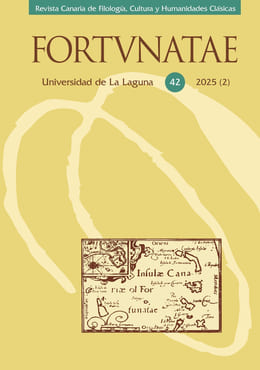
As always, Fortunatae remains committed to publishing high-quality scholarship across all areas of classical studies and to further strengthening its international profile. Issue number 42, which contains seven articles and three reviews, opens with Thomas Acevedo Algarbe’s “Pudicitia and Sexual Desire in the Representation of Octavia and Poppaea: Historical–Mythological Paradigms of Femininity in Tacitus’ Annales and the Octavia of Pseudo-Seneca”. From the notion of pudicitia, Acevedo Algarbe posits the contrast between both characters, based on their associated sexual behaviours and protocols, along with the development of these two models of femininity as different perspectives on imperial violence and the points of contact and divergence that can thus be established between the historiographical genre and Roman tragedy.
“The power of proof: On verosimile and probabile in Ciceronian Rhetoric” by Lorelei Cisneros and Marcela Coria examines the complex relationship between falsum, verum, and the problem of knowledge in the writings of Cicero. The range of concepts that emerges, paradoxically, fails to uphold the opposition between what is true and what is false, leading to a study of the semantic peculiarities of verosimile and probabile, and their reworking from Aristotle’s Rhetoric.
In “The Prologue of Plautus’ Menaechmi and the Opening Scene of Shakespeare’s The Comedy of Errors (i.1.1-160): a Comparative Analysis”, Anthofili Kallergi explores how Shakespeare's Comedy of Errors (in particular scene I.1) moves away from Plautus’ Menaechmi in its adaptation and interpretation, creating a more complex plot from the very start of the play.
“The Pompeian theme decoration in Schliemann’s house in Athens” by Antonio Ramón Navarrete Orcera studies the frescoes that decorated archaeologist Heinrich Schliemann’s house in Athens and demonstrates that the mythological themes are a faithful representation of the frescoes of the most important houses discovered in Pompeii, today preserved in the National Archaeological Museum of Naples.
In “The restraint of the Alcmaeonids, according to Herodotus: The wedding of Agariste and Megacles”, Ángel Ruíz Pérez scrutinises the episode of the wedding contest arranged by Cleisthenes, tyrant of Sicyon, for his daughter Agariste, which is only preserved in Herodotus (6.126–131). Ruíz Pérez thoroughly analyses the verb κατέχω—the central term of the entire episode and key to understanding it—through an in-depth study of the episode’s most defining historical, literary, and folkloric aspects.
In “Fellini-Satyricon, a free adaptation of Petronius Arbiter’s novel: A comparative reading”, Gelbart Souza Silva and Cláudio Aquati examine the way and the extent to which a wide variety of literary genres, discourses, and languages used in the development of Petronius’ critical and creative Roman novel come together and are transposed, rearranged, and transformed in the modern film discourse of Federico Fellini.
Finally, in “Knowledge and self-government in Horace’s Satire 2, 7”, Mariano Zarza highlights the role reversal in this satire, since the satirist is not the poet Horace but his slave Davus. By giving voice to this character to make fun of his own faults, the poet is being self-critical and perhaps subtly reproaching the powers-that-be.

Indexed in:




This work is licensed under CC BY-NC-ND 4.0


