Faculty of Sciences
Anchieta Campus
Infrastructure and services
Chemistry Section
The Chemistry Section has the following material resources and services:
Resources needed for each subject
The necessary infrastructure for the proper development of each subject (teaching rooms, laboratories, computer rooms, etc.) is indicated in the timetable for both the Bachelor's Degree in Chemistry as for the Bachelor's Degree in Environmental Sciences.
The following describes, in a general way, the material resources available to the Chemistry Section that ensure optimal development of the teaching it provides.
Teaching Classrooms
The Chemistry Department at the University of La Laguna has 23 classrooms, 4 of which are assigned to the Bachelor's Degree in Industrial Chemical Engineering. The remaining 19 classrooms are used for the Bachelor's Degree in Chemistry (morning session), the Bachelor's Degree in Environmental Sciences (morning session), and the Master's Degree in Chemistry (afternoon session). The classrooms are adequately equipped to ensure effective teaching, allowing for the planned group sizes and adapting to the teaching and learning methodology.
Each degree program has specific classrooms assigned for lecture-problem sessions (large groups) based on the number of students enrolled in the course with the highest enrollment per year. If the training activity includes splitting classes (medium or small groups), smaller classrooms are used. The number of classrooms is sufficient, especially considering that split classes do not occur every day at all times. Split classes that require the use of multiple classrooms are held for each year group at the same time slot but at a different time: two years do not split classes simultaneously (except in very specific cases).
The center has four classrooms with a capacity of 24 students each and two more with a capacity of 36 students each. These classrooms are unique in that the seating is not fixed, making them ideal for teaching and learning methodologies aligned with the European Higher Education Area (EHEA). The classrooms offer excellent natural light and acoustics; they are fully accessible and equipped with standard teaching and learning equipment: a whiteboard, a computer with internet access, digital projectors, a projection screen, and Wi-Fi.
There is a Graduation Hall and a Conference Room, both equipped with the same equipment as the classrooms and in which there is also a sound system installed in the first, and a multimedia system for holding videoconferences and a digital whiteboard, in the second.
In addition to the classrooms of the Center, the Departments involved in teaching the degree frequently use their classrooms/seminar rooms which are generally equipped with a whiteboard, digital projector, projection screen and Internet connection.
In the afternoon, only one classroom is used for the Master's in Chemistry course, so the Over 25 Course has several classrooms in the Center available for its instruction.
Laboratories, workshops and experimental spaces
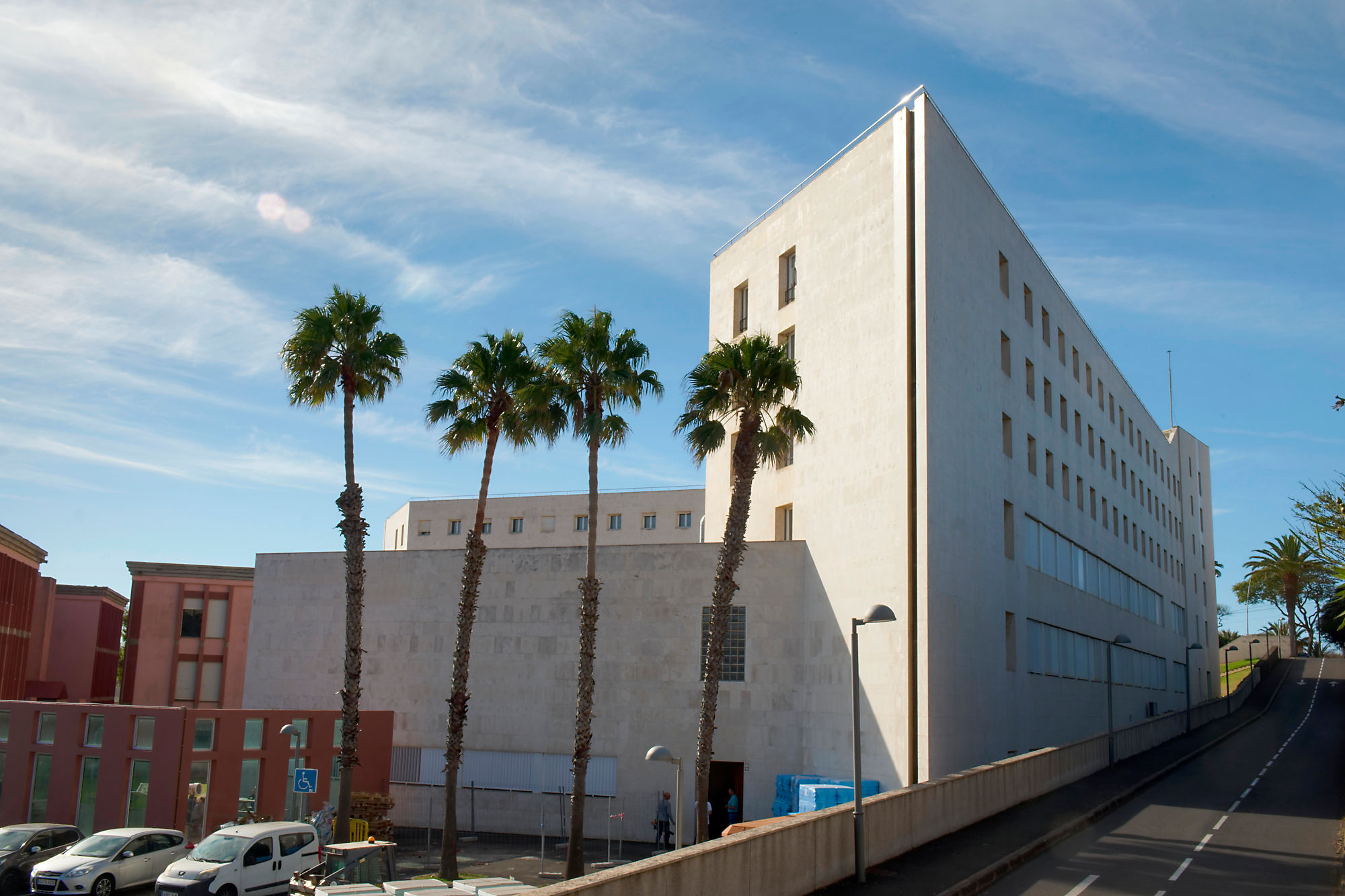
The material resources (spaces, facilities, laboratories, scientific and technical equipment) are sufficient to ensure the proper functioning of the teaching. The experimental laboratories are located in the different departments/departmental units involved in the training program; most of them are part of the Chemistry Section (Chemical Engineering and Pharmaceutical Technology, Analytical Chemistry, Physical Chemistry, Inorganic Chemistry, and Organic Chemistry). The main part of the Section's building was constructed in 1995 and the Annex in 2003, so the laboratories are currently in optimal condition. In most cases, the laboratories are shared with other degree programs in which the corresponding Department is involved.
The laboratories are equipped with high and low workbenches, with grating for mounting equipment, and are supplied with compressed air, water, and vacuum systems, fume hoods, cabinets and display cases for storing materials and reagents, safety measures such as eyewash stations and showers, as well as emergency exits. It is worth noting that the Department of Chemical Engineering and Pharmaceutical Technology has a four-story industrial building, three of which are dedicated to student practical training. Each floor has an area of approximately 250 m².2, Each laboratory is equipped with modular facilities and currently has the capacity to install new equipment. The lighting, acoustics, and safety conditions in the laboratories are good, and there are no architectural barriers.
In addition to the specific laboratory equipment, the General Research Support Services of the University of La Laguna are also available.
Academic Staff Space
The professors involved in the Section's training programs have offices in their respective Departments, the vast majority of which are individual, with an average area of 12.5 m²2. The Departmental Units have meeting rooms suitable for holding meetings of academic staff. The Section also has a Multipurpose Room and a Boardroom available for faculty use, as well as four shared offices organized by area of knowledge for the use of professors.
Library
The Chemistry and Biology Library houses the collections of the Chemistry and Biology Sections. It is located in the Chemistry building and has a usable area of 1,012 m².2, of which 642 m2They correspond to the library and 370 m2 to the newspaper archive.
The library consists of a reading room with capacity for 210 students distributed in 48 tables as reading stations, 9 tables with 18 CLABE stations (computers with Internet connection and to consult the catalog) and 19 shelves with direct access monographs.
The newspaper library has a reading room with 27 seats, of which 19 are reading seats and 8 are CLABE seats, in addition to a display for the most recent periodicals.
It has a repository for monographs, final year projects, and ongoing periodicals. Closed-end publications are kept in a compact repository located in the same section.
The library has two offices for group work with 10 workstations and one CLABE workstation in each.
Regarding opening hours, in general, the library remains open from Monday to Friday from 8:15 a.m. to 8:30 p.m., with reduced hours during certain periods of the year, after prior notice to users.
In addition, next to the Chemistry building is the ULL-Caja Canarias Student Services Building, which includes a 24-hour study room. The Chemistry and Biology Library's collection comprises approximately 20,000 monographs and 688 periodical titles in print. Currently, the Center's policy is to prohibit faculty members from including bibliographic references in the Course Guide unless the books have been previously purchased. At the end of the academic year, the Center places an annual book order based on usage statistics.
The Chemistry and Biology Section library provides the following services:
Computer Resources
The computer resources are sufficient and adequate to guarantee the proper functioning of the teaching.
Meeting room
The center has two meeting rooms, a Board Room and a Multi-Purpose Room, where coordination meetings, information meetings, etc. are held.
Other departments
The following are available to students:
The Chemistry Department, within its Internal Quality Assurance System, has a procedure, PR-22, "Service Management." This procedure defines how the Chemistry Department ensures the proper management of the services it provides to the university community, both those managed internally ("internal") and those contracted to external companies ("external"), to adapt to the needs and expectations of its stakeholders. Likewise, there is a procedure, PR-15, "Management of Deviations, Incidents, Complaints, and Suggestions," which defines the Chemistry Department's procedures for handling and managing deviations, incidents, complaints, and suggestions submitted by any stakeholder. This ensures their thorough investigation and effective response, and that the necessary measures are taken to satisfactorily resolve any issues that may arise.
The Dean's Office is responsible for defining the objectives of the Faculty's internal services. The heads of these services are responsible for defining and planning their activities. The Quality Officer is responsible for disseminating information about the services' activities and objectives.
External Services
Internal Services
| Secretariat | |
|---|---|
| Responsible | Elena Gallego Agulló (Administrator) |
| Goals | – Reception and processing of all documents and written submissions presented by interested parties – Personalized attention regarding any query about the administrative processes of the University and especially those specific to this Faculty – Management of personal academic records – Issuance of all types of certificates related to the student's academic record – Registration – Processing of files for the issuance of the corresponding degrees, etc. |
| Goal | |
|---|---|
| Responsible | Alicia M. Sánchez López (Concierge) |
| Goals | – Information on the location of different departments within the building – Building access control – Supervision of infrastructure maintenance – Mail management – Replenish the consumable materials needed for teaching – Closing and opening of classroom doors and other facilities |
| Deionized water | |
|---|---|
| Responsible | Alicia M. Sánchez López (Concierge) |
| Goals | To offer deionized water for use in both teaching and research. |
| Generator | |
|---|---|
| Responsible | Alicia M. Sánchez López (Concierge) |
| Goals | To provide electricity in the event that the external supplier stops doing so. |
| Computer Labs | |
|---|---|
| Responsible | Alejandro González Orive |
| Goals | The primary objective of the computer labs is to serve as a teaching tool; in this sense, computer help and support will be offered to teachers and students for use in academic activities. |
| Compressed air and vacuum | |
|---|---|
| Responsible | Alicia M. Sánchez López (Concierge) |
| Goals | Maintaining the supply of compressed air and vacuum in the Departments' laboratories for use in both Teaching and Research |
| Section Website | |
|---|---|
| Responsible | Vicente Valverde Hernández (Administrative Officer of the Dean's Office) |
| Goals | To offer via the Internet all the information about the Training Programs taught by the Section as well as all the relevant information about it for the different interest groups |
| Photocopier | |
|---|---|
| Responsible | Alicia M. Sánchez López (Concierge) |
| Goals | To offer a photocopying service to the teaching and research staff and administrative and service staff of the Faculty |