Faculty of Humanities
Guajara Campus
Infrastructure and services
Philosophy Section
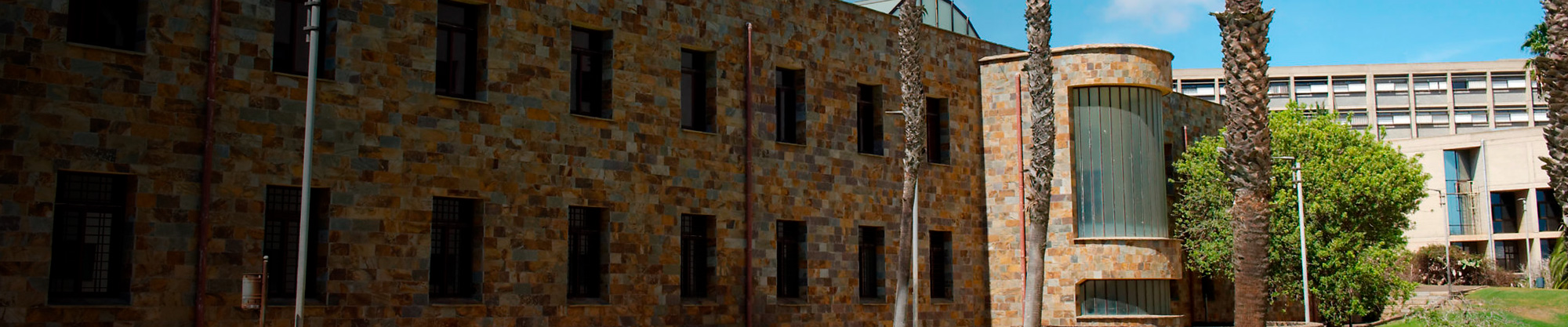
The Philosophy Department is part of the Guajara Campus. The layout of the buildings, roads, and gardens gives the entire complex an excellent environmental quality. The Philosophy Department has its own departmental building, located between the parking area and the General and Humanities Library. Much of the teaching takes place in the Guajara Classroom Annex (2003-04), which, like the General and Humanities Library, is shared with the other departments of the Faculty of Humanities.
The Philosophy Department building houses the general offices, the offices of the professors who teach in the Section, and the research staff attached to it.
All campus buildings have elevators and ramps to eliminate architectural barriers, as well as fire safety measures (alarms, fire extinguishers, etc.).
Teaching infrastructure
Teaching is carried out in two types of facilities: the classrooms available in the Annex Building to the Classroom Building and the Graduation Hall, multimedia seminars and computer room, located in the departmental building
Classrooms
In the building adjacent to the General Lecture Hall of the Guajara Campus, the Philosophy Section has a total of 4 classrooms, which are distributed in morning and afternoon shifts between the Degree in Philosophy, the Master of Research in Philosophy and the Master in Gender and Equality Policies.
Regarding the provision of teaching equipment, it can be stated that the classrooms are conveniently equipped with the usual means for teaching, both face-to-face and telepresence (projection screen, computer, projector, camera, microphone, speakers and internet connection).
| Classrooms | |
|---|---|
| Classroom | Capacity |
| 4.7 | 50 |
| 4.6 | 40 |
| 4.5 | 40 |
| 3.4 | 40 |
Seminars and other teaching facilities
The Departmental Building has four seminar rooms (of different capacities) and a Graduation Hall, which are also used for face-to-face and telepresence teaching, being equipped with the means to make presentations and videoconferences with optimal quality, all having, at a minimum, mobile equipment with 65-inch televisions and NUC-type computers.
Library and Newspaper Archive
The ULL library is organized by center collections, so that the bibliographic acquisitions made by the departments involved in the degrees of the Section are cataloged and installed in the Philosophy collection, which occupies the fifth floor of the General and Humanities Library.
The General and Humanities Library organizes its bibliographic collection for direct access, so the arrangement of the collection on the shelves follows the Universal Decimal Classification system, although the oldest part of the collection (those over 15 years old) remains largely classified and stored according to the current numbering sequence assigned to them in the departmental libraries (before the centralization of collections into a single collection). Along with the Philosophy collection, faculty frequently use the serial collections of scholarly journals in the Humanities Periodicals Room located on the second floor. Both faculty and students constitute the main user group of the Canary Islands Collection located on the first floor, where all publications (monographs, serials, and periodicals produced in or about the Canary Islands) are centralized. It should also be noted that the Library has an important old collection with more than 12,623 volumes (manuscripts, incunabula, publications prior to 1801, rare books, etc.).
Regarding the provision of study rooms, there is a study room with 250 seats.
In addition to the Library's study spaces, the Guajara campus also houses the ULL-CajaCanarias Student Services Building, which serves as a 24-hour open study room.
The library provides the following services:
Computer resources
Regarding IT equipment, it should be noted that the University of La Laguna (ULL) has a corporate communications network (voice and data) managed by the Center for Communications and Information Technologies. This network provides internal communication services to all its campuses (teaching, administration, research, and services). The corporate network offers email, web, and licensed software distribution services to all ULL faculty and administrative and service staff, supports the management systems and the University Library's online catalog query system, and provides internet access to all workstations in our computer labs. The section's building also has a Wi-Fi network.
The computer resources are sufficient and adequate to guarantee the proper functioning of the teaching.
As already indicated, all classrooms have digital projection and everything necessary to teach classes by videoconference.
The Section also has a computer lab, as well as licenses for the software programs that the University has contracted for office automation and licenses for design, calculation, simulation, optimization, etc. programs. The computer lab's equipment is considered sufficient for its current use.
Academic Staff Space
The professors involved in the Section's training programs have offices in the Departmental Building, the vast majority of which are private. Only the offices of the professors in the Aesthetics area are shared, as they only teach part of their courses in the Section. The Departmental Building also has rooms suitable for faculty meetings. In addition, the building houses a lecture hall equipped with projection and videoconferencing systems.
Research staff area
In addition, there are other offices that are used, as needed, for postdoctoral researchers (such as Juan de la Cierva or Agustín de Bethencourt), visiting professors, cultural chairs and other units or associations closely linked to the Section.
The Philosophy Department ensures the proper management of the services it provides to the university community, both those managed internally and those contracted to external companies, in order to adapt to the needs and expectations of its stakeholders. Likewise, there is a procedure that defines the Department's systematic approach to addressing and managing deviations, incidents, complaints, and suggestions submitted by any member of the stakeholders, guaranteeing their thorough review and effective response, and ensuring that the necessary measures are taken to satisfactorily resolve any issues that may arise.
The Dean's Office is responsible for defining the objectives of the Section's internal services. The service managers, in turn, are responsible for defining and planning the services' activities. The Quality Manager is responsible for disseminating information about the services' activities and objectives.
External Services
Internal Services
| Goal | |
|---|---|
| Responsible | Manuel Benedicto Piñero (Caretaker) |
| Goals | – Information on the location of different departments within the building – Building access control – Supervision of infrastructure maintenance – Mail management – Replenish the consumable materials needed for teaching – Closing and opening of classroom doors and other facilities |
| Computer Labs | |
| Responsible | Margarita Vázquez Campos |
| Goals | The primary objective of the computer labs is to serve as a teaching tool; in this sense, computer help and support will be offered to teachers and students for use in academic activities. |
| Section Website | |
| Responsible | María Rosario Hernández Borges |
| Goals | To offer via the Internet all the information about the Training Programs taught by the Faculty as well as all the relevant information about it for the different interest groups |
| Photocopier | |
| Responsible | Manuel Benedicto Piñero (Caretaker) |
| Goals | To offer a photocopying service to the teaching and research staff and administrative and service staff of the Faculty |