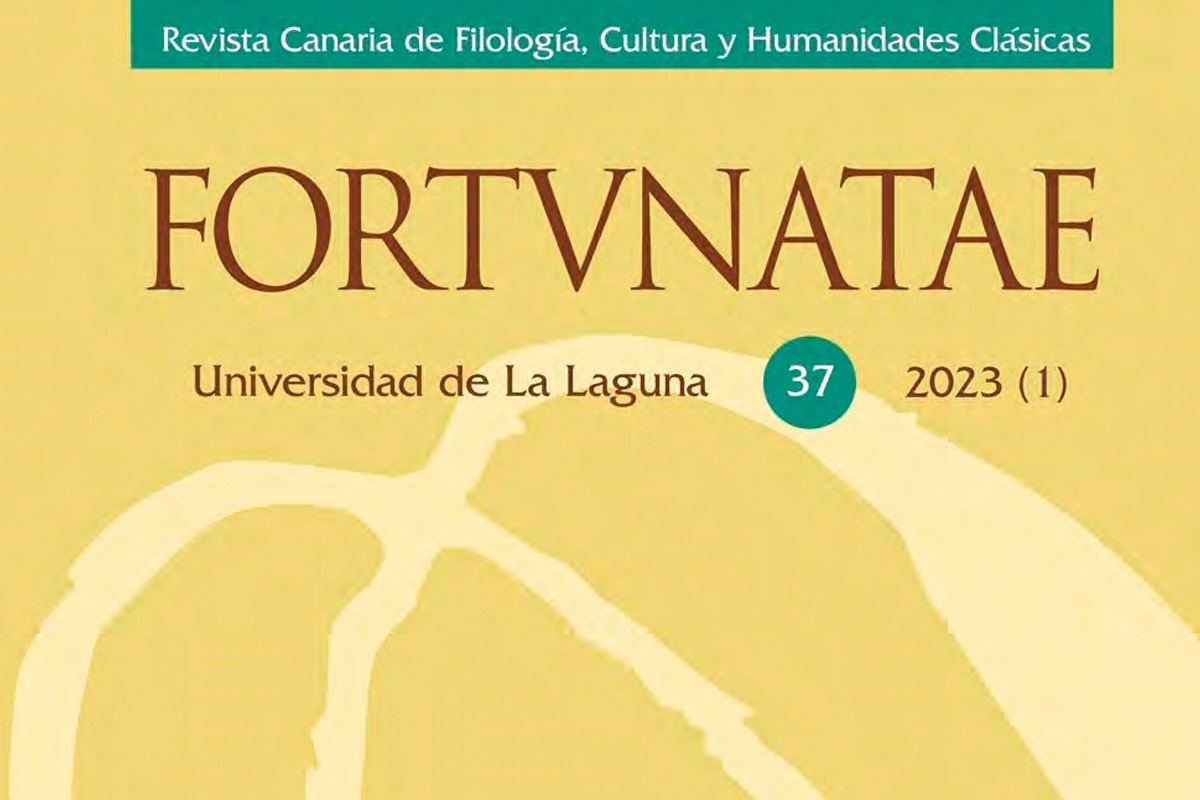
Fortunatae (Revista Canaria de Filología, Cultura y Humanidades Clásicas) is an open-access electronic publication affiliated with the Department of Classical, French, Arabic, and Romance Philology at the University of La Laguna. Its latest issue has just been released. number 37 (2023, 1), with 130 pages divided between seven articles and two reviews from five countries and in four different languages. The Journal is published once again in the OJS platform, which allows it to maintain and even expand its international reach among specialists in Classical Studies.
In the first article, «Polybium secuti sumus? Disagreements regarding the genesis of the First Macedonian War in the Stories y Ab Vrbe Condita»In «O conceito de letra nas gramáticas de Fernão de Oliveira (1536), João de Barros (1540) e Anchieta (1595): Uma leitura historiográfica», Leonardo Ferreira and Melyssa Cardozo study the evolution of this term in the Portuguese grammars of the 16th century and its relationship to the evolution of this discipline from the Renaissance onwards.
 In the field of Greek epigraphy, Christina Papadaki's article "Σκέψεις γύρω από την αποτροπαϊκή λειτουργία των ενεπίγραφων μινωικών Κοσμημάτων (Reflections on the apotropaic function of Minoan inscribed jewelry)" hypothesizes that the message appearing on a number of Minoan jewels may have an apotropaic or protective meaning. "Ekphrasis as a rhetorical-discursive genre in the Gigantomachia "C. Claudiano", by Liliana Pégolo and Alexis Robledo, studies the function of ekphrasis, which the bilingual Greco-Latin author, representative of the end of the Second Sophistic, elevates to the category of backbone of his entire epic narrative and not as a mere rhetorical figure.
In «Textual Notes on the Library of Photius (Δάρας, Δονάτος, Σουρήνα, συνέχεε, αὐτοῦ)» Pedro E. Rivera focuses on aspects of textual criticism of that work, studying several terms whose misinterpretation may have led to an inadequate transmission of the text. María Alejandra Valdés in «Encomium of Moses (Basil., Hex. 1, 1)» analyzes the prologue of Hexameron by Basil of Caesarea from the point of view of classical precepts and rhetoric and the function that these play in biblical exegesis. "The irreligious formula ὁ τῆς Ἑλλάδος ἀλιτήριος and its codification as antidemosthenic propaganda" is the last of the articles, and part of the results of Silvia Vergara's studies on religious and irreligious lexicon in classical Greek oratory and its semantic values as a contribution to a better understanding of the political context in which they developed and the role they played in relation to the use of rhetorical resources.
The issue concludes with two reviews. The first, by Elvira C. Real, is about the collective book On the margins of myth: Hybridizations of classical mythology in contemporary mass culture, and the second, around Atheism, rhetoric, and politics. The irreligious lexicon in Lysias's Against Andocides for Impiety, by Silvia Vergara Recreo and directed by Jordi Sanchis.
From classical historiography to the oratory of Aeschines or Dinarchus, including sixteenth-century grammar, Minoan epigraphy, late classical rhetoric, textual criticism, and Greek Christian exegesis, Fortunatae He continues to contribute quality work in the various specialties of Classical Studies.

 Spanish
 English
 French