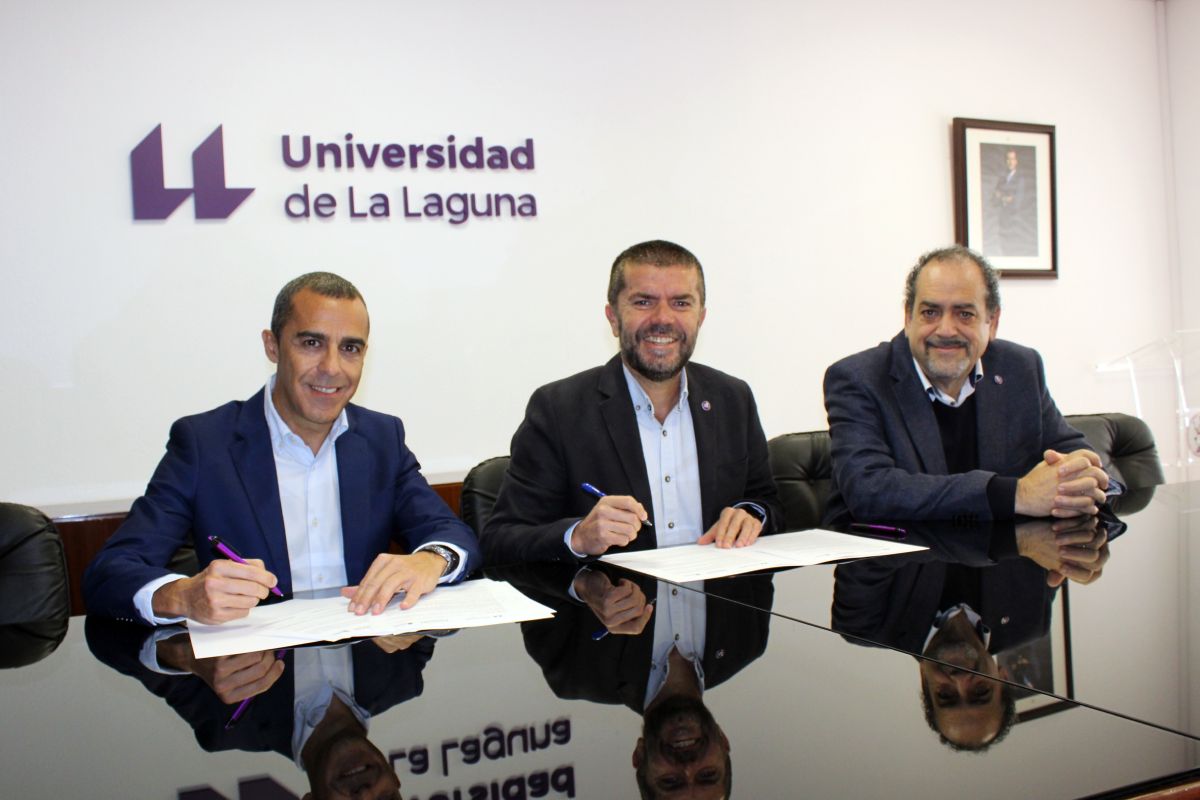
The Rector of the University of La Laguna, Francisco García Rodríguez, and the Director of the School of Health and Social Services of the Canary Islands (ESSSCAN), José Francisco Montelongo Espinosa, have signed today, Friday, January 26, a framework agreement for collaboration through which the collaboration between both organizations will be structured during the four years of renewable duration that this agreement will last.
The Vice-Rector for Teaching at the academic institution, José Manuel García Fraga, was also present at the signing ceremony, as it is presumed that the proposed collaborations will primarily consist of training activities in areas of interest to ESSSCAN, namely healthcare and social care. In any case, all activities arising from this agreement will require a specific agreement to regulate them.
Montelongo Espinosa explained that the health training activities of his school are well covered and, in fact, the corresponding agreements have already been signed with the general hospitals of all the islands of the Archipelago to maintain in 2024 the continuing training activities dedicated to their staff that were already being maintained previously.
However, he expressed his desire to give new impetus to the socio-health aspect of his training activities, for which he is establishing contacts with different institutions to launch initiatives that fall within this focus. He cited, for example, the support that the Lanzarote Island Council has provided to a course on suicide prevention in young people, whose morning sessions have been geared towards professionals and the afternoon sessions towards secondary schools, and which have been so successful that he hopes to expand it to the other islands.
The rector mentioned that with European funding through the Next Generation funds for the implementation of training programs using micro-credentials, activities could be developed within the framework of this agreement, especially through postgraduate degrees, which seem to be the most suitable format for this type of training.
The collaboration could extend to the formation of a teaching group that can develop training programs already underway on other islands, such as the "One hour, one life" course, which in that time period quickly teaches three basic first aid techniques that help maintain the vital signs of an injured person until the health services arrive at the scene of the emergency.
The academic institution can also collaborate by providing its facilities for the development of activities promoted by ESSSCAN, since, as its director explained, sometimes one of the difficulties they encounter in developing their courses is precisely the lack of suitable spaces.

 Spanish
 English
 French