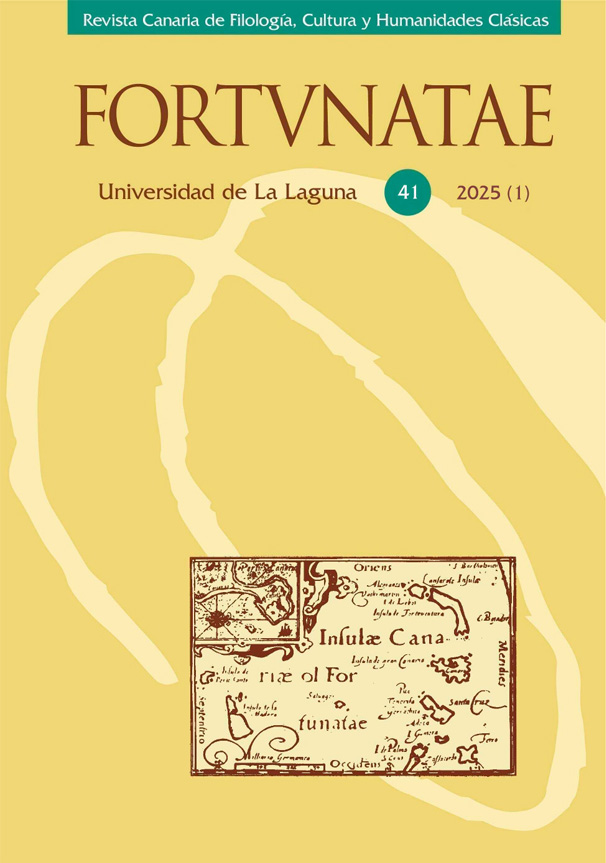
Fortunatae (Canary Islands Journal of Classical Philology, Culture and Humanities) It is an open-access electronic publication affiliated with the Department of Classical, French, Arabic, and Romance Philology at the University of La Laguna, and published by the institution's Publications Service. Following its semi-annual publication schedule, issue number 41, corresponding to June (2025, 1), has just been released. It comprises 204 pages, seven articles, and two reviews from the American universities of Buenos Aires and UNAM and Panamericana in Mexico, as well as the Spanish universities of Cádiz, Murcia, Complutense, UNED, Castilla-La Mancha, and Salamanca, thus maintaining the plurality and international scope of its origins.
 It is worth noting that this edition comes immediately after the hosting of Fortunatae in the prestigious international database SCOPUS, after having met all the entry requirements, and while the Journal is also awaiting evaluation by FECYT to obtain its seal.
The issue opens with the article by Juan Manuel Arriaga Benítez, “The Thetis that Jupiter rejected: the Hesiodic closure of dethronements in a Valerian ekphrasis (Arg. I, 130-139), which is based on one of the paintings adorning the Argonauts' ship in Valerius Flaccus, briefly depicting the wedding of Thetis and Peleus. This decoration has had two predominant interpretations: the conquest of the ocean and the anticipation of the marriage between Medea and Jason. However, this article proposes a third interpretation related to the cycle of alternating deities, with the dethronement of one supreme deity by another, culminating in the closing of this cycle by Zeus/Jupiter as the god of undisputed power.
In “The lexicon of erogenous zones in the Palatine Anthology”, Esteban Calderón Dorda presents a study on the lexicon of erogenous zones in the epigrammatists of the Palatine Anthology, but with special emphasis on the influence that popular language has in coexistence with technical terms and showing a poetic mastery in the combination of all of them with high-quality amphibological or euphemistic games.
For her part, Soledad Correa addresses death, drama, and exemplary conduct as the three central axes for approaching Seneca's letters in “Non trepidabo ad extrema: mors, performance and exemplary conduct in Sen., Epist. 54”. The chosen card would represent a meditation on death and establishes the moment of death as a performance decisive for the evaluation of one's own life. This letter can be read as the staging of a rehearsal for his forced suicide, whose later account in Tacitus (Ann. 15, 60-64) would lead us to interpret a certain coherence with what has been theorized and an agreement between prayer y life.
The “critical edition of Pseudo-Hippocrates, De venae sectione (excerpt from Galen, De cur. rat. per venae sect.)” by Elsa García Novo includes the edition of a small treatise on phlebotomy attributed mainly to Hippocrates and collected in thirteen manuscripts, actually being an extract from Galen, from his De curandi ratione. The work manages to establish a stemma The texts are grouped into three families, and their comparison with Galen's original provides some important lessons for it.
Antonio Ramón Navarrete Orcera's article focuses on "Greek inscriptions in the decoration of Schliemann's house in Athens." The study shows that most of them (a total of 48), aside from their thematic appropriateness to the room in which they are located, are characterized by their preceptual and moral value, having been extracted from the most important Greek authors, the sayings of the Seven Sages, and preserved fragments of the Palatine Anthology, demonstrating the famous archaeologist's mastery of the texts.
Joaquín Pascual-Barea presents a study on the toponymy of the town of Noheda in Cuenca, arguing its origin from Novata, the name of a nearby Roman villa, in which some mosaics representing theatrical works are preserved, and in which there are scenic references to a story by Apuleius or a textual remnant that leads us to Host by Plautus. The last article in the series is dedicated to etymology, authored by María Teresa Santamaría Hernández: “Etymology of ajar and of lost garlic, and its relation to alear and lío”.
The Spanish verb ajar (allēuareThe word *ajar* is formally and semantically linked to the noun *ajo*, which is different, in origin and meaning, from the homograph and homophone that designates the vegetable frequently used as a culinary ingredient. Other interpretations of *ajar* proposed previously are reviewed. The various uses and meanings in Spanish of the term *ajo* derived from *ajar* are analyzed and explained, thus revealing its connection to the word *lío*. The formal and semantic differentiation of both *ajos* clarifies some confusions that have persisted in the field of lexicography over time.
The issue is completed by two reviews of recent works: Guus Kroonen (ed.), Sub-Indo-European Europe, led by Marcos Medrano Duque, and Francisco García Jurado, Theory of classical tradition. Concepts, history and methods, reviewed by Genaro Valencia Constantino.
From the critical edition of Greek texts, through mythology in the work of Valerius Flaccus, the erotic lexicon in the Palatine Anthology or the philosophy of Seneca, to two studies on Latin etymology and toponymy respectively, Fortunatae It maintains its line of collecting quality works with a wide range of topics within Classical Studies.

 Spanish
 English
 French