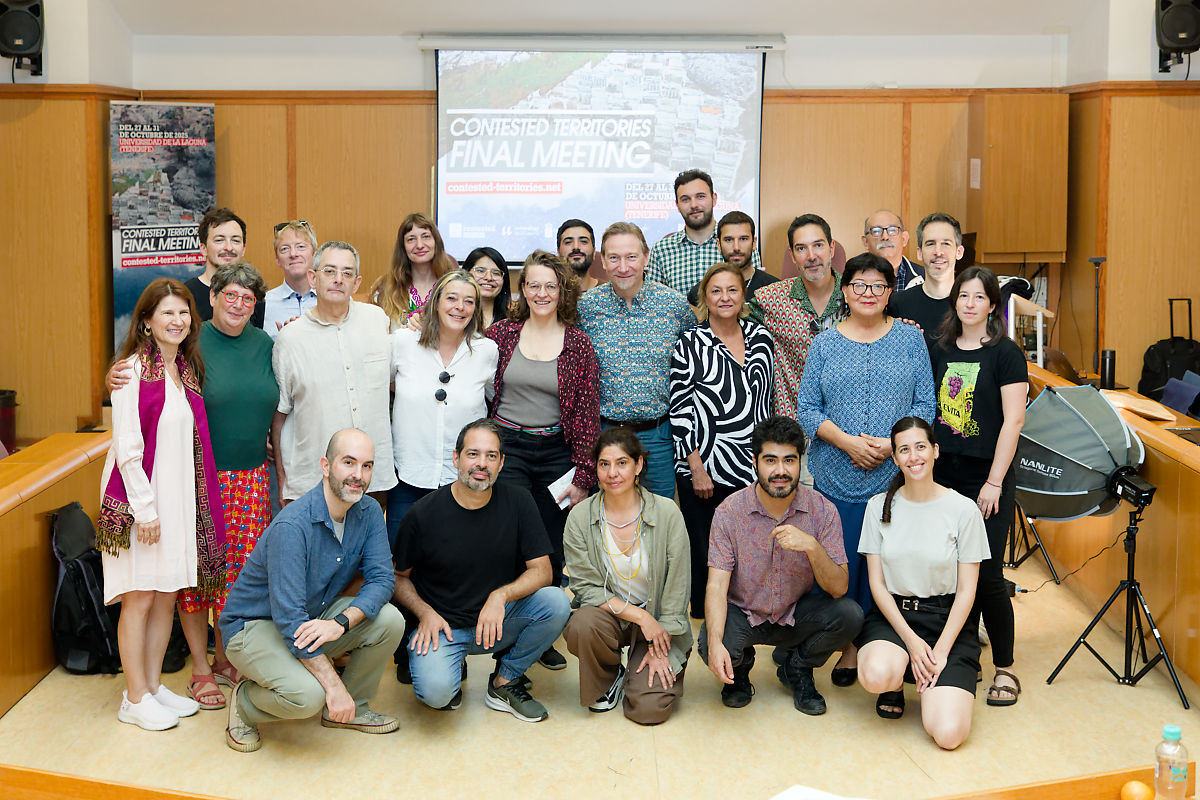
Contested Territories It is an intersectoral alliance funded by the European H2020 program that brings together researchers from universities and social, artistic, and cultural organizations in Latin America and Europe to reflect on territorial inequalities, territorial accumulation, and local resistance. For almost five years, it has developed research, training, and cooperation activities around these socio-spatial conflicts and inequalities in different regions of the world, and this week it is holding its closing meeting at the University of La Laguna, co-financed by the European Union and the Vice-Rectorate for Research and Transfer.
This final event It is being held in the Lecture Hall of the César Manrique Building on the Guajara Campus and began on Monday the 27th, with a closing date of Friday the 31st of October. Around twenty researchers are participating, presenting the main results of the network and sharing experiences of collaborative work, addressing issues such as housing, citizen science, energy, gender, youth, and territorial resistance in Latin America. Also taking place on Wednesday at 9:00 p.m. Revealed Cities Festival in the Paraninfo; and on Friday the 31st there will be visits to projects that have received social response located in the south of Tenerife.
Regarding the choice of Tenerife as the venue for the final event, Alejandro Armas, Professor [Name], from the Department of Geography and History at the University of La Laguna and coordinator of the local node, pointed out the many similarities with Latin America. “We were the first colony and share characteristics with southern Europe; some processes cannot be fully explained from either a European or a Latin American perspective. Here, we intensely experience the effects of over-tourism and the commodification of nature. Our island status, as a finite territory, allows us to reflect on how to curb the processes of accumulation and territorial dispossession.”.
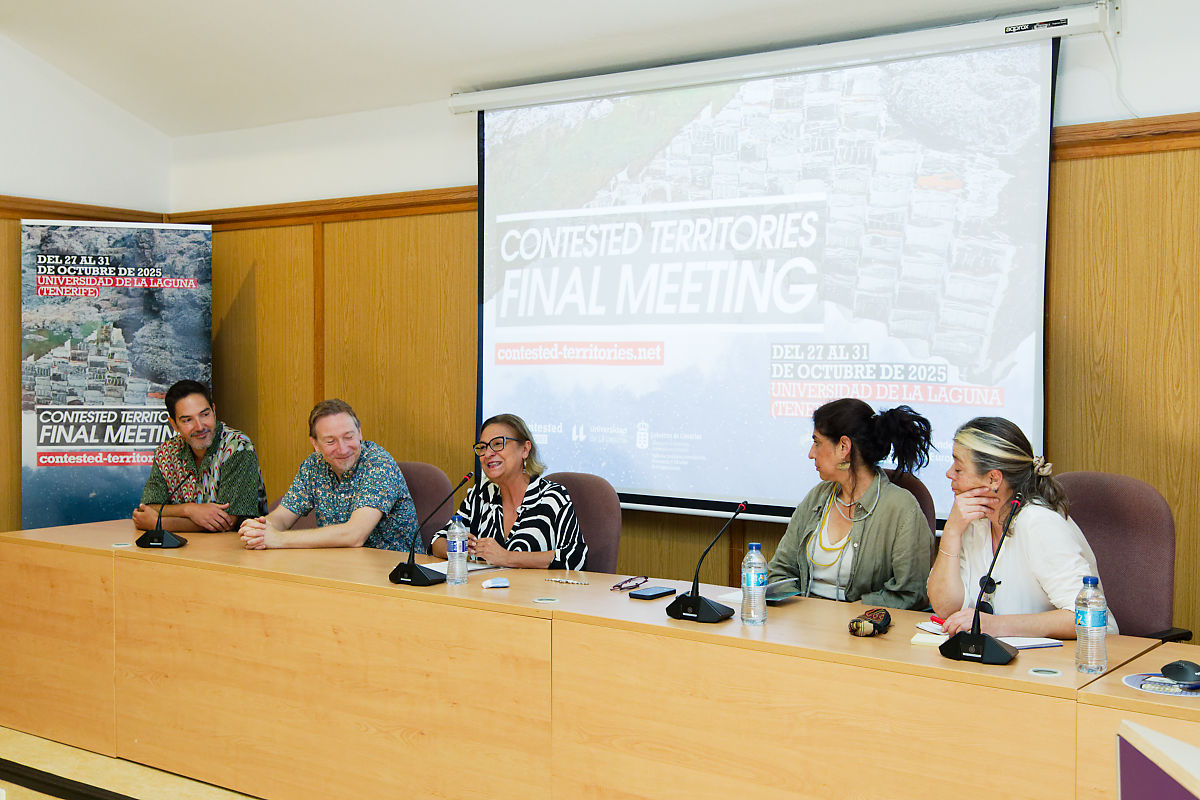
The meeting was opened by the Vice-Rector for Internationalization and Cooperation, Inmaculada González.
Contested Territories
Coordinated by Michael Janoschka from the Institute of Regional Science at the Karlsruher Institute of Technology-KIT (Germany), the network has brought together a broad group of universities, artistic collectives and social organizations from Europe and Latin America that work on generating conceptual and empirical knowledge, oriented towards understanding and transforming disputed territories.
The network has focused on generating critical and comparative knowledge about the processes of accumulation, dispossession, and territorial resistance, through innovative methodologies and proposals that promote sustainable and inclusive forms of development. It has also sought to understand how communities collaboratively produce knowledge and alternative practices that shape territories amidst unequal power relations. Furthermore, it has highlighted unconventional models and practices of social integration and territorial management that emerge from grassroots sectors and ancestral communities.
The local nodes have developed collaborative research, community workshops, audiovisual productions, and international meetings, obtaining results such as the Atlas of Territorial Accumulation; the Tenant Survey, implemented in seven cities in seven countries in conjunction with social movements and urban collectives; meetings on experimental research methodologies that resulted in different ways of mapping and visualizing territories; training in participatory methodologies with communities; and the recognition of forms of struggle and knowledge, all with the purpose of influencing urban, rural, and environmental public policies.
Janoschka believes the project has been a great success in coordinating scientific activity with activities aimed at political transformation in citizen spaces. “The 180 researchers who have worked on and participated in the project have joined forces with hundreds, even thousands, of people in the territories, across the five Latin American countries involved in the project, as well as in the participating European countries. The territorial impact we have generated will last beyond the project's duration.”.
Janoschka adds that the Tenant Survey has had a concrete impact on local and national policies, especially in cities like Buenos Aires, Barcelona and Lisbon, where the results have contributed to legislative debates on housing and urban law.
From Latin America, the following are part of the FLACSO-Ecuador network: the Institute for Research and Action for Integral Development- IIADI; the Center for Urban and Regional Studies-CEUR-CONICET; the Civil Association for Equality and Justice-ACIJ; Revealed Cities and the Pontifical Javeriana University Cali; Mayor de San Simón; Chile; de la Frontera-UFRO; Buenos Aires; and National University of San Martín-UNSAM.
From Europe, the following participate: KIT; the Polytechnic University of Milan; Basurama; the research team “Risk Studies and Territories” made up of Centre National de la Rechereche Scientifique-CNRS Toulouse; Institut de Recherche pour le développment-IRD Paris; the IDRA Urban Research Institute of Barcelona; Torero Films; Habitat 65; Left Hand Rotation; and the universities of Sheffield; Leeds; Newcastle; Autonomous University of Madrid and La Laguna.

 Spanish
 English
 French