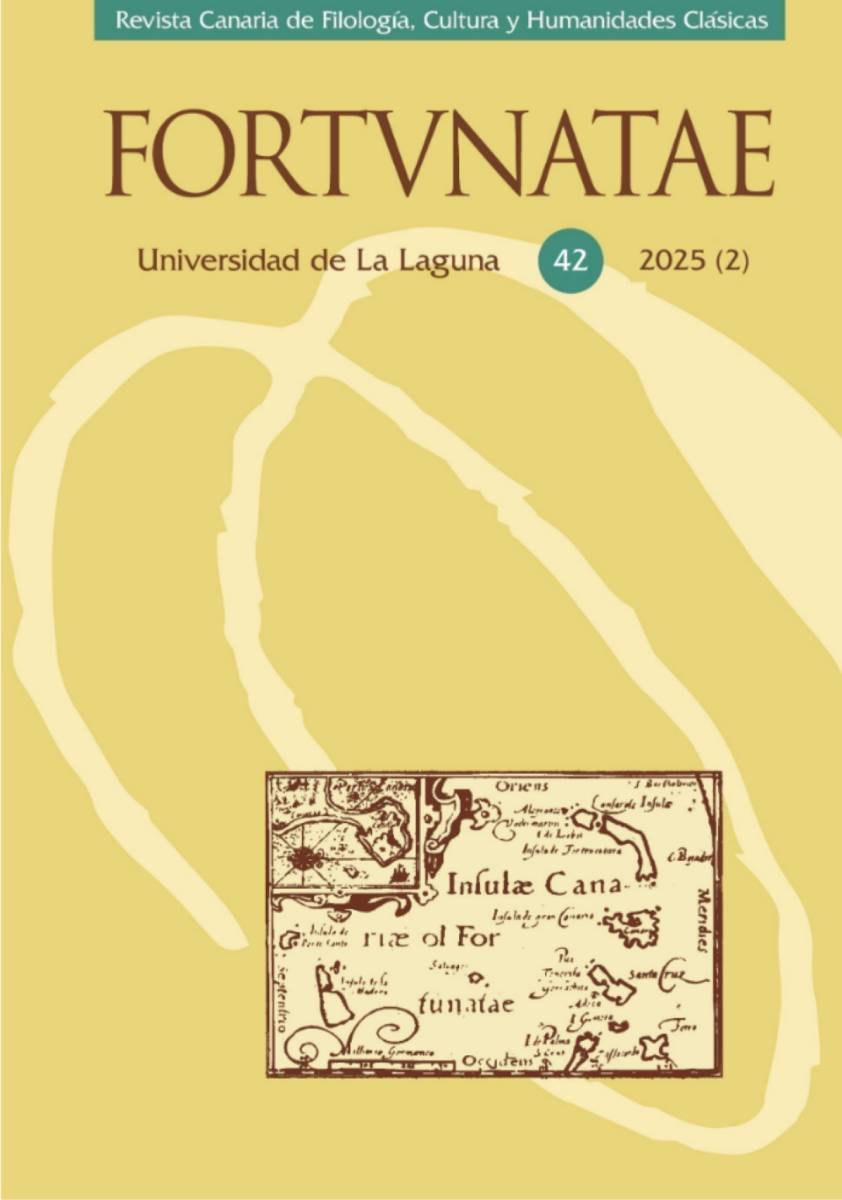
 Fortunae The Canary Islands Journal of Classical Philology, Culture and Humanities is an open-access electronic publication affiliated with the Department of Classical, French, Arabic and Romance Philology at the University of La Laguna. Following its biannual publication schedule, issue number 42 has just been released and, as with the previous issue, after its inclusion in the international database SCOPUS, the Spanish Foundation for Science and Technology (FECYT) has informed its editors of the provisional award of its prestigious national seal, pending official publication.
This issue, corresponding to December 2025, comprises 166 pages with seven articles and three reviews. The articles come from the Argentinian universities of Buenos Aires, Rosario, and La Plata; the Brazilian Universidade Estadual Paulista “Júlio de Mesquita Filho”; the Greek University of Ioannina; and the Spanish universities of Santiago de Compostela and UNED, reaffirming its international character and diversity, with articles in Spanish, English, and Portuguese.
Thomas Acevedo Algarbe opens the issue with the article “The modesty and sexual desire in the representation of Octavia and Poppaea. Historical-mythological paradigms of femininity in the Annals of Tacitus and the Octavia of pseudo-Seneca,” proposing the contrast between the two characters based on the notion of modesty, based on their associated sexual behaviors and protocols, as well as the development of these two models of femininity as different positions with respect to imperial violence, and the points of contact and divergence that, from there, can be established between the historiographical genre and Roman tragedy.
“The strength of the evidence: on plausible y probable in Ciceronian rhetoric” is the proposal of Lorelei Cisneros and Marcela Coria based on Ciceronian texts that address the complex relationship between falsum, true and the problem of knowledge, from which a series of concepts are introduced that, paradoxically, are far from supporting the opposition between true and false, and the examination of the semantic peculiarities of plausible y probable and its reworking from the Rhetoric by Aristotle.
Anthophili Kallergi, in “The Prologue of Plautus'’ Menaechmi and the Opening Scene of Shakespeare's The Comedy of Errors (i.1.1-160): a Comparative Analysis”, examines how The Comedy of Errors Shakespeare's, specifically scene I.1, departs from Menaechmi Plautus, in his adaptation and interpretation, created a more complex plot from the beginning of his work.
“The Pompeian-themed decoration in Schliemann’s house in Athens,” by Antonio Ramón Navarrete Orcera, studies the frescoes that decorated the house of the archaeologist Heinrich Schliemann in Athens, and demonstrates that they faithfully reproduce, with their mythological themes, frescoes from the main houses found in Pompeii, which are preserved today in the Archaeological Museum of Naples.
Ángel Ruiz Pérez, with the work “The containment of the Alcmaeonids, according to Herodotus: the wedding of Agarista and Megacles”, studies in detail the episode of the wedding contest organized by the tyrant Cleisthenes of Sicyon for his daughter Agarista, which we only have in Herodotus (6.126-131), carrying out an exhaustive analysis of the central term of the whole episode, the verb κατέχω, key to understanding the whole, contextualizing it in the in-depth study of the most defining historical, literary and folkloric aspects of the episode.
Gelbart Souza Silva and Cláudio Aquati study in “Fellini-Satyricon, releases riduzione from the romance of Petronio Arbitro: ”A joint reading” how and to what extent a wide variety of literary genres, discourses and languages used in the formation of Petronius’s critical and creative Roman novel are joined, transposed, reorganized and transformed in the modern film discourse of Federico Fellini, also very creative and critical of the reality from which it arises.
Finally, Mariano Zarza, in “Knowledge and self-governance in the Satire ”2, 7 of Horace” shows how the roles are reversed in this satire, since the satirist is not the poet Horace but his slave Davo, resulting in the fact that, by giving voice to this character to mock his own defects, the poet demonstrates self-criticism, and perhaps subtly develops an invective against power.
The issue is completed by three reviews of recent works: Liborio Hernández Guerra, The Roman priesthood in Hispania during the imperial period. Prosopographical study of the flamingo and Christina Papadaki, Στον Έρωτα και στον Πόλεμο. Η Μαγεία στα Ομηρικά Έπη, by Ángel Martínez Fernández, and Hernán Ruiz de Villegas, Aesop's Fables, in charge of Aday Pérez-Santana.
From the mythology expressed in the Pompeian frescoes and the Schliemann House, through Herodotus, Roman historiography and tragedy, Aristotelian rhetoric reflected in Cicero, the Shakespearean tradition of Plautine texts, to the Satyricon as much like Petronius as Fellini or the Satires of Horace, Fortunatae It maintains, in its upward trajectory, the academic commitment to collect quality work across the entire field of Classical Studies.

 Spanish
 English
 French