
The University of La Laguna presented the project on Monday, February 23rd in Madeira. IMPLAMAC Capitalization, an initiative co-financed by the Interreg MAC 2021-2027 Programme with ERDF funds whose objective is to consolidate and transfer the scientific methodology previously applied by the IMPLAMAC project for the monitoring of microplastics on the coasts of Macaronesia.
The project, which was publicly presented The agreement, launched on December 10th at the University of La Laguna and valid for two years, is currently in its first stage of implementation, focused on publicizing it in all participating territories of Macaronesia and strengthening institutional and scientific involvement in each archipelago.
The event in Madeira, organized by the Regional Agency for the Development of Research, Technology and Innovation (ARDITI), a partner in the project, took place at the Jesuit College in Funchal and brought together institutional representatives, the scientific community, and media from the Autonomous Region of Madeira. The speakers were the Regional Director of the Sea and Environment of the Government of Madeira, Manuel Ara Oliveira; the coordinator of MARE-Madeira (a center affiliated with ARDITI), João Canning-Clode; and the project's principal investigator, Javier Hernández Borges, Professor of Analytical Chemistry at the University of La Laguna.
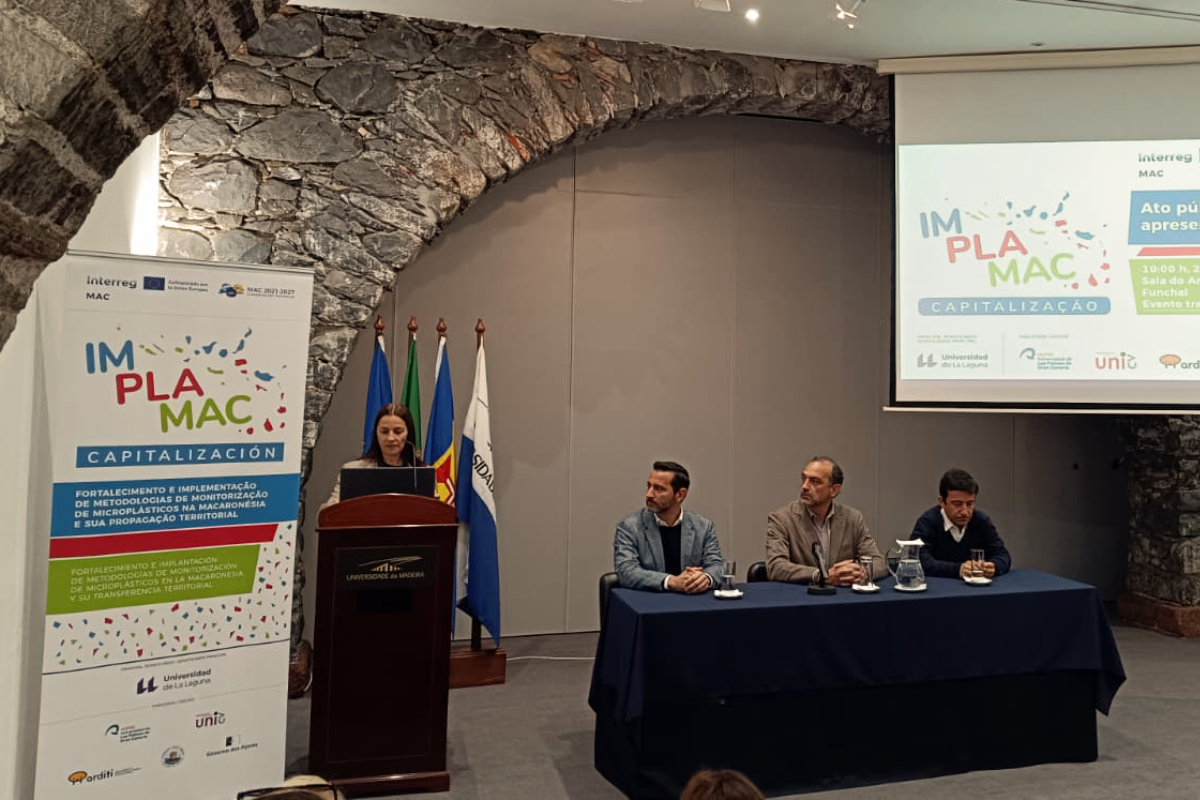
Presentation of IMPLAMAC Capitalization at the Jesuit College of Funchal (Madeira).
The meeting, which was streamed online, was attended by several members of Research group in Applied Analytical Chemistry which is currently directed by Professor Hernández Borges, and several researchers from the EOMAR group (Ecophysiology of Marine Organisms) of the University of Las Palmas de Gran Canaria, led by May Gómez Cabrera, who was also present at the event, also traveled to Madeira, reinforcing the joint work between the scientific teams of both Canary universities.
The new phase of the project aims to scale up and transfer the already validated scientific methodology to consolidate a Macaronesian regional observatory that allows for the comparison of data between archipelagos, understanding what types of microplastics reach each territory, how they do so and in what concentrations, and thus strengthen environmental governance.
With this meeting in Madeira, IMPLAMAC Capitalización is advancing its territorial implementation strategy throughout Macaronesia, with the aim of maintaining a key scientific cooperation network to address one of the main environmental challenges in the Atlantic: microplastic pollution.
The project is coordinated by the University of La Laguna and includes the participation of the University of Las Palmas de Gran Canaria, the Regional Secretariat for the Sea and Fisheries of the Government of the Azores, the Regional Agency for the Development of Research, Technology and Innovation of Madeira, the University of Cape Verde, and the Gaston Berger University of Senegal, forming a consortium that strengthens scientific cooperation between European and African regions of the Atlantic. In addition to these, the Regional Secretariat for the Sea and Environment of Madeira and the Ministry of Ecological Transition of the Government of the Canary Islands are also participating as associate entities.

 Spanish
 English
 French