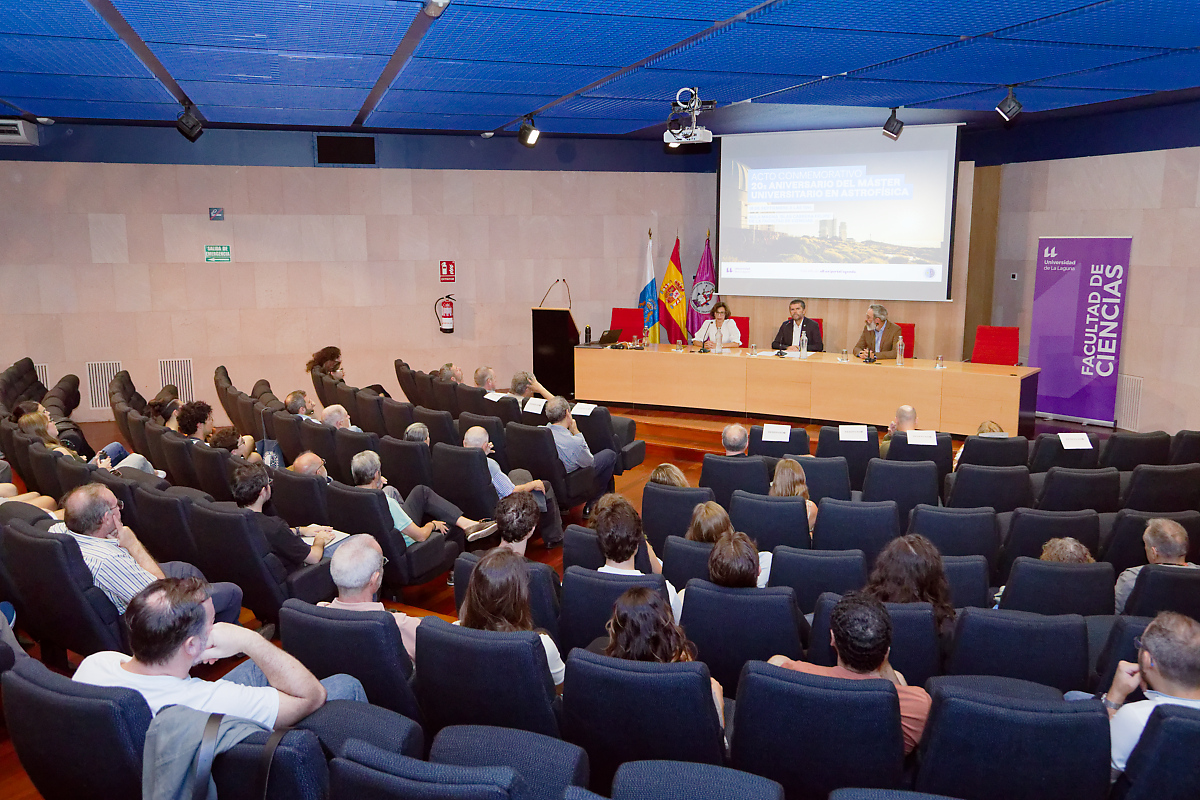
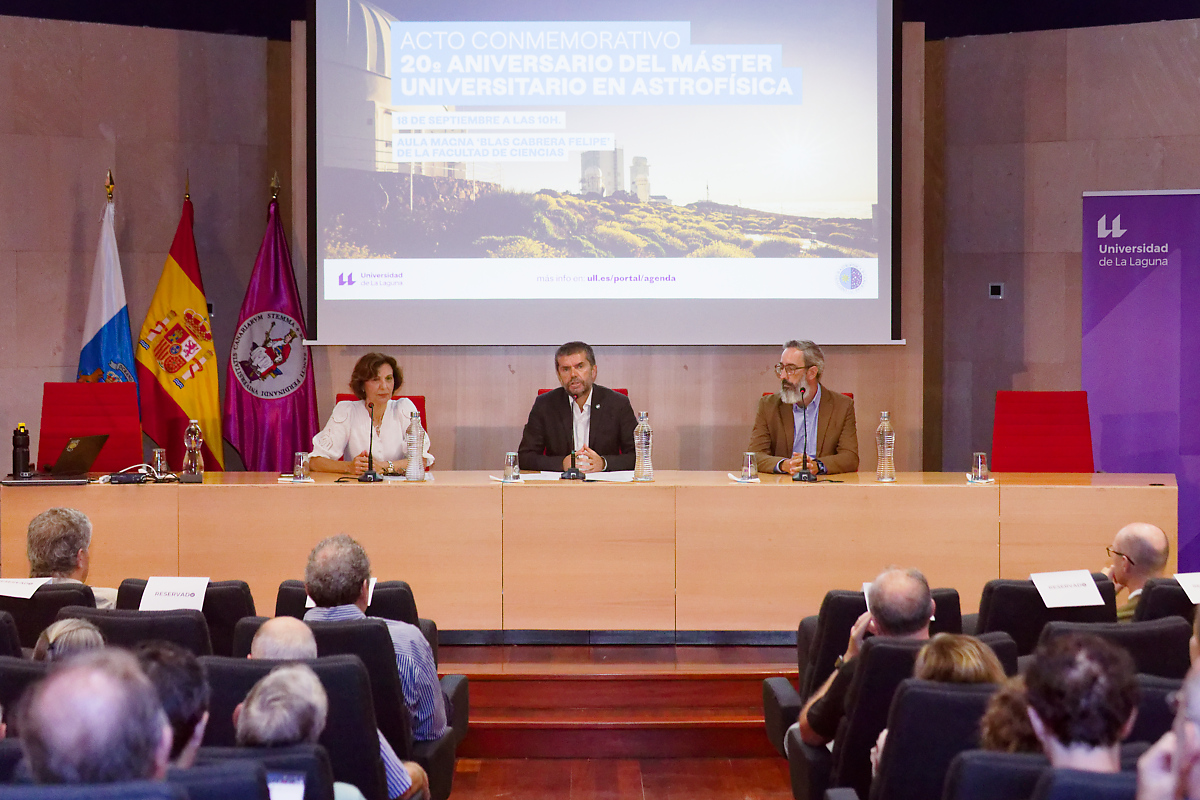
He Department of Astrophysics The University of La Laguna celebrates the twentieth anniversary of its Master's degree in Astrophysics, This program, one of Spain's most prestigious postgraduate offerings in the field of Astrophysics and a pioneer in the implementation of official master's degree studies at the University of La Laguna, celebrated its anniversary with a commemorative event in the Blas Cabrera Felipe Auditorium of the Faculty of Sciences. The event reviewed the program's history, which over the past two decades has become a national and international benchmark in the training of researchers thanks to the ongoing collaboration between the Canary Islands Institute of Astrophysics (IAC) and the University of La Laguna.
During the official welcome address, Francisco García, Rector of the University of La Laguna, reflected on the strategic importance of the Master's Program in Astrophysics for the academic institution. First, García pointed out that this degree program is a fundamental component of the collaborative ecosystem between the IAC (Instituto de Astrofísica de Canarias) and the University of La Laguna, providing an essential link between university education, cutting-edge research, technological development, and international outreach.
“One of the keys to this success is undoubtedly the excellence of the education our students receive.” In the last four academic years, nearly one hundred students have graduated: 60 men and 36 women, he stated. He added, “If we broaden our perspective from the 2008/09 academic year to 2024/25, we are already talking about 334 graduates.” Furthermore, he emphasized that the average grades obtained are very high, exceeding a grade of 8.
The rector also highlighted the influence of other factors on the master's program's success, such as the significant practical component of the studies, the close connection with research, the social and scientific interest that astrophysics generates by addressing some of the major questions about the origin of the Universe, and the opportunity to access world-class scientific infrastructure. Specifically, the collaboration between the IAC and the ULL allows students access to exceptional resources, such as astronomical observatories, associated technology centers, and leading scientific infrastructures like IACTEC and other facilities developed in collaboration with various public administrations. García also mentioned the advanced computing resources and access to equipment and facilities that constitute a distinct advantage.
 García also highlighted the program's appeal, noting that 581% of the students come from outside the Canary Islands: 52% from other Spanish autonomous communities and 61% from abroad. From his perspective, this figure reflects the recognition the degree has achieved and its contribution to the international profile of the university in La Laguna. He also emphasized that many of its graduates are currently working in top-tier international institutions and projects, holding positions of significant responsibility.
The rector also highlighted the master's contribution to the institution's research output and linked the prestige achieved by Astrophysics and Space Sciences with the position of the University of La Laguna in various international rankings, such as the Shanghai Ranking by Subject, in which Physics is in the 301-400 range worldwide and between positions 7 and 11 in Spain.
Finally, the rector indicated that the University of La Laguna is promoting new initiatives related to Space Sciences. “As part of expanding our University's presence in La Palma, we are working on training programs linked to advanced scientific instrumentation,” he stated. He also noted that the institution is making progress in developing new degree programs related to aerospace engineering and other strategic areas.
At the opening of the event, the director of the Master's Program in Astrophysics, Jairo Méndez, recalled that this degree was the first at the University of La Laguna (ULL) to adapt to the requirements of the European Higher Education Area. He explained that the anniversary was organized with the aim of pausing for a moment, "looking back and reflecting on all that we have achieved over these years," as well as sharing thoughts on the future of these studies.
For her part, the Dean of the Faculty of Sciences, María del Mar Afonso, congratulated all those who, over the past two decades, have made it possible for this master's program to become a national and international benchmark. She also highlighted the partnership between the IAC and the ULL, which, in her opinion, should serve as a model for other fields of knowledge. The Faculty has collaborated in adapting the necessary spaces to ensure high-quality teaching.
Currently, the Master's in Astrophysics, which is updating its curriculum, comprises 90 ECTS credits and offers 32 places each year. The program provides advanced training over three semesters, combining fundamental Astrophysics content with three specialization tracks: Theory and Computation, Observation and Instrumentation, and Structure of Matter. It is worth noting that a significant number of graduates from this Master's program continue their studies in the Doctoral Program in Astrophysics, one of the most successful at the University of La Laguna, with over one hundred students.

 Spanish
 English
 French