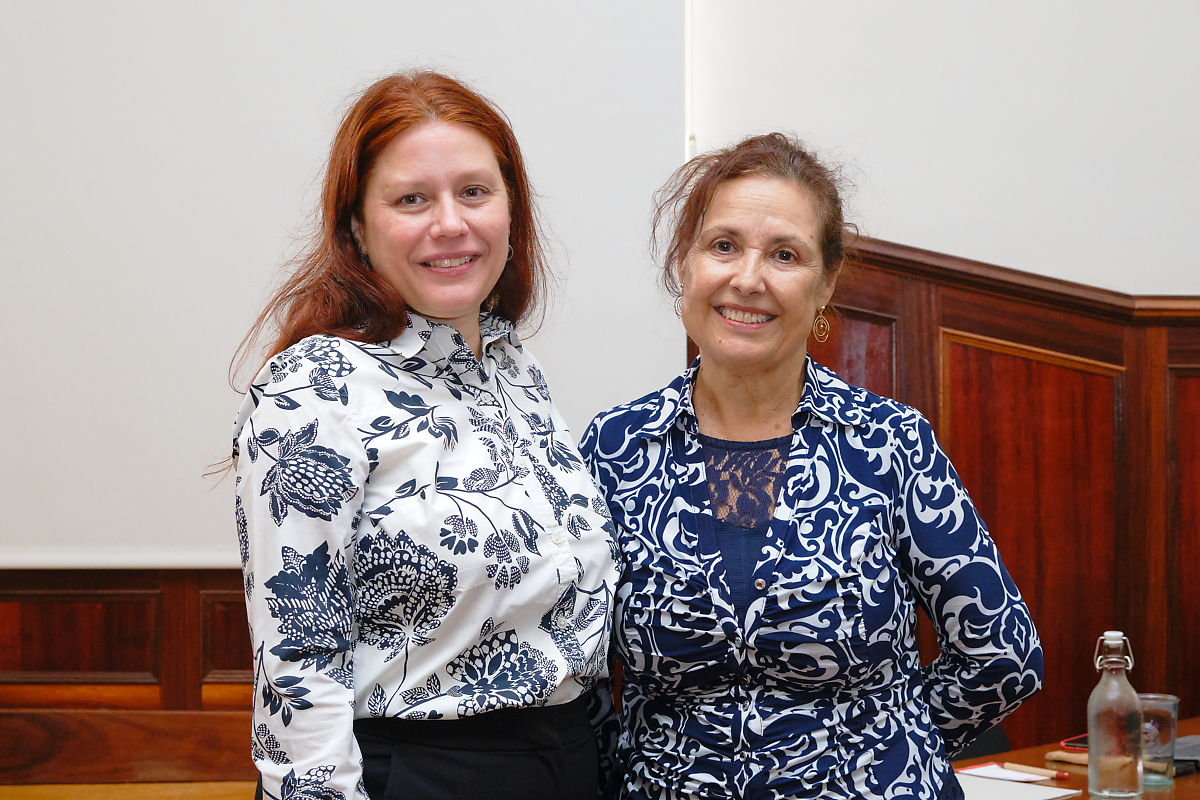
Knowing how to routinely use a mobile phone, an app, or a digital platform doesn't necessarily mean knowing how to use technology for learning. Nor does being a university student automatically imply having acquired the tools to organize one's own learning, plan a task, or evaluate one's work. This is one of the starting points of Mónica Souto González's doctoral thesis, defended at the University of La Laguna.
The work, titled Educational policies and pedagogical practices. The planned integration of the development of key competencies in the curriculum of Spanish as a Foreign Language in higher education, analyzes how to explicitly incorporate digital competence and personal, social and learning-to-learn competence in introductory university courses of Spanish as a Foreign Language (ELE).
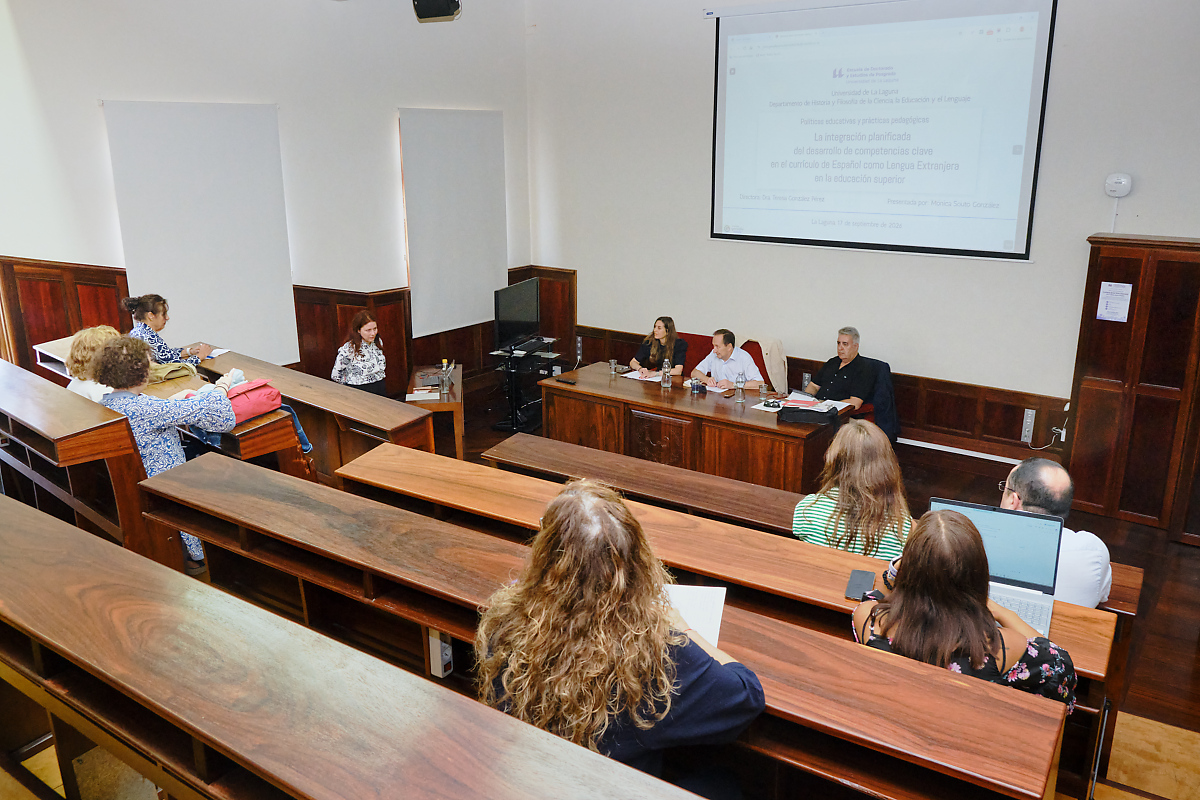
The thesis, attached to Doctoral Program in Education, has been directed by Teresa González Pérez. The tribunal was chaired by Rafael Carpintero Ortega, from Istanbul University, and included Juan Manuel Díaz Torres, The committee consisted of María Pilar Valero Fernández, from the University of La Laguna, as secretary, and María Pilar Valero Fernández, from the University of Heidelberg, as member. The work received the cum laude distinction and the International Mention, the latter after completing a research stay at a foreign university.
The research stemmed from difficulties Souto observed repeatedly among her students: problems organizing themselves, understanding what was expected of them in certain tasks, planning their work, or using assessment criteria to improve. This was compounded by the tendency to assume that, because students used technology daily, they already possessed digital competence.
However, practice showed that “knowing how to use a device or application does not necessarily mean knowing how to search for and select information critically.” The researcher thus identified a contradiction: students were required to have certain skills to successfully complete tasks, skills that, since they were assumed to have been acquired, were not always explicitly taught.
 Using technology to learn
The thesis argues that these competencies should not be addressed as separate content areas, but rather integrated into the activities, course objectives, and assessment. The results indicate greater coherence between the intended learning outcomes, the work carried out in the classroom, and the methods of assessment, as well as fostering more conscious student participation in their learning process.
In the digital realm, this means moving from simply using a tool to complete an activity to also using it to search for and select information, manage materials, review work, or address specific needs. At the same time, students take on a more active role in planning, reviewing, self-assessment, and peer assessment.
One of the examples highlighted by Souto is peer assessment of oral interactions, in which students analyze their classmates' work and propose possible improvements. For the researcher, one of the most valuable aspects is that they discover that "a classmate can also be a source of learning," progressively reducing their dependence on the teacher to validate each decision.
 Research and improvement of teaching practice
The study was conducted between 2019 and 2023 using a qualitative action research approach, structured in five successive cycles of planning, action, observation, and reflection on teaching practice. Among the measures implemented were the simplification of assessment tools, the use of criteria before and during tasks, the development of strategies for searching for information online, and a clearer organization of digital learning environments. The process also transformed Souto's own teaching methods. Planning shifted its focus from exclusively linguistic content to also incorporating what students need to know and what support they require to progress toward greater autonomy.
This shift particularly affected assessment, which ceased to be understood solely as a final check and became a tool that accompanies learning and allows for planning, review, and decision-making for improvement. Research also modified its relationship with digital resources. Instead of accumulating platforms and tools, Souto advocates selecting them based on pedagogical needs: "Now I try to ensure that technology doesn't add complexity, but rather reduces it.".
Although the study was conducted within the context of Spanish as a Foreign Language, its principles can be applied to other educational contexts. Searching for and selecting information, planning a task, collaborating, revising work, and using digital tools for a specific purpose are skills present in numerous subjects.
Souto cautions, however, that there is no single recipe that can be automatically applied to any classroom, as strategies must be adapted to the objectives, the students, and the conditions of each context. Teacher training is thus seen as one of the areas with the greatest potential for putting concepts such as digital competence, self-regulation, collaboration, and formative assessment into practice.

 Spanish
 English
 French