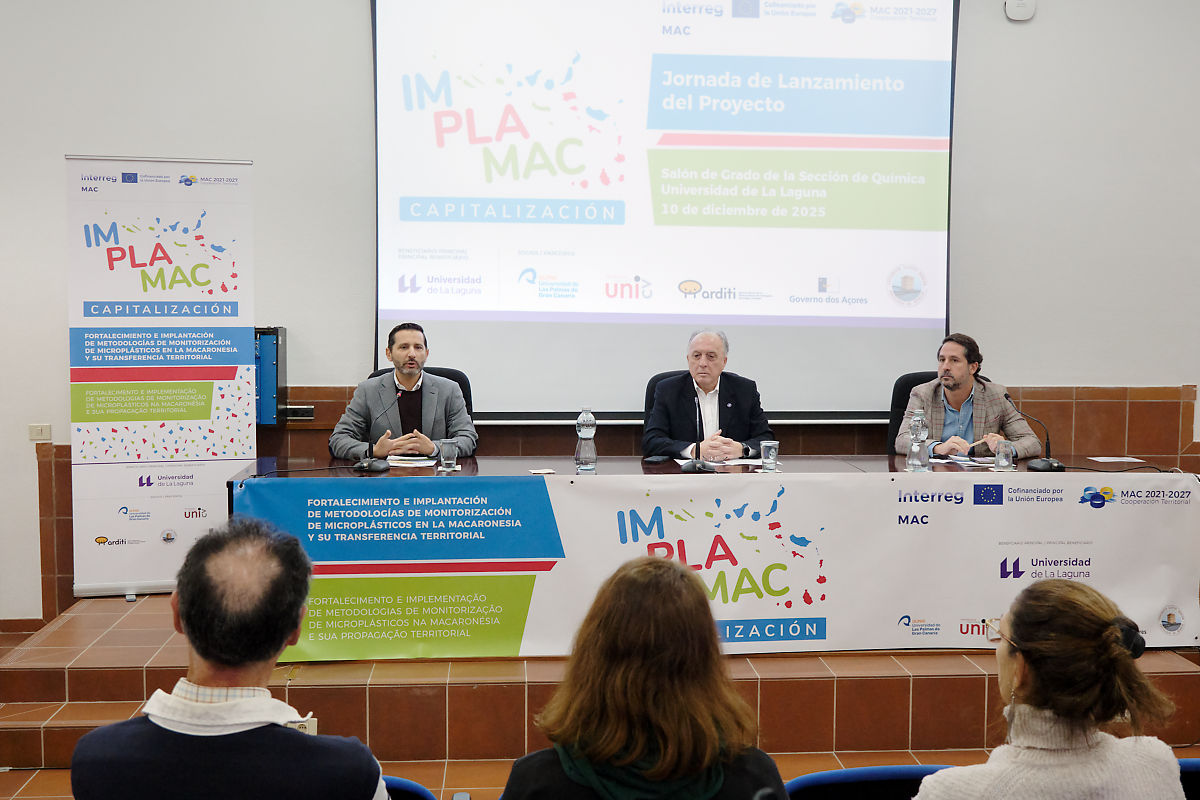
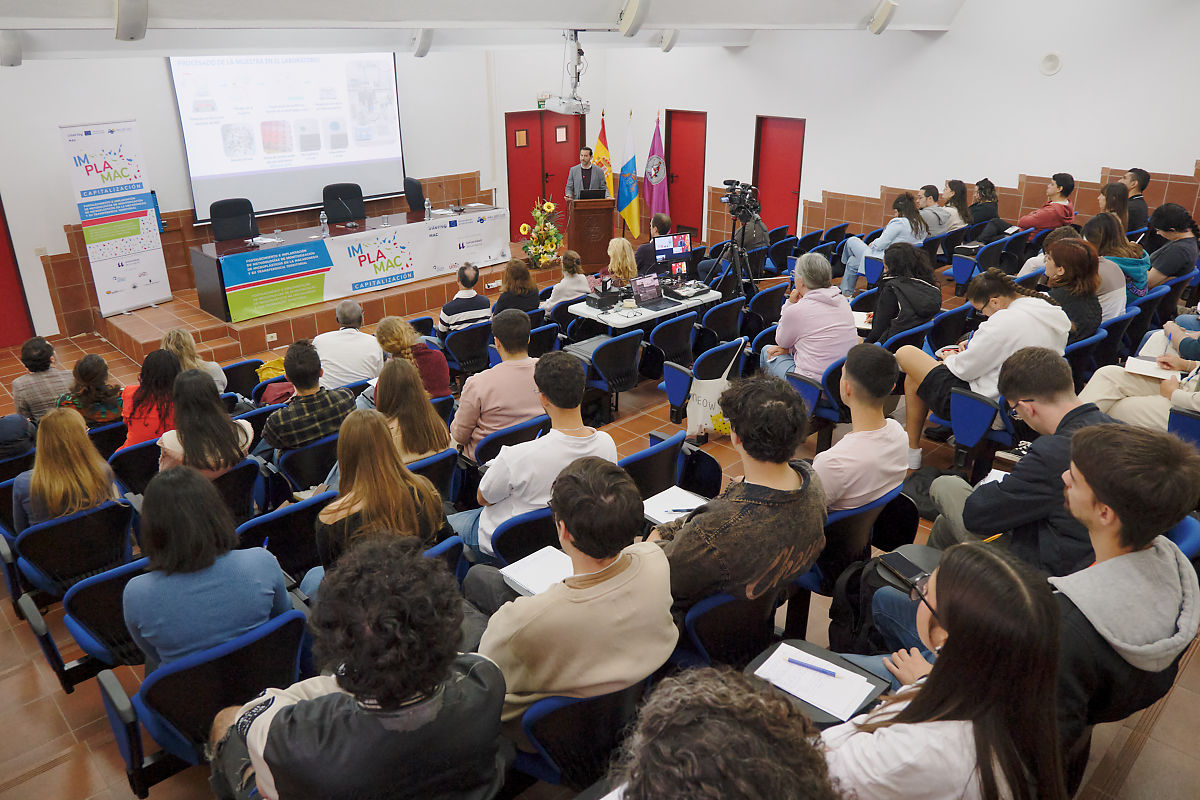
The University of La Laguna held today, Wednesday, December 10, the Launch Day of the IMPLAMAC Capitalization project, an initiative framed within the Interreg MAC 2021-2027 program and co-financed by FEDER Funds, whose main objective is to strengthen, expand and transfer the scientific methodology for the monitoring of microplastics on the coasts of Macaronesia.
The project is led by the University of La Laguna and builds upon the work carried out between 2019 and 2023 in the IMPLAMAC project, which monitored 46 beaches in the archipelagos of the Canary Islands, the Azores, Madeira, and Cape Verde for three years. This analytical work generated the first extensive and continuous time series of data on micro, meso, and macroplastics in the region and one of the most extensive worldwide.
The Vice-Rector for Research and Transfer at the academic institution, Antonio Aparicio, emphasized that inter-regional synergy encompassing all of Macaronesia is fundamental, especially in a field as closely linked to the area as oceanography. He highlighted the successful studies being conducted that are advancing knowledge and informing the development of strategies to combat microplastics. He also stressed the importance of recognizing those behind the project and the significance of research of this nature.
Furthermore, during the event, the Director General of Ecological Transition and Climate Action for the Canary Islands Government, Ángel Pablo Montañés, emphasized the importance of having research of this magnitude in the Canary Islands, addressing a crucial problem for the archipelago and the entire planet. He added that the involvement of other universities and regions makes the project even more robust and important for the region.
The principal investigator of the IMPLAMAC Capitalization project, Javier Hernández Borges, Professor of Analytical Chemistry at the University of La Laguna, noted that in the previous project a total of 6,400 samples were processed, which allowed the generation of the first extended time series on micro, meso and macroplastics in the Macaronesian archipelagos.
The aim of this new initiative is to scale up and transfer the methodology developed during the previous project to consolidate a regional observation system that allows for data comparison. This will strengthen environmental governance and help understand what types of microplastics reach the Canary Islands and the other archipelagos, how they arrive, when, and in what concentrations, as well as establish an observatory to better understand this pollution. The funding opportunity also allows for the transfer of results to other territories and institutions.
 First IMPLAMAC project
The IMPLAMAC project assessed the impact of microplastics and emerging pollutants on the coasts of the Canary Islands, Cape Verde, Madeira, and the Azores, with the aim of creating an observatory to generate quantitative and qualitative data. It also included improving sampling and analysis methodologies to determine the distribution and accumulation zones, studying the effects of microplastics on food chains and ecosystems (analyzing more than 700 commonly consumed fish, in which microplastics were detected), and determining the presence of emerging pollutants in water and sand.
The collected data showed significant differences between the archipelagos. In the Canary Islands, approximately 23 beaches were monitored, confirming that this archipelago receives the most micro, meso, and macroplastics due to its geographical location. The beaches of Arenas Blancas in El Hierro, Puertito de Adeje in Tenerife, Las Vueltas in La Gomera, Las Canteras in Gran Canaria, Caletillas and Caleta de Marrajo in Fuerteventura, Famara in Lanzarote, and Lambra in La Graciosa were identified as pollution hotspots. The highest concentrations of particles per square meter were recorded at Playa Grande with 21,000 particles, Caletillas with 14,000, and Playa Lambra with 11,000, while these same beaches exceeded 100 grams per square meter by weight.
Regarding color distribution, white or colorless particles predominate in all the archipelagos, suggesting a common origin. The most frequent form is rigid plastic fragments, especially in the Azores and the Canary Islands. In Madeira, foam-like material, easily carried by the wind, predominates, while in Cape Verde, remnants of bags and fishing gear are prominent. Pellets, a raw material for the plastics industry, were found in small quantities throughout Macaronesia. Furthermore, it was observed that beaches facing northwest to east receive a greater quantity of plastic debris than those facing southeast to west.
The entities that are part of the IMPLAMAC Capitalization project are the University of La Laguna as the main partner, the University of Las Palmas de Gran Canaria, the Regional Directorate of Maritime Affairs of the Azores, the Directorate of Research, Technology and Innovation of the Azores, the Regional Agency for the Development of Research, Technology and Innovation of Madeira, the University of Cape Verde and the Gaston Berger University of Senegal.

 Spanish
 English
 French