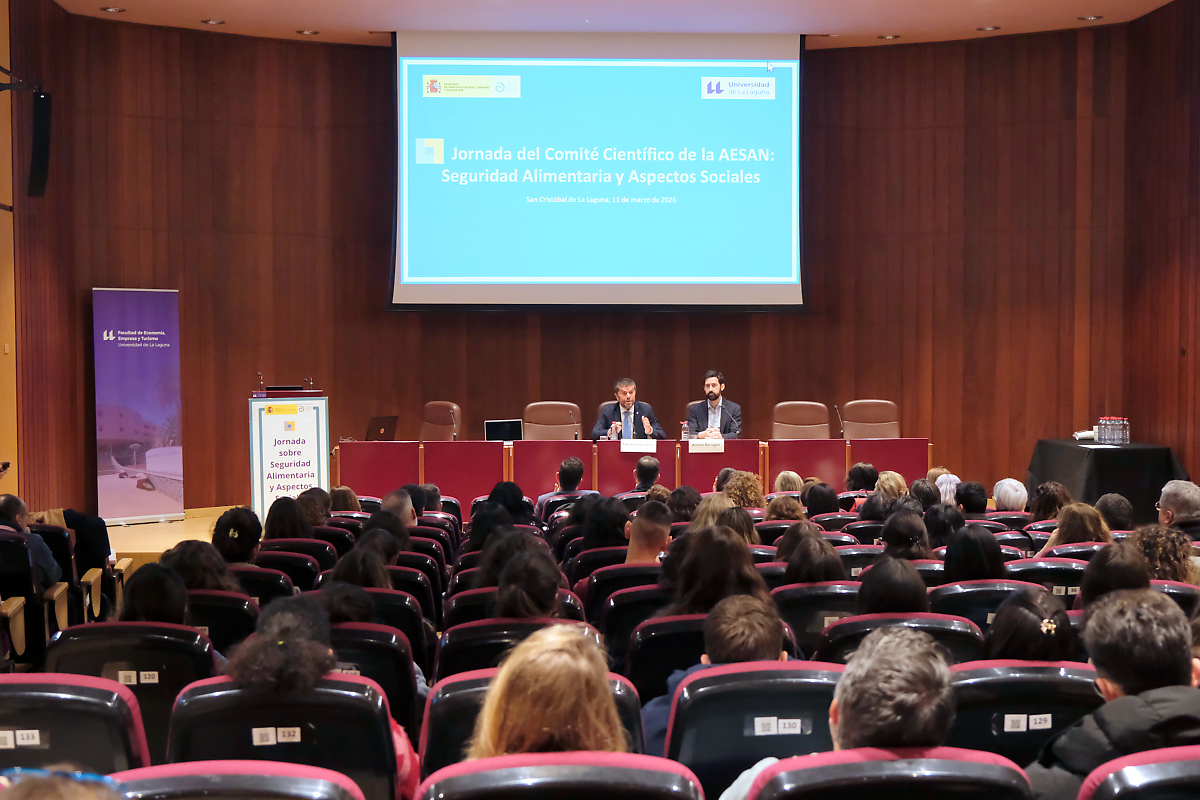
The University of La Laguna held the conference “Food Security and Social Aspects” yesterday, March 11, organized in collaboration with the Spanish Agency for Food Safety and Nutrition (AESAN)), a public body responsible for food risk assessment in Spain that reports to the Ministry of Social Rights, Consumer Affairs and Agenda 2030. This event, held in the Aula Magna of the Faculty of Economics, Business and Tourism, aimed to publicly disseminate some of the main reports prepared by the AESAN scientific committee, especially those related to aspects that affect society.
The event was held after the regular meeting of the scientific committee, which took place on March 10 and was hosted by [name of host]. Angel Jose Gutierrez, researcher in the Toxicology area of the University of La Laguna and one of the 20 experts who make up the scientific committee of AESAN.

Francisco García and Andrés Barragán.
The event was opened by Francisco J. García, Rector of the University of La Laguna, and Andrés Barragán, President of AESAN. As its Executive Director, Ana López-Santacruz, pointed out, the agency, “which is celebrating its 25th anniversary, is still relatively unknown to the public, and these kinds of gatherings are a way to raise awareness of its role and ensure that food on the market is safe.”.
During the conference, several highly relevant reports were presented on various aspects of nutrition and health, such as the importance of iodine intake at all stages of life, especially during pregnancy and breastfeeding, as well as on obesogenic substances, that is, substances that can contribute to the development of obesity. Issues related to menopause and other life stages where nutrition takes on particular importance were also addressed.
Another key topic discussed at this event was the report on food intolerances and allergies, which are increasingly affecting more people. Experts noted the growing frequency of intolerances to various allergens, such as fructose, in addition to more well-known ones like gluten.
The role of the University of La Laguna in this event was important due to the contribution of researcher Ángel Gutiérrez, the institution's leader in the European project. ALSEMAC. This initiative, funded by the Interreg-MAC program, addresses food security, the circular economy, and the use of locally sourced food, both in Macaronesia and in African countries such as Ivory Coast and Senegal. “This conference is very important because it is the first time the AESAN scientific committee has met in the Canary Islands, specifically at the University of La Laguna,” he states. He also emphasizes that the conference not only addresses food security issues with the utmost rigor, but also related social aspects that affect the population.
These topics included presentations on the nutritional status of the immigrant population residing in Spain or the impact of visual impairment on eating habits, given by various specialists, health professionals and scientists from across Spain.
Preventive approach
The aim of this event is to highlight the importance of healthy eating for the Spanish population, promoting the prevention of problems such as obesity and addressing the specific needs of different groups. It also seeks to raise awareness of the policies and protective measures promoted by the Spanish Agency for Food Safety and Nutrition (AESAN). According to its executive director, both the European Union and Spain have a high level of food safety, and the agency ensures that it coordinates efforts with all the autonomous communities and international organizations to guarantee not only this level of safety but also that food is healthy and sustainable.
López-Santacruz emphasizes that the existence of this scientific committee, composed of independent specialists from Spanish universities and research centers, allows for the preparation of rigorous, independent reports based on scientific evidence, and the adoption of measures to protect the population, whether through legislation or consumption recommendations.

 Spanish
 English
 French